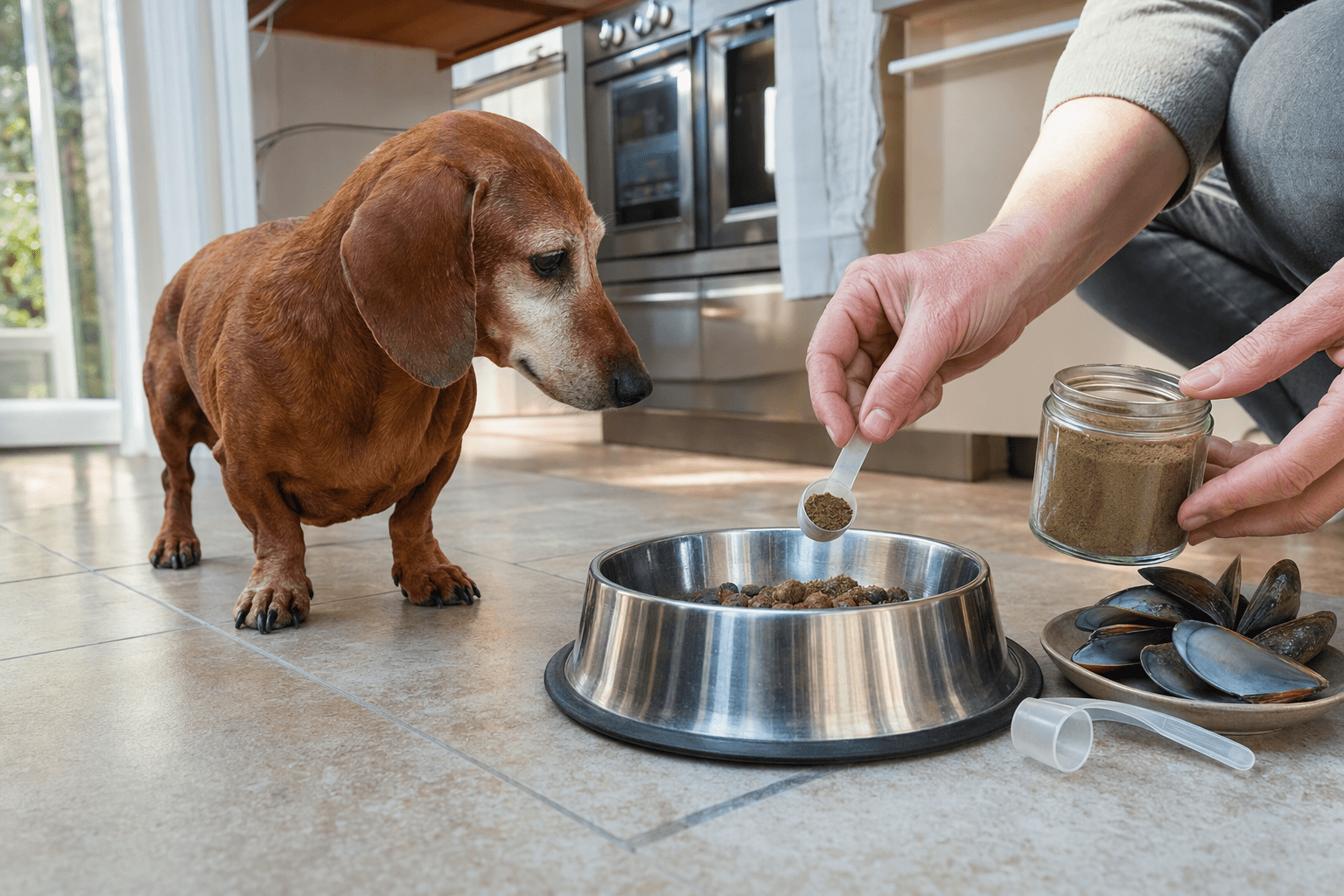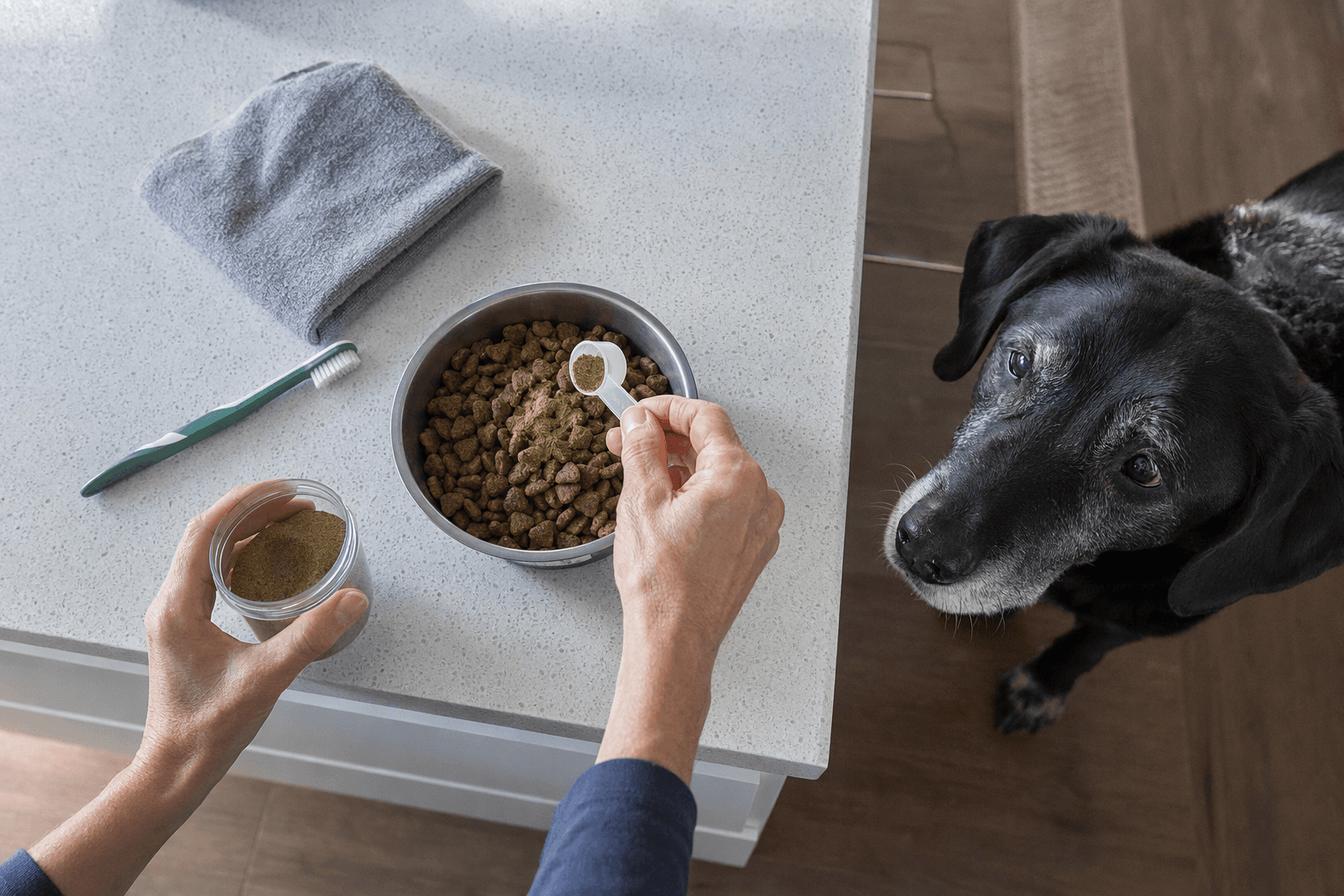
Older dogs often lose muscle. Sometimes the change is gradual: the thighs look narrower, the spine feels more prominent, or climbing into the car becomes harder. Sometimes it follows illness, restricted activity, pain, or surgery.
HMB, short for beta-hydroxy-beta-methylbutyrate, is often promoted as an answer. The biology is plausible and there are canine studies. The important catch is that none of the published trials has established an effective HMB dose for ordinary senior dogs with age-related muscle loss.
That gap should shape how owners, brands, and veterinarians talk about the ingredient.
What is HMB?
HMB is a metabolite made from the amino acid leucine. Researchers have studied it in humans and animals because of its relationship to protein turnover and muscle metabolism. Commercial products commonly use calcium HMB, although other forms exist.
The ingredient has attracted attention in sports nutrition, periods of inactivity, and diseases associated with muscle loss. Those settings are not interchangeable. A result in a young racing dog or a dog with an inherited muscular disease does not establish what will happen in a typical 12-year-old pet.
What has been tested in dogs?
The direct canine literature is small.
A 2025 pilot study enrolled six young dogs with a canine model of Duchenne muscular dystrophy. Each dog received 3 g of HMB or placebo daily for 28 days in a randomized, double-blind crossover design. Activity-monitor data and several whole-body amino-acid measurements differed during HMB supplementation. Creatine kinase did not differ significantly, and the researchers did not report clinical or biochemical adverse effects during the short trial.
This was careful work, but it was still a six-dog pilot in a severe inherited disease model. It did not test healthy older dogs, age-related sarcopenia, muscle strength, or a consumer serving measured in the low hundreds of milligrams.
A 2026 paper reported two athletic-dog cohorts. In the randomized greyhound study, 37 racing dogs received 1 g of calcium HMB or control treatment daily during a 12-week racing period. The HMB group showed a smaller decline in some racing-performance measures. The second cohort followed 22 sled dogs and was observational rather than a comparable randomized trial; several laboratory trends did not reach statistical significance.
Both authors of the 2026 paper were affiliated with MTI Biotech, and the paper disclosed commercial and patent interests involving HMB. Industry involvement does not make a result invalid. It does make independent replication especially valuable.
There is also a 2013 canine inflammatory bowel disease study that used 30 mg/kg per day, but muscle retention was not its clinical question. A small conference abstract described postoperative dogs without reporting enough dosing and design information to guide a finished product.
Taken together, these studies show that HMB can be researched in dogs and may influence activity or metabolism in particular settings. They do not establish a standard senior-dog dose.
Why a dose from one study cannot simply be scaled down
It is tempting to divide a study dose by body weight and call the result a recommendation. That would assume that young athletic dogs, dogs with muscular dystrophy, and naturally aging pets share the same response. We do not know that they do.
The published trials also used different populations, durations, outcomes, and HMB exposures. Researchers have not produced a canine dose-response curve for age-related muscle loss. There is no validated threshold at which HMB begins to preserve lean mass in senior pets.
Dogevera's current muscle-support soft chew provides 150 mg HMB per serving. That number is a product fact, not a clinically established canine dose. Published randomized dog studies used different and generally higher daily amounts. We therefore do not describe 150 mg as "clinically proven," nor do we advise owners to increase the serving to imitate a research protocol.
Higher is not automatically better. A fixed dose creates very different exposure in a 5 kg dog and a 40 kg dog, and the short canine studies do not define a long-term safety ceiling for routine home use.
Muscle loss is a clinical sign, not a supplement diagnosis
Reduced muscle can accompany aging, but it can also reflect osteoarthritis, spinal or neurological disease, endocrine problems, kidney disease, cancer, inadequate nutrition, or prolonged inactivity. A dog that suddenly becomes weak, drags a foot, knuckles a paw, struggles to stand, or loses muscle on one side needs veterinary evaluation.
A useful assessment may include body weight, body condition score, muscle condition score, gait, pain, neurological function, diet history, and laboratory testing. Looking only at the number on the scale can miss muscle loss because added fat may conceal it.
What has better evidence for maintaining function?
HMB research is interesting, but it does not replace the basics.
Adequate complete nutrition matters. So does enough high-quality dietary protein for the individual dog, unless a medical condition requires a different plan. Regular activity provides the mechanical stimulus that muscle needs. For a dog with pain, weakness, or recent surgery, a veterinarian or rehabilitation professional can choose exercises that are realistic and safe.
The most responsible place for a supplement is beside those measures, not in place of them.
Safety questions that remain open
The short canine trials did not reveal major clinical or biochemical safety signals at the doses studied. That is reassuring, but the samples were small and did not answer questions about years of use, uncommon reactions, pregnancy, puppies, or dogs with complex liver or kidney disease.
The finished formula matters too. A soft chew may contain protein, minerals, vitamins, creatine, herbal ingredients, or flavoring agents in addition to HMB. Safety cannot be judged from one ingredient while ignoring the rest of the label.
Ask a veterinarian before adding a muscle-support product if a dog has kidney disease, is recovering from surgery, takes multiple medications, or is losing muscle without an explanation.
Where the evidence leaves us
HMB has a legitimate research basis, including two small randomized canine studies in specialized populations. It has not been clinically proven to prevent or reverse age-related muscle loss in ordinary senior dogs, and no trial has validated a 150 mg daily serving for that purpose.
That is not a reason to dismiss the ingredient. It is a reason to describe it accurately, keep expectations measured, and pay attention to the parts of muscle care that already have a clear role: diagnosis, adequate nutrition, pain management, and appropriate movement.
References
1. Nghiem PP, et al. HMB improves daily activity and whole-body protein metabolism in Duchenne muscular dystrophy dogs: a pilot study. *Scientific Reports*. 2025. DOI: 10.1038/s41598-025-88651-8. 2. Fuller JC, Rathmacher JA. Calcium HMB supplementation in racing greyhounds and mushing dogs. *Open Veterinary Journal*. 2026. DOI: 10.5455/OVJ.2026.v16.i6.47. 3. Freeman LM. Cachexia and sarcopenia: emerging syndromes of importance in dogs and cats. *Journal of Veterinary Internal Medicine*. 2012. 4. World Small Animal Veterinary Association. Global Nutrition Guidelines and clinical nutrition tools. 5. FDA Center for Veterinary Medicine. FDA's regulation of pet food.
About the author
Morty Tang is the founder of Dogevera. His interest in mobility began with painful personal experience: both a pug and a corgi in his family developed serious rear-limb problems and later died. He now approaches senior-pet products with a question that is harder than "does this ingredient sound promising?": what has actually been shown in dogs, at the dose being sold? Morty is not a veterinarian. This article is educational and does not replace veterinary care.
For individual health questions, your veterinarian remains the best partner.