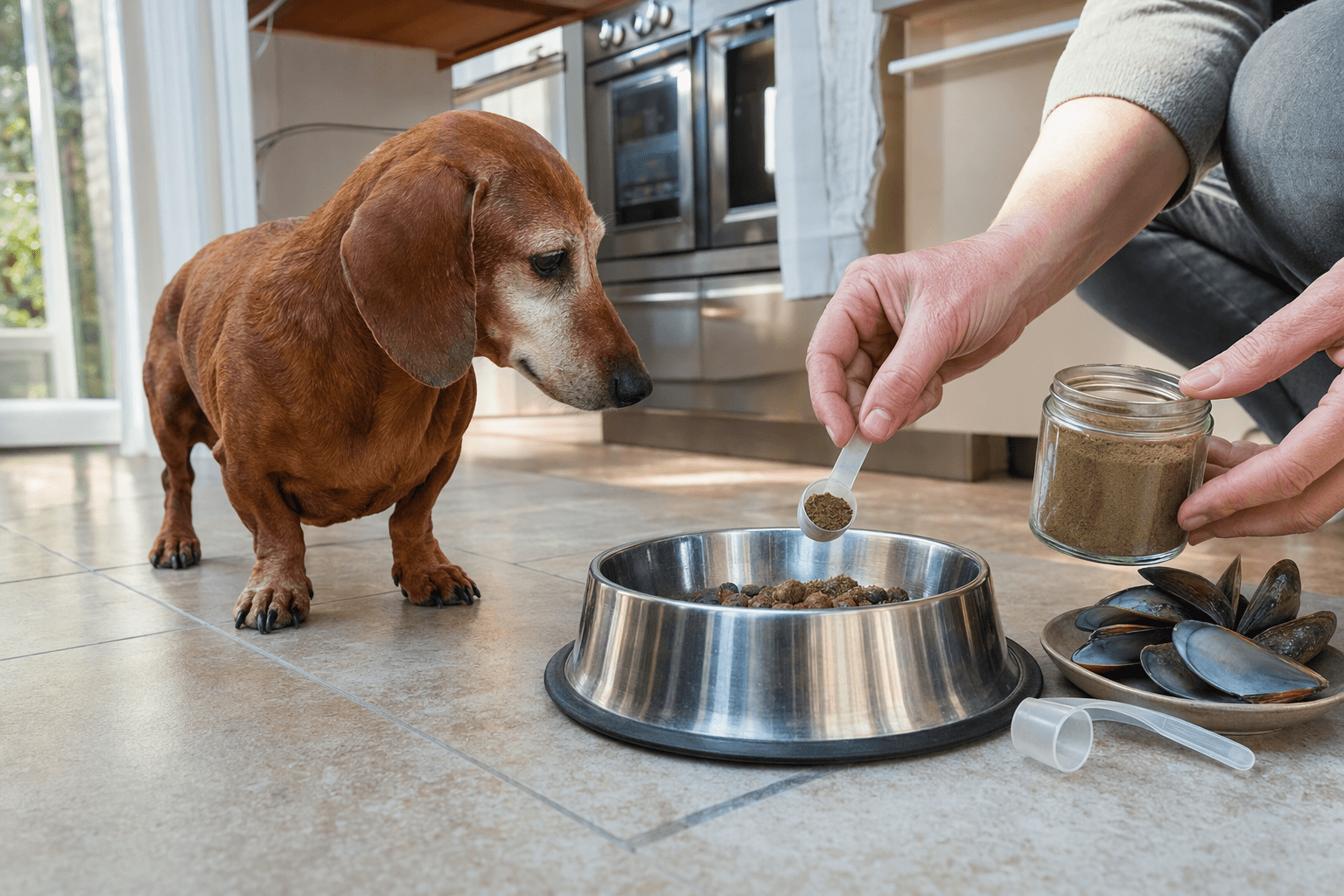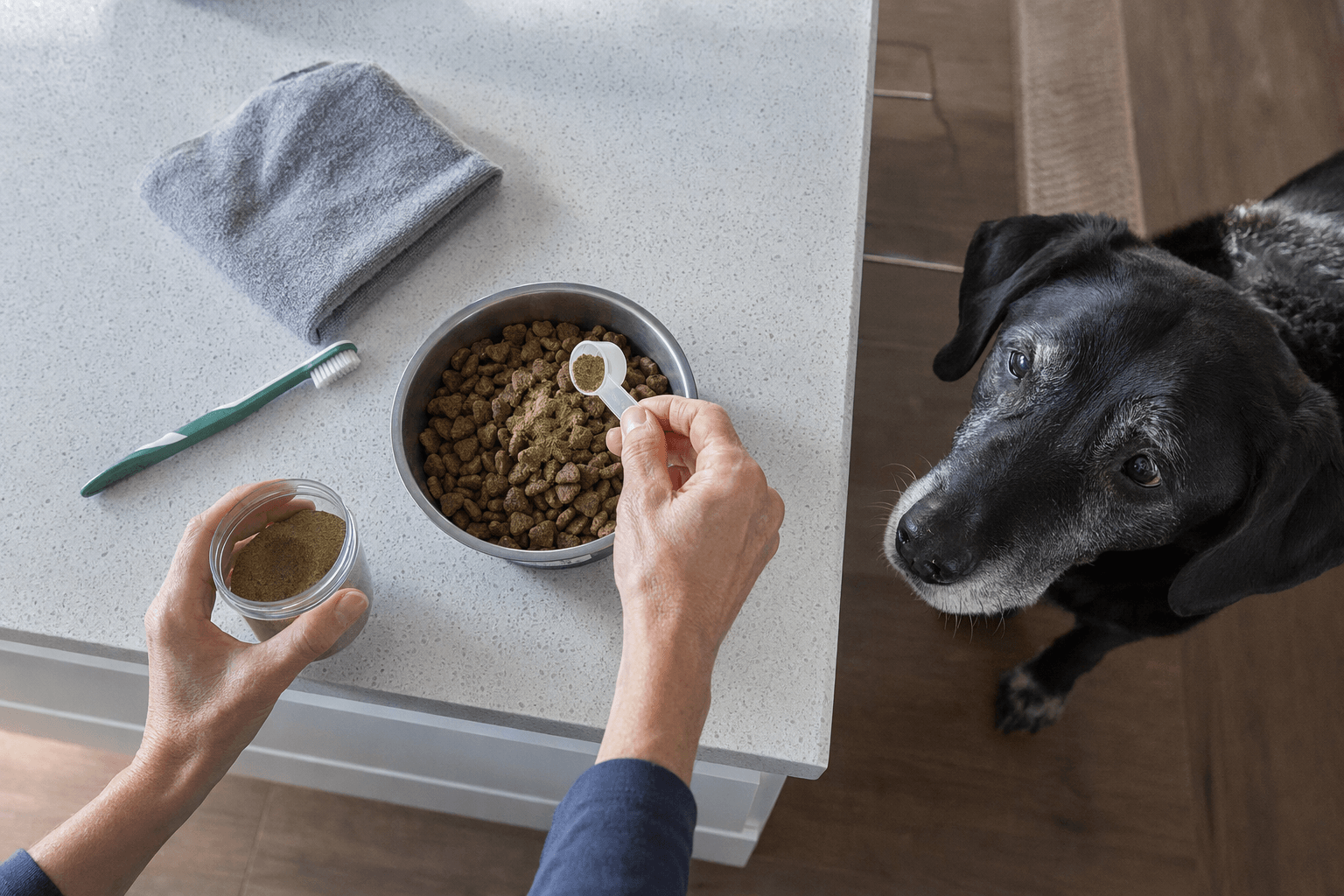
A scoop of powder is easier than brushing a reluctant dog's teeth. That convenience explains the appeal of mix-in dental products. It does not make a powder a substitute for brushing, a veterinary oral examination, or professional cleaning.
The best-studied ingredient in this category is the brown alga *Ascophyllum nodosum*. A few canine trials are encouraging, and one specific commercial powder has earned Veterinary Oral Health Council acceptance for plaque and tartar control. The evidence still belongs to the products, amounts, and study conditions that were tested.
Plaque and tartar are not the same thing
Plaque is a soft bacterial biofilm that forms on teeth. Daily mechanical cleaning can disrupt it before it matures. Tartar, also called calculus, is mineralized plaque. Once a hard deposit is attached to the tooth, sprinkling powder over food will not scrape it away.
Bad breath can accompany plaque and periodontal disease, but it can also occur with oral infection, a broken tooth, a foreign object, kidney disease, diabetes, or other medical problems. Masking odor is not the same as treating its cause.
Watch for red or bleeding gums, dropping food, chewing on one side, facial swelling, pawing at the mouth, loose teeth, or reluctance to eat hard food. Those signs call for a veterinary dental examination.
What the brown-algae trials tested
A 2018 randomized, double-blind trial enrolled 60 client-owned dogs after professional dental cleaning. The active group received a daily edible treat containing *A. nodosum* for 90 days. The researchers reported less calculus by day 30, lower plaque scores by day 90, and changes in measured breath compounds later in the study.
This is useful evidence for the exact edible treat and dose. It was not a trial of a generic mix-in powder, and every dog started after a professional cleaning. The study therefore does not show that a powder can remove established tartar from a dog that already needs dentistry.
A separate 2021 randomized, double-blind study did test a powdered *A. nodosum* product. Sixty dogs again received professional cleaning before the trial. The powder or placebo was given for 30 days according to body weight. The main research question concerned changes in the saliva metabolome, not a stand-alone claim that a generic powder reduced plaque by a particular percentage. The work was funded by Swedencare, the company associated with the tested product.
These trials support continued study of *A. nodosum* in canine oral care. They do not make every seaweed powder equivalent.
What VOHC acceptance means
The Veterinary Oral Health Council reviews data submitted for specific finished products. ProDen PlaqueOff Powder appears on the VOHC accepted-products list for helping control plaque and tartar.
That seal belongs to ProDen PlaqueOff Powder. It is not an approval of the *A. nodosum* ingredient that automatically transfers to another brand, dose, seaweed source, or multi-ingredient formula. A product that has not earned the seal should not display it or describe itself as VOHC approved because one ingredient appears in an accepted product.
VOHC acceptance is also not a replacement for veterinary dentistry. The Council describes brushing as the gold standard for daily plaque control and treats accepted products as home-care tools.
How powders fit into a realistic routine
If a dog tolerates brushing, use a dog-safe toothpaste and a soft brush or veterinary-recommended tool. Human toothpaste is not appropriate for dogs. Introduce the routine slowly and reward cooperation rather than forcing the mouth open.
Some dogs will never accept effective brushing. A powder, dental diet, accepted chew, wipe, or water additive may then be a practical addition. Look for evidence tied to the actual finished product and make sure the calories or minerals fit the rest of the diet.
Home care works best after the mouth is already healthy enough to maintain. If calculus extends under the gumline, a non-anesthetic cosmetic scraping cannot examine and treat the tissues around the roots. A veterinarian can determine whether the dog needs dental radiographs, anesthesia, scaling, polishing, extraction, or another treatment.
Safety questions, including iodine
Brown seaweed naturally contains iodine. The concentration can vary with the source and finished product. The 2018 trial measured iodine exposure in the tested treat and did not report obvious clinical problems during 90 days, but that does not establish that every seaweed product is suitable for every dog.
Ask a veterinarian before using a seaweed dental product if a dog has thyroid disease, receives thyroid medication, eats a therapeutic iodine-controlled diet, is pregnant or lactating, or takes several supplements. Check the entire ingredient list rather than assuming "natural" means inert.
Evidence for other powder ingredients is uneven. A probiotic mixed over kibble did not significantly change the oral microbiota in a small four-week study of healthy dogs. Results from toothpaste applied directly to teeth cannot be used to prove that swallowing an enzyme in food has the same effect. Delivery method matters.
Questions to ask before buying
Start with the exact product, not a long ingredient story:
- Has this finished formula been tested in dogs?
- Did the study use a powder, treat, toothpaste, or coated food?
- Were plaque and tartar measured directly?
- Did the dogs begin after a professional cleaning?
- How long did the study last?
- Who funded it?
- Is the amount adjusted for body weight?
- Does the company disclose iodine or relevant thyroid precautions?
A citation is only useful when it matches what is in the container and how the dog will receive it.
Where powder fits
Specific *Ascophyllum nodosum* products have credible canine research behind them, and one powder has VOHC acceptance. That is a reasonable basis for considering brown algae as part of home oral care. It is not proof that all dental powders work, and it does not mean powder removes existing tartar or treats periodontal disease.
Use the easiest evidence-based routine your dog will accept, but do not let convenience hide pain. Daily care and veterinary dentistry solve different parts of the problem.
References
1. Gawor JP, et al. Effects of edible treats containing Ascophyllum nodosum on the oral health of dogs. *Frontiers in Veterinary Science*. 2018. 2. Gawor JP, et al. Influence of dietary supplementation with a powder containing A. nodosum on the dog saliva metabolome. *Frontiers in Veterinary Science*. 2021. 3. Bell SE, et al. Stability of the canine oral microbiota after probiotic administration. *Frontiers in Veterinary Science*. 2020. 4. Veterinary Oral Health Council. Accepted products for dogs. 5. Veterinary Oral Health Council. Home oral-health guidance. 6. American Veterinary Dental College. Information for pet owners.
About the author
Morty Tang is the founder of Dogevera. He writes about the questions pet owners face between routine care and the moment something has clearly gone wrong. His work focuses on reading the canine evidence closely, including negative studies and manufacturer involvement. He is not a veterinarian, and this article is not a diagnosis or treatment plan.
For individual health questions, your veterinarian remains the best partner.