TL;DR
Dog dental powder side effects depend on the specific ingredients and your dog's individual sensitivities; a label cannot tell you how your dog will respond. Check the full ingredient list, introduce only one new product at a time according to its directions, and stop using it if you notice a concerning change.
What should you check before choosing a dog dental powder?
Start with the current package, not an old product page or a general claim about dental powders. Formulas can differ, so look for the complete ingredient list, the product's use directions, and any warnings or allergen information. If the label does not clearly identify an ingredient or its source, contact the manufacturer before buying or using it.
Use this quick checklist:
- Ingredient identity: Is the ingredient named clearly, and is its source described where relevant?
- Your dog's history: Has your dog reacted to that ingredient, a related food, or a previous supplement?
- The full formula: Are there other ingredients that might matter, not just the one highlighted on the front?
- Routine fit: Can you follow the product's directions without changing prescribed food or medication?
- Dental purpose: Is the powder an optional part of home care, rather than a substitute for an oral examination or dental treatment?
For broader label-reading questions, compare products using a dog dental powder buying guide. To understand the limits of claims about tartar, see what dental powder can and cannot do.
Which ingredients deserve a closer label check?
Ingredient names can help you decide what to ask about, but they do not establish that a product will cause a reaction. Similarly, an ingredient being common in dental powders does not prove it is suitable for every dog. Use the specific label and your dog's known sensitivities as the starting point.
- Seaweed or brown algae: Check which seaweed is listed and whether the package describes its source. Some seaweed ingredients contribute iodine, so ask your dog's veterinary team whether that ingredient fits your dog's circumstances if iodine intake is already a concern. Do not infer an iodine amount from the word “seaweed” alone.
- Egg-derived lysozyme: Some formulas include lysozyme from egg. Check the label for its source and any egg-related allergen statement. If your dog has a known or suspected egg sensitivity, choose a product without that ingredient or ask the veterinary team before trying it.
- Probiotics: Look for the specific organisms named on the label and any directions for storage or use. “Probiotic” by itself does not tell you how your dog will respond, and different products should not be assumed to have interchangeable formulas.
- Sodium hexametaphosphate: Confirm that the ingredient appears on the current label and check the product's directions. If your dog has a health-related dietary restriction or you are unsure whether the ingredient fits their routine, ask before adding it.
These are screening questions, not evidence that any of the ingredients causes a particular problem in your dog. Product-specific information matters more than assumptions based on an ingredient category.
How can you tell a possible sensitivity from a proven side effect?
A change that appears after starting a powder may be worth recording, but timing alone does not prove the powder caused it. An ingredient list can identify what is present; it cannot provide a reliable rate of adverse events for the finished product. Without product-specific evidence, avoid treating online anecdotes or ingredient concerns as established side-effect rates.
If you decide to try a powder, keep the routine easy to interpret. Follow the package directions, avoid adding another new supplement or treat at the same time, and note the start date. Record what you notice, when it happened, whether it recurred, and any other changes in food or routine. This gives you a clearer account to share if you seek advice.
Do not press on with a product just to complete a trial. If your dog seems unwell or you notice a change that concerns you, stop the powder and contact your veterinary clinic for guidance. Seek urgent veterinary help for a severe or rapidly worsening problem. The goal is not to diagnose the cause at home; it is to prevent further exposure while getting appropriate advice.
What should you do if your dog reacts?
Take a simple, practical approach:
1. Stop the new powder. Do not give another serving while you decide what to do. 2. Save the package. Keep the label and note the product name, lot information if available, and when you started using it. 3. Write down what changed. Include the timing, what you observed, and any other new foods, treats, medicines, or supplements. 4. Contact your veterinary clinic. Share the label and your notes, and ask whether your dog needs to be seen and what to do next. 5. Do not restart it without guidance if the reaction was concerning or the clinic recommends against it.
For a suspected food or ingredient sensitivity, do not try to confirm the cause by deliberately giving the ingredient again. A clinic can help decide what information is useful and whether another approach is appropriate. Keep the powder separate from food or medication changes so the details remain easier to interpret.
How does powder fit into a dental-care routine?
A dental powder is only one possible part of care, and not every dog needs or accepts the same approach. Check what the product claims to do and avoid treating a powder as a replacement for brushing, an oral examination, or care advised by your dog's veterinary team. If you are comparing formats, this guide to dental powder versus water additives explains practical differences to consider.
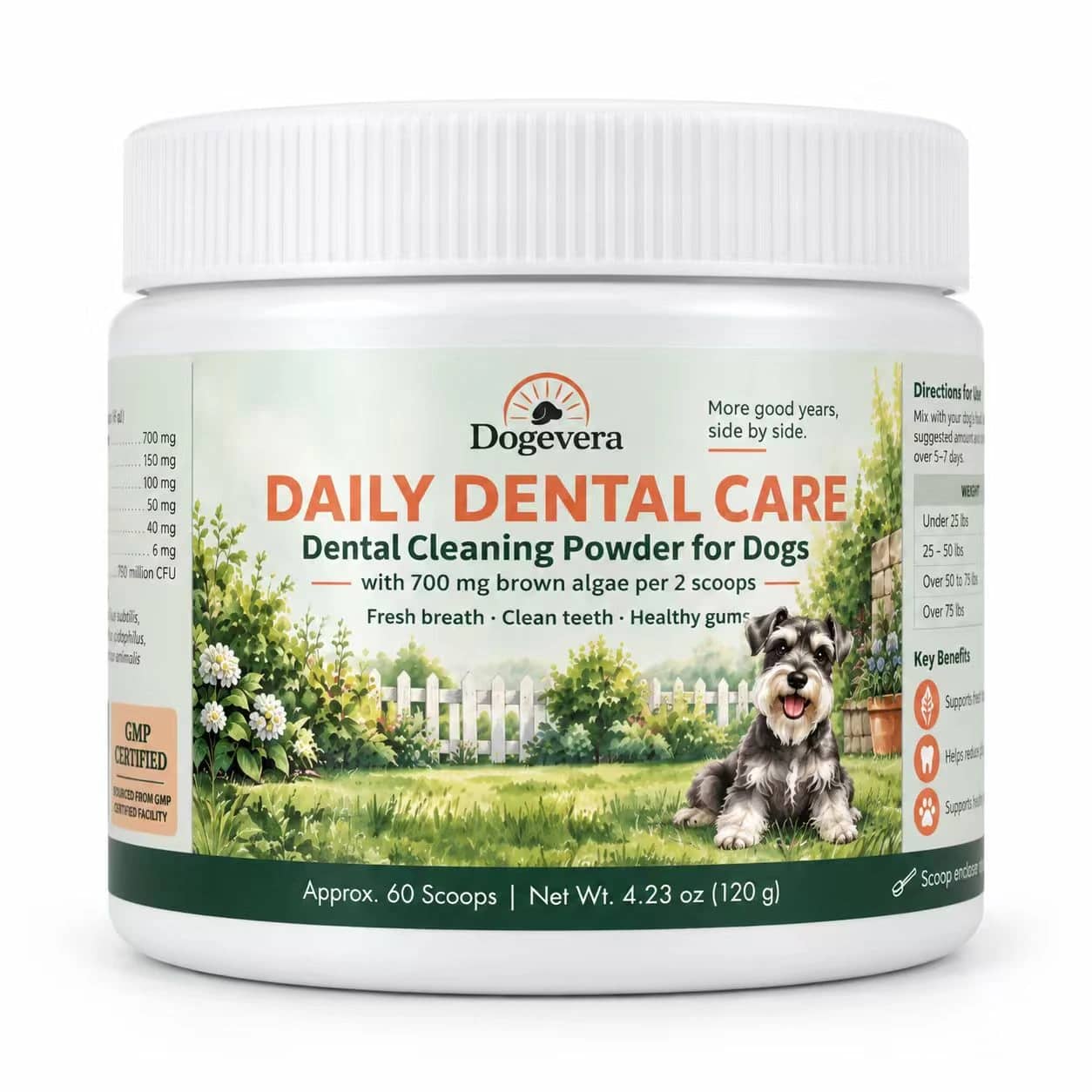
If the label is clear, the ingredients fit your dog's known sensitivities, and you choose to try the product, follow its own directions rather than estimating a serving. For example, the Daily Dental Cleaning Powder for Dogs is one product whose current label you can review against this checklist. If a powder makes your dog refuse food or complicates a prescribed routine, stop and ask about alternatives rather than forcing the change.
FAQ: Dog dental powder side effects
Can dental powder cause diarrhea?
A change in stool after starting a powder is something to record, but timing does not establish the cause or predict what will happen with another product. Stop the new powder if you are concerned and contact your veterinary clinic for advice, especially if your dog seems unwell.
Is seaweed in dental powder safe for every dog?
No ingredient should be assumed to suit every dog. Check the label for the seaweed source and ask the veterinary team if iodine intake is a particular concern for your dog.
Should I try the powder again after a reaction?
Do not restart a product after a concerning reaction without veterinary guidance. Keep the package and your notes so the clinic can consider the full formula and timing.
For individual health questions, your veterinarian remains the best partner.