TL;DR
Sleeping more by itself does not establish dog dementia. Look instead for a new pattern across memory, interaction, sleep, house habits, and navigation, then record what happens before deciding what to raise with your veterinarian.
This is a home-observation guide, not a diagnosis; a veterinarian can help interpret changes that persist, progress, or interfere with daily life.
What separates normal aging from dog dementia?
The most useful distinction is not one isolated behavior. It is the pattern, direction, and effect on ordinary routines.
An older dog may choose longer naps, take more time to get moving, or show less interest in a long outing. Those changes can be easier to understand when they occur without a broader change in recognition, familiar routines, or navigation.
A pattern worth discussing with a veterinarian may look different: several new changes appear together, repeat in familiar settings, become more frequent, or make ordinary activities harder to complete. Canine cognitive dysfunction, sometimes described as a form of dementia, involves cognitive decline. It should not be inferred from sleep alone.
Use this quick comparison as a starting point:
| What you notice | More useful question | What to record | |---|---|---| | More sleeping | Is your dog otherwise engaged during their usual waking periods? | When they sleep, wake, eat, and interact | | Not responding | Do they respond to visual cues or familiar routines? | Sound, sight, distance, and context | | Wandering or staring | Is it occasional or a repeating episode in a familiar place? | Time, location, duration, and what helped | | Indoor accidents | Is this a new pattern, and does your dog seem aware of the routine? | Time, location, access outside, and preceding events | | Night waking | Is there restlessness, pacing, or vocalizing rather than simply an earlier bedtime? | Waking time, activity, and return to rest |
These notes do not label the cause. They make the change clearer to discuss.
Which changes deserve closer observation?
Cognitive concerns are easier to organize by looking at several everyday areas rather than searching for a single “dementia sign.” Consider these five categories:
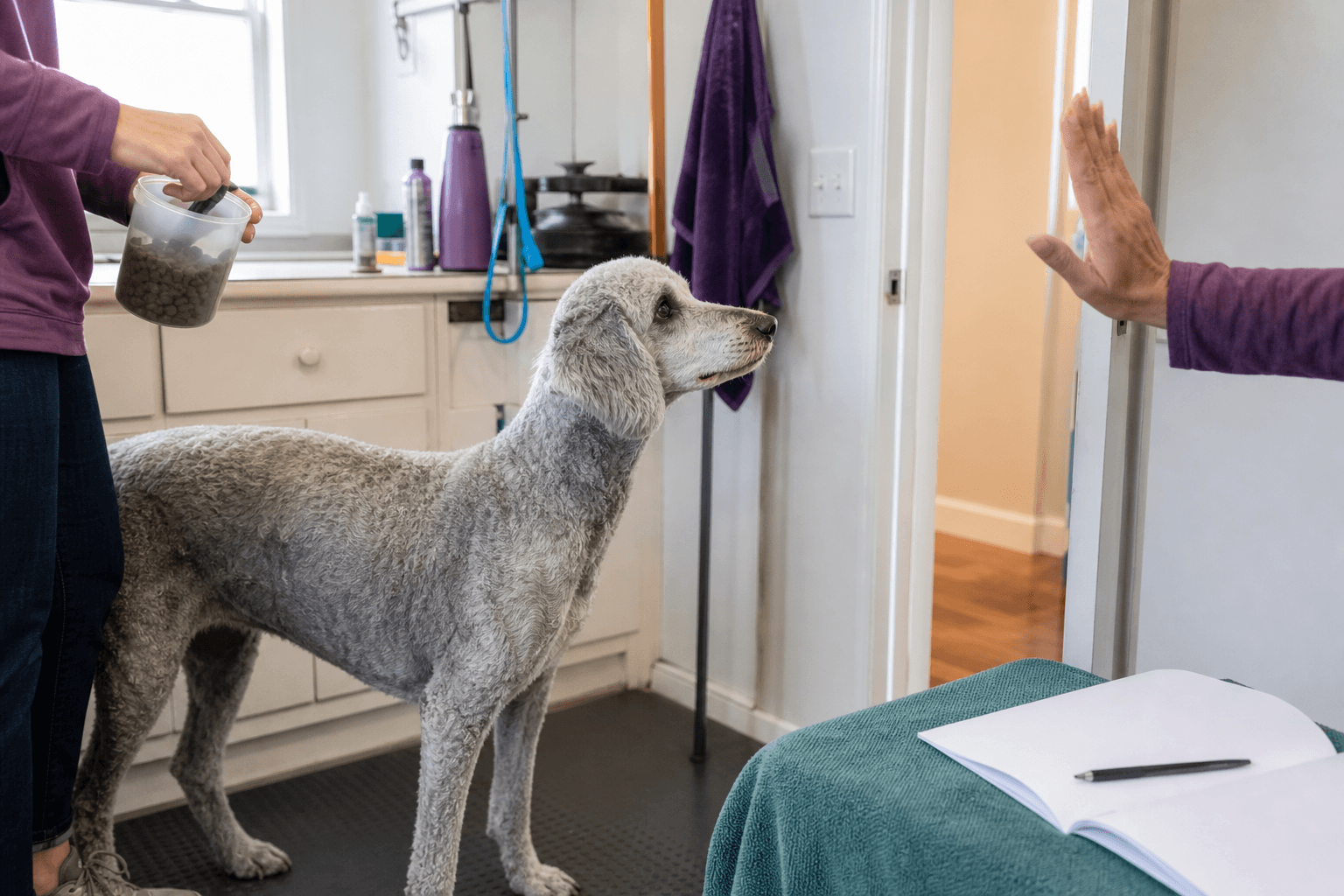
- Recognition and interaction: Does your dog respond differently to familiar people, their name, or ordinary invitations? Compare sound-based responses with visual cues instead of assuming the change is cognitive. The guide on an old dog not responding to their name offers a practical way to make that comparison.
- Sleep and nighttime behavior: More daytime sleep is not the same observation as repeated nighttime waking. Note whether your dog settles again, wanders, paces, or vocalizes. For a focused log, see senior dog pacing at night.
- House habits: Record a change in timing, location, or routine. Avoid treating one accident as proof of cognitive decline.
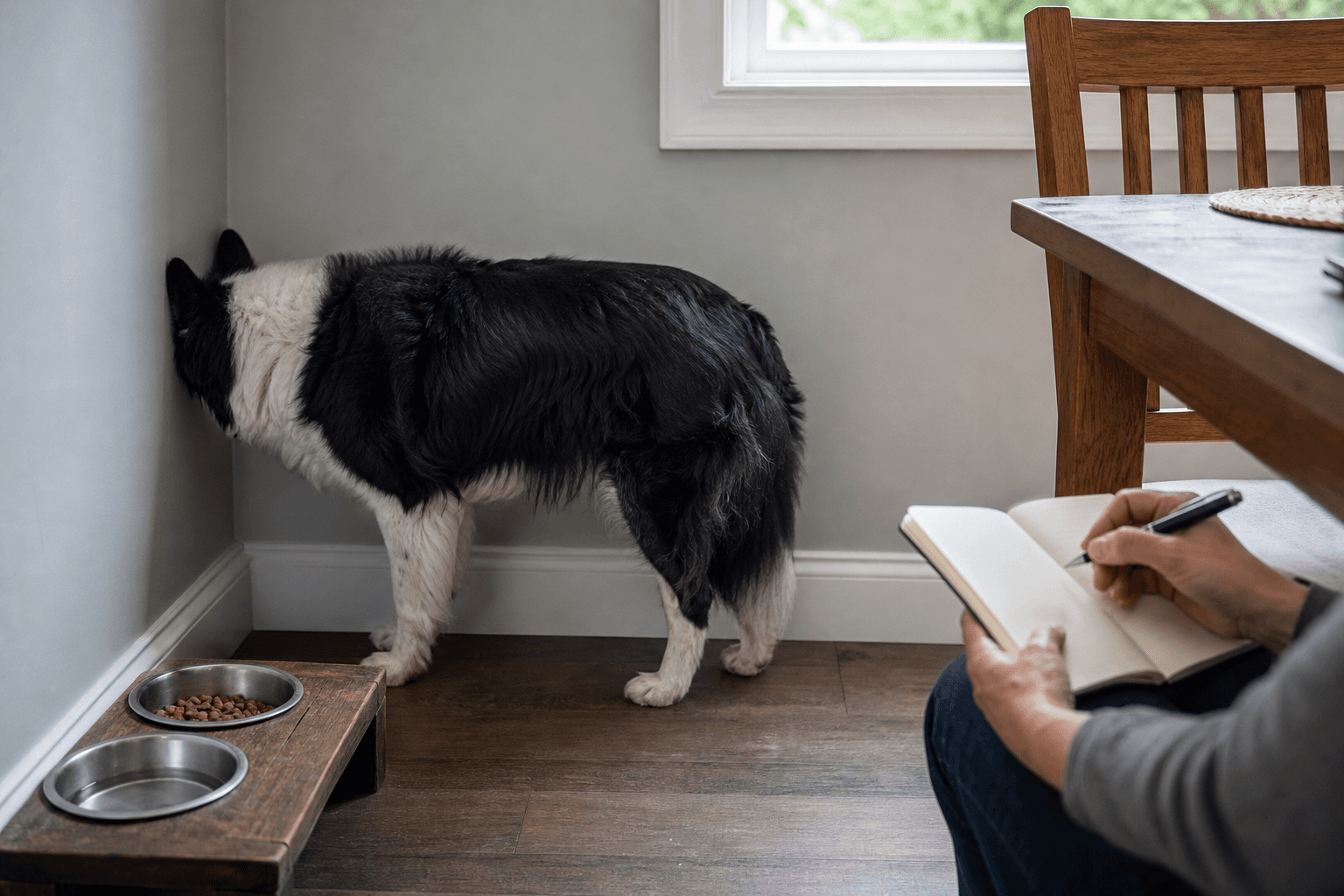
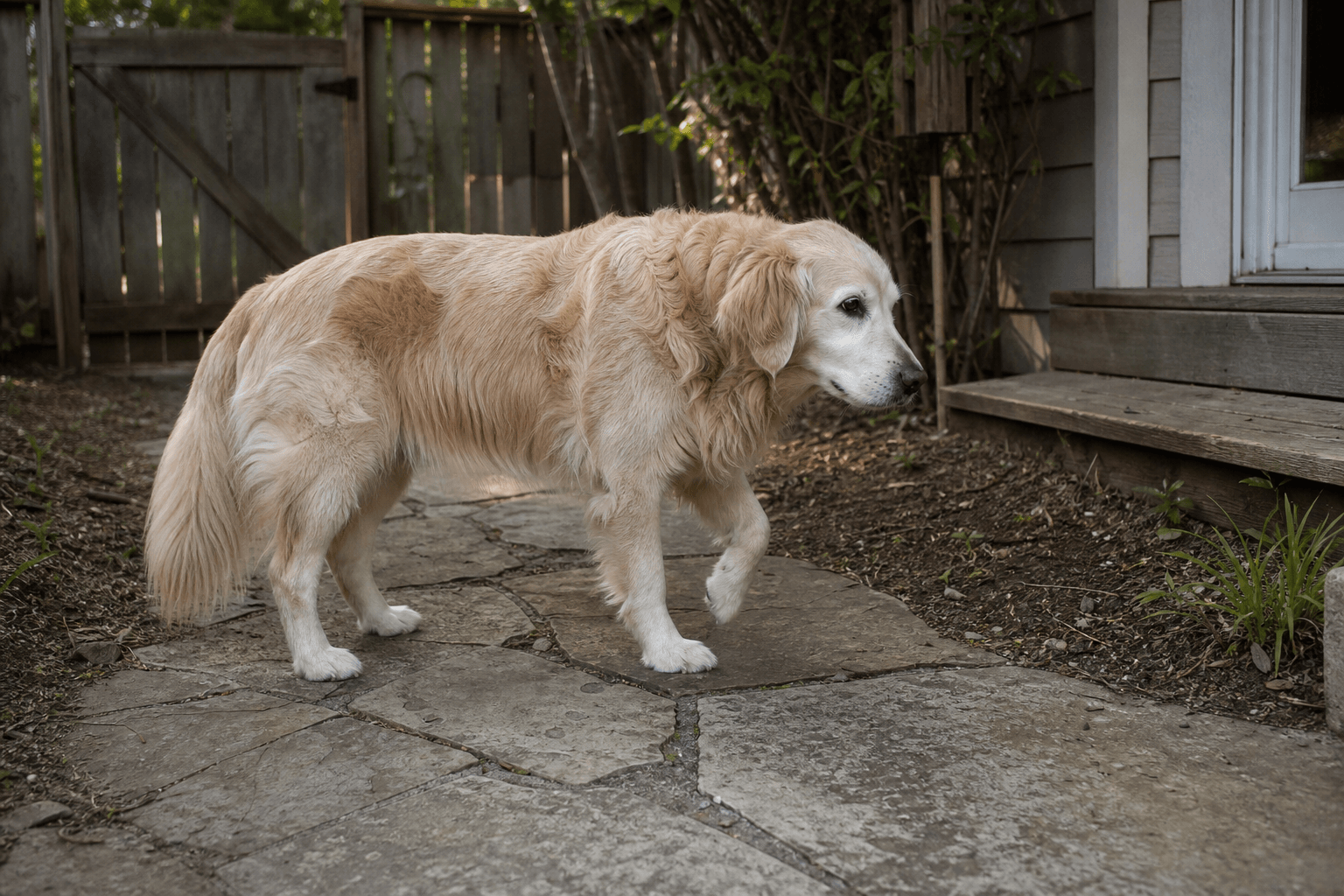
- Navigation: Note hesitation in familiar rooms, getting stuck near furniture, standing in a corner, or staring at a surface. Write down whether the episode repeats and whether your dog can redirect to a familiar activity.
- Daily engagement: Record interest in meals, gentle interaction, sniffing, and familiar activities. A change in engagement is more informative when you can compare it with the dog’s usual pattern.
The aim is not to test your dog at home. It is to describe what they do, where it happens, and how often it repeats.
Is sleeping more by itself a sign of dementia?
No single sleep change can answer that question. Sleep should be considered alongside waking behavior and the rest of the daily pattern.
For example, write down whether your dog wakes normally for food, responds to a familiar person, follows a known route through the home, and settles comfortably after waking. Also note whether the change is gradual or appeared suddenly. “Sleeps more” is a starting observation; “sleeps more, wakes repeatedly at night, seems lost in a familiar room, and no longer follows a familiar routine” is a more specific pattern to bring to a veterinary appointment.
Do not try to force wakefulness or interrupt every nap to check your dog. Keep the day predictable, use gentle invitations to familiar activities, and record the response.
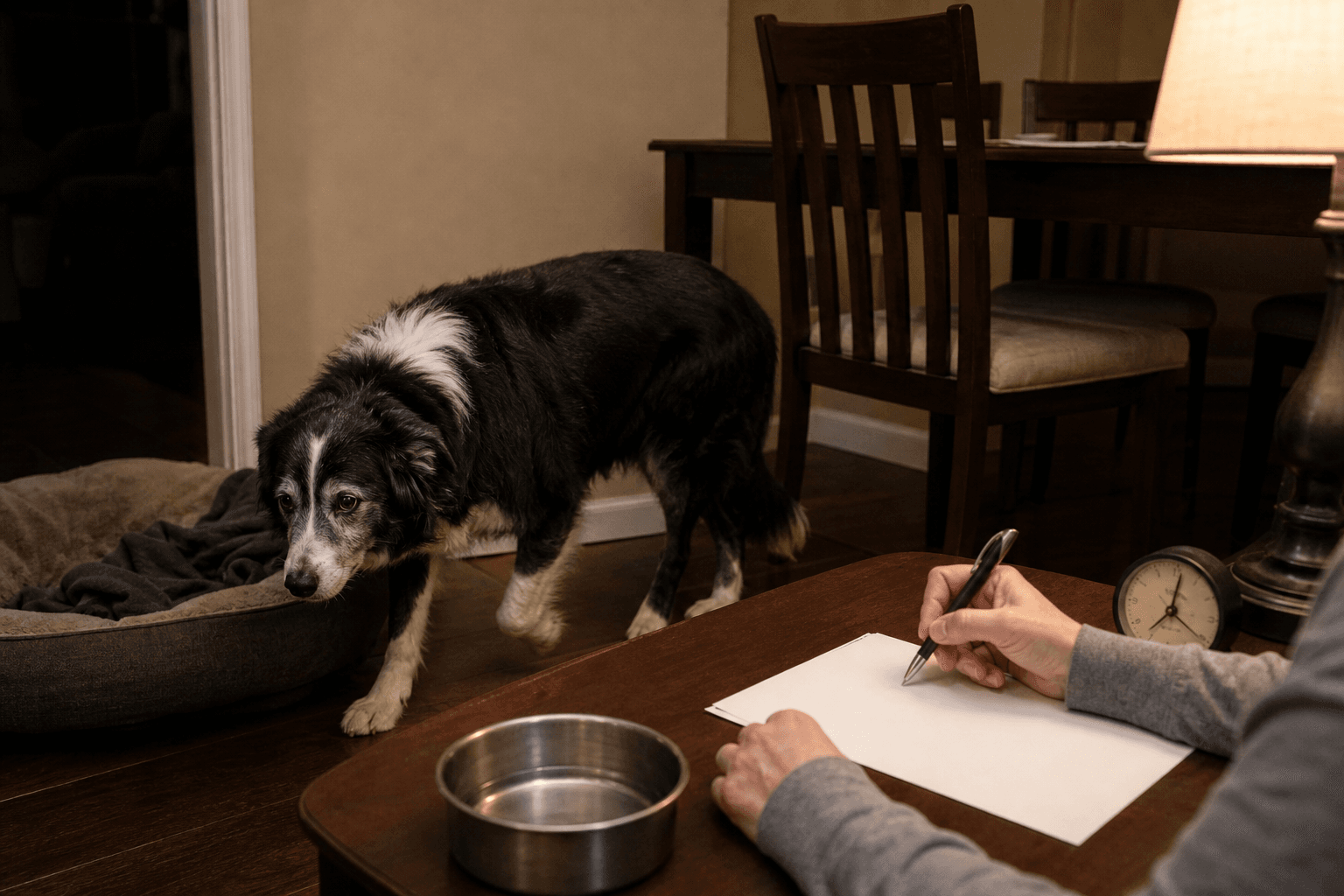
A simple three-day observation process
A short, consistent record can be more useful than trying to remember a week of small moments. For three days, use the same categories each day:
1. Morning: Note wake time, response to your greeting, appetite, and movement toward a familiar location. 2. Daytime: Record naps, interaction, interest in a familiar activity, and any unusual wandering, staring, or getting stuck. 3. Evening: Note when your dog settles, whether they wake, and what they do after waking. 4. House habits: Record accidents or changes in the usual request to go outside. 5. Context: Add anything that could affect the observation, such as visitors, a changed room layout, unusual noise, or a different schedule.
Use plain descriptions rather than conclusions. “Stood beside the hallway table and looked toward the wall for about a while, then followed me to the kitchen” is more useful than “seemed confused.” Avoid adding measurements or labels you cannot verify.
If a behavior occurs again, note whether the same place, time, or trigger is involved. A repeating context may give your veterinarian a clearer starting point than a general statement that your dog “seems older.”
What did the large dog study actually show?
One observational, cross-sectional study used owner-reported questionnaire data to assess cognitive health, physical activity, health conditions, training history, and dietary supplements in 11,574 companion dogs aged 6-18 years. Cognitive health was assessed with a validated scale, and 287 dogs had scores over the clinical threshold for CCD.
The study found an association between physical activity and better cognitive outcomes. In its models, physical activity had a significant negative relationship with current symptom severity, with an estimate of -0.10 and a 95% confidence interval of -0.11 to -0.08. It also had a significant negative relationship with symptom worsening over a 6-month interval, with an estimate of -0.07 and a 95% confidence interval of -0.09 to -0.05.
Those findings do not show that activity prevents dementia or treats cognitive dysfunction. The study cannot determine causality, and the researchers noted that future prospective studies are needed to rule out reverse causation and evaluate activity interventions.
For home care, choose comfortable, familiar movement that your dog already handles well. Do not turn the study into a reason to push a tired, painful, or unsteady dog. Gentle enrichment can also be simple. If your dog enjoys food-based activities and can use them comfortably, puzzle toys for senior dogs can provide a familiar activity without requiring a complicated setup. If you are considering Brain Cognitive Support Soft Chews for Dogs, treat the label as something to review with your veterinarian rather than as a way to identify or diagnose dementia.
When should you raise the pattern with a veterinarian?
Bring your notes when changes persist, progress, occur in more than one category, or interfere with eating, resting, moving through familiar spaces, house habits, or interaction. A sudden or striking change is also a reason to contact your veterinarian rather than waiting for a longer home log.
Share the first date you noticed the change, what happened before and after it, and whether your dog could return to their usual routine. Include videos when safe and practical, especially for nighttime behavior or repeated navigation problems. Ask what other explanations should be considered and what changes would make follow-up more urgent.
FAQ
#### Is every older dog who sleeps more developing dementia?
No. Sleeping more alone does not establish cognitive decline. Compare sleep with waking interaction, recognition, navigation, house habits, and nighttime behavior.
#### Can I diagnose dog dementia with a checklist?
No. A checklist can organize observations, but it cannot establish the cause. Bring the pattern and timeline to a veterinarian.
#### Should I increase exercise to protect my dog’s brain?
Do not use an observational association as a treatment promise. Keep movement familiar and comfortable, and adjust the activity when your dog shows they cannot manage it well.
#### What is the most useful thing to write down?
Record the behavior, time, place, trigger, duration, and what happened next. Specific observations are more useful than a label such as “confused.”
For individual health questions, your veterinarian remains the best partner.