TL;DR
When choosing liquid omega 3 vs capsules for dogs, compare the actual EPA and DHA amount per labeled serving, not the size of the bottle or capsule. Liquid is easier to adjust and mix into food, while capsules can make dispensing cleaner and more consistent. They are not automatically interchangeable, so compare each product's serving directions, ingredients, storage instructions and capsule materials before switching.
Start With EPA and DHA, Not “Fish Oil”
“Fish oil” describes a source, not the amount of the omega-3 fats that matter on the label. A useful comparison starts with the declared EPA and DHA per serving. Check whether the serving is listed as a measured volume of liquid, a number of capsules, or another unit, then compare products on that same basis.
A label may list total fish oil prominently while placing EPA and DHA elsewhere. Those figures should be easy to find and tied to a defined serving. If a product gives only a broad oil amount without identifying EPA and DHA, you have less information for a meaningful comparison.
The serving size also matters for cost. A large bottle may contain less usable EPA and DHA per serving than a smaller, more concentrated product. For a fuller label checklist covering EPA, DHA, carriers, serving directions and batch information, see Best Omega 3 Supplement for Dogs: A Label Guide.
Liquid Omega 3: Easier to Mix and Adjust
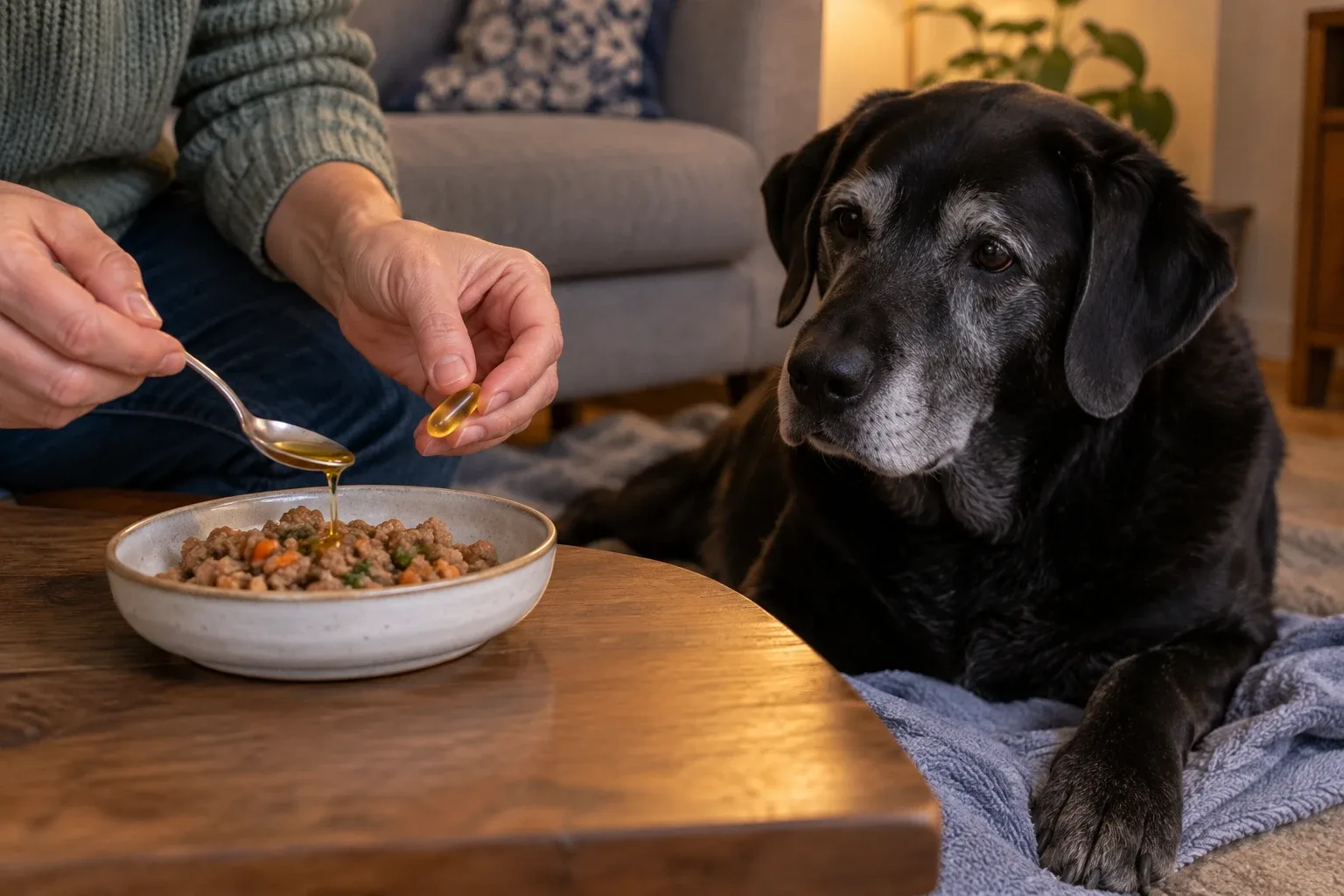
Liquid omega 3 usually fits dogs that accept a small addition to wet food or a meal. Its main practical advantages are:
- You can mix the labeled serving into food rather than placing a capsule in the mouth.
- The bottle can be useful when a dog refuses pills or has difficulty swallowing them.
- The serving is measured by volume, so the product's instructions are visible as a liquid amount rather than a count of capsules.
The tradeoff is that liquid dispensing depends on a clean, accurate measuring method and a dog eating the portion that contains it. If food is left behind, the dog may not receive the full labeled serving. Mixing a supplement into a large shared bowl can also make it harder to know which dog received what.
Look for the measuring instructions supplied by the product. Do not convert a liquid serving into a capsule serving by guessing from the total oil amount. Different products can have different EPA and DHA concentrations, carriers and serving directions.
Capsules: Cleaner Handling and Defined Units
Capsules may suit households that want a premeasured unit and less exposed oil. They can be given according to the package directions or opened only when the label permits it. Some dogs take them in food; others reject them or need a different format.
Compare these details before buying:
- Whether the capsule is softgel, hard capsule or another format.
- What the capsule itself is made from, including gelatin or other shell materials.
- Whether the label says the capsule may be opened and mixed with food.
- How many capsules make up the labeled serving.
- The EPA and DHA amount supplied by that serving, not just by the oil inside one capsule.
A capsule shell is part of the product, so it should not be treated as an irrelevant wrapper. Capsule materials can matter when a dog has a known ingredient concern or when the owner needs to open the capsule. If the label does not explain how to use the capsule, do not assume that opening, puncturing or crushing it is appropriate.
For a broader comparison of how dog supplements behave in powder, tablet and liquid forms, read Dog Joint Supplements: Powder vs Tablets vs Liquid. The comparison principles apply here, but the omega-3 label still determines the product-specific details.
Storage Is Part of the Choice
Storage instructions can change which format is more practical in your home. Follow the product's directions for temperature, light, sealing and refrigeration. Do not infer a stability timeline from the format alone, and do not assume that one liquid fish oil has the same storage requirements as another.
For liquid products, note whether the cap closes securely and whether the bottle needs special handling after opening. Wipe the dispenser if the instructions call for it, and keep the bottle where the dog cannot reach it.
For capsules, check whether they should remain in the original container and whether moisture protection is included. A capsule may be easier to portion, but it still needs storage that follows the label. Record the product name, lot or batch information and opening date if you need to investigate a change in smell, appearance or tolerance.
A Five-Minute Comparison Checklist
Before choosing liquid or capsules, write down the answers for each product:
1. What are the EPA and DHA amounts per labeled serving? 2. How is that serving measured: volume, capsule count or another unit? 3. Does the label identify every active ingredient and its amount, without hiding them in a proprietary blend? 4. What are the carrier ingredients and capsule materials? 5. Can your dog reliably receive the full serving in the way the product directs? 6. What storage instructions apply in your home? 7. What is the ongoing cost per labeled serving, rather than per bottle?
If the answers are incomplete, the products are not ready for a fair comparison. The better format is the one whose label is clear and whose routine you can repeat accurately.
If you are also weighing fish oil against a non-fish source, compare the named source, EPA and DHA disclosure, carriers and evidence separately in Fish Oil vs. Algae Oil for Dogs: How to Compare.
FAQ
Is liquid omega 3 better than capsules for dogs?
Neither format is automatically better. Liquid may be more practical for a dog that accepts supplements mixed with food, while capsules may be easier for an owner who wants a defined unit and less exposed oil. The label concentration and reliable daily routine matter more than the format name.
Can I replace one capsule with the same amount of liquid?
Do not assume that you can. Compare the EPA and DHA amounts and the serving directions for both products. The total oil amount, capsule size and liquid volume may differ substantially.
Can I open an omega-3 capsule and mix it into food?
Only when the product instructions allow it. Check the capsule material, directions and storage requirements before opening it. If the label is silent, use the product as directed rather than creating a new method.
What if my dog refuses the supplemented food?
Stop treating the uneaten portion as the full serving. Record how much food was left and follow the product's directions before changing the routine. A new or sudden symptom, including a reaction after starting a supplement, needs prompt professional care. Supplements do not replace diagnosis or treatment.
For individual health questions, your veterinarian remains the best partner.