TL;DR
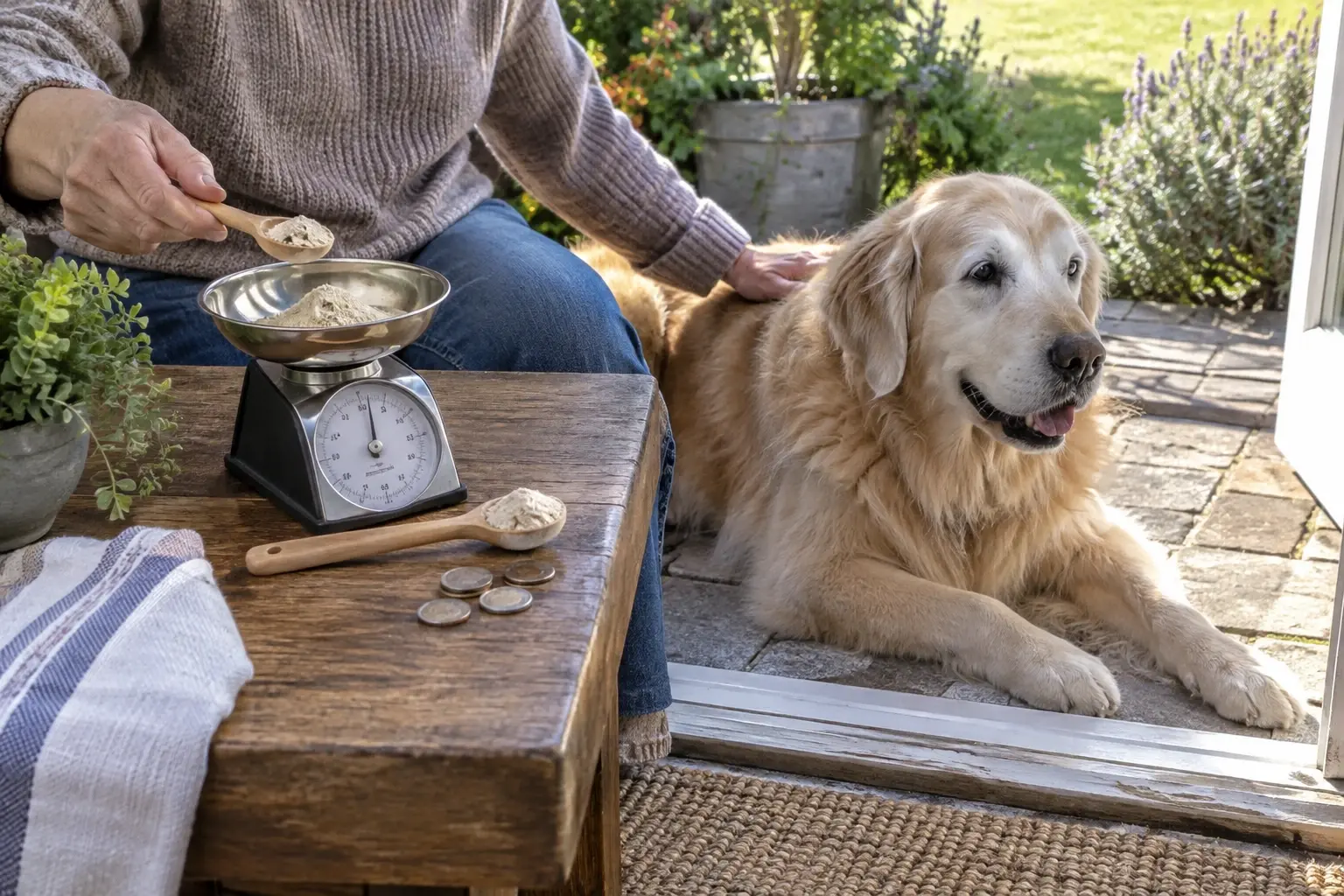
If your dog eats around a tablet or leaves supplement powder in the bowl, the practical question is which form you can give consistently. When comparing dog joint supplements, powder vs tablets vs liquid comes down to administration, ingredients, the labeled serving, and daily cost; format alone does not establish effectiveness or dose equivalence. Choose a product with clearly declared amounts and a routine your dog accepts without making meals or handling stressful.
Match the format to how your dog eats
For an older dog, a manageable daily routine matters. Start with what already works at mealtime and during gentle handling, rather than choosing by package size or the apparent convenience of a scoop, tablet, or pump.
Powder
- Administration: Requires measuring and mixing according to the package directions.
- Acceptance question: Will your dog finish food with the powder mixed into it?
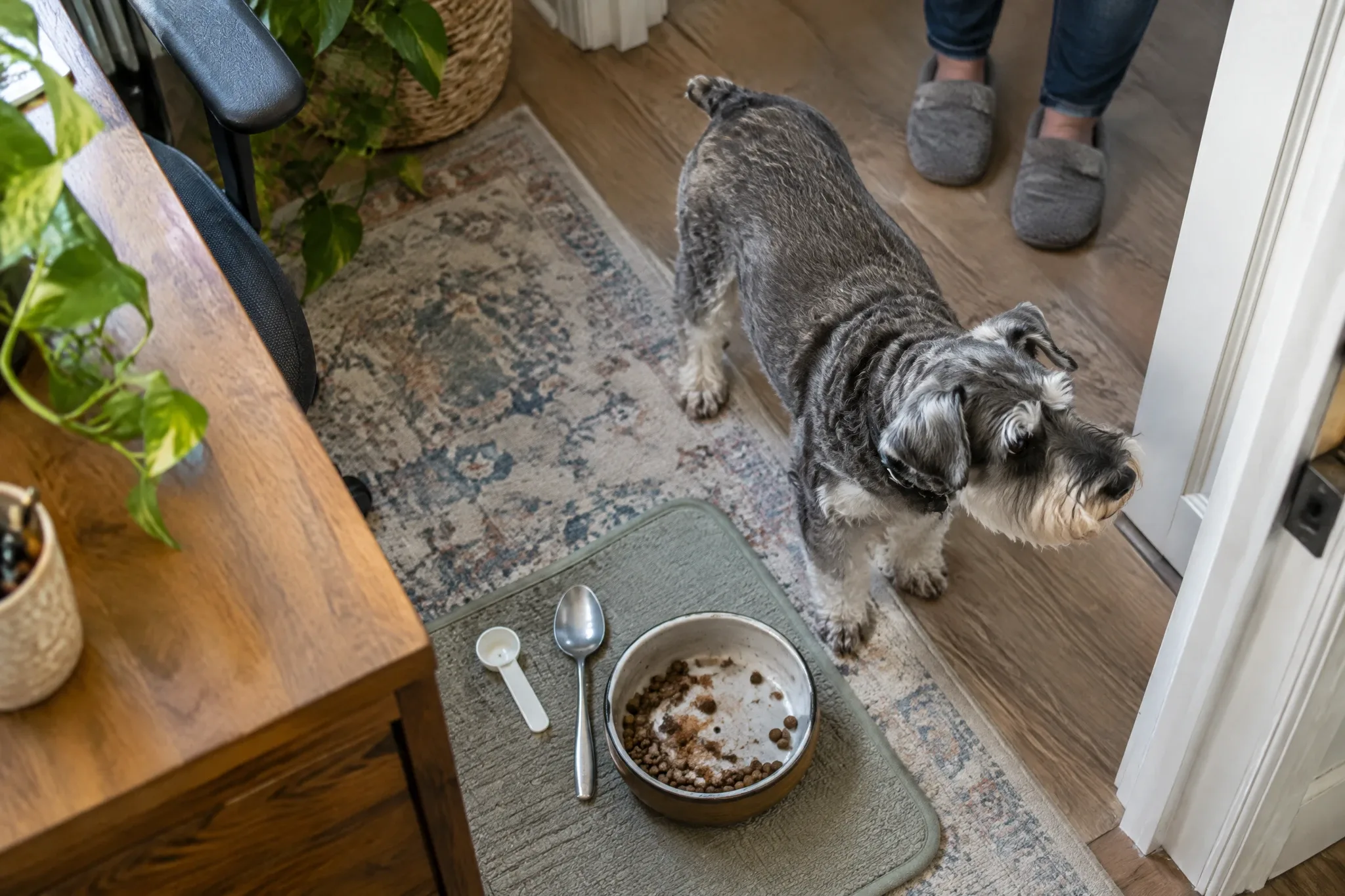
- Practical limitation: Powder left in the bowl or in an unfinished meal makes intake uncertain. Serving it does not establish that your dog consumed it.
- Best practical fit: A dog that reliably finishes the food used to carry the supplement, with an owner comfortable measuring each serving.
Tablets
- Administration: Offers countable units, but the labeled daily serving may involve more than one tablet.
- Acceptance question: Will your dog take the tablet in the permitted way, without repeated attempts or force?
- Practical limitation: A tablet hidden in food can still be spat out. Do not assume it can be crushed or split unless the product directions permit it.
- Best practical fit: A dog that already accepts tablets comfortably and a household that prefers counting units to measuring powder or liquid.
Liquid
- Administration: Requires the specified measuring device and any preparation stated on the label, such as shaking.
- Acceptance question: Does your dog accept the flavor and the permitted method of administration?
- Practical limitation: Liquid can remain in the bowl or spill during measuring. A pump or dropper is useful only when its output is clearly connected to the labeled serving.
- Best practical fit: A dog that accepts the liquid in food or through another label-approved method, with an owner comfortable measuring it accurately.
None of these formats establishes how well a formulation supports joints. The distinction between ingredient research and evidence for a finished product matters more, as explained in whether dog joint supplements actually work.
Compare carriers alongside active ingredients
The active ingredients are only part of what your dog will consume. Compare the full ingredient lists, including anything used to carry, bind, flavor, or preserve the formulation.
- Powders: Check whether the product contains one declared ingredient or includes flavorings and other added ingredients.
- Tablets: Identify binders, coatings, and flavorings instead of assuming the entire tablet consists of joint-support ingredients.
- Liquids: Identify the liquid base and any added oils, flavorings, or preservatives. Bottle volume alone does not reveal the amount of a named active ingredient.
For a dog with known food sensitivities or dietary restrictions, these differences can narrow the choice before price enters the comparison. Neither a shorter ingredient list nor a liquid format automatically makes a product the better fit.
Dogevera's New Zealand Green Lipped Mussel Powder for Dogs belongs in the powder side of this comparison. Evaluate its current ingredient declaration and serving directions against the same requirements you apply to tablets and liquids.
Keep serving size separate from active amounts
A scoop, tablet, and milliliter are different serving units. They are not interchangeable doses, even when products feature the same ingredient on the front of the package.
For each candidate, write down:
- The exact ingredient name and form.
- The labeled daily serving for your dog.
- The declared amount of each active ingredient in that serving.
- Any amount the manufacturer does not disclose.
Dogevera's standard is to state every active ingredient and its amount per serving in plain text, without proprietary blends. Apply that standard across your shortlist: a blend total cannot tell you how much of each ingredient your dog would receive.
Likewise, a whole-ingredient powder and an extract should not be treated as equivalent simply because their names share a source. The green-lipped mussel versus fish oil comparison expands on why product form and declared components affect what you can meaningfully compare.
Do not increase a serving to make one label resemble another. Missing declarations are a limit on the comparison, not an invitation to calculate your own dose.
Calculate daily cost from each product's directions
Use the current US purchase price and the labeled routine for your dog:
Package price ÷ number of labeled daily servings in the package = daily cost.
Find those daily servings differently for each format:
- Powder: Use net weight and the labeled daily quantity. If directions use scoops, use the manufacturer's stated scoop information rather than estimating by eye.
- Tablets: Divide the tablet count by the number required per day.
- Liquid: Divide usable bottle volume by the labeled daily volume. Do not assume that a dropperful or pump equals a particular volume without that information.
Include required shipping charges when comparing checkout costs. Record any different starting and ongoing directions separately so that one price does not conceal two routines.
Keep waste visible, too. An inexpensive serving repeatedly left in the bowl is still money spent. Early, consistent care is better for the dog and an economical choice for the owner; buying a format you can use reliably helps avoid preventable waste. It does not guarantee lower future veterinary bills.
Use a short acceptance log before settling on a routine
Start planning joint support while everyday movement is still comfortable, alongside appropriate food, activity, and an accessible home. Stairs becoming harder, stiff back legs after rest, or less interest in the usual walk deserve attention rather than an automatic supplement purchase.
Supplements do not replace diagnosis or treatment; new or sudden symptoms need prompt veterinary care, and emergency signs require immediate professional attention.
Once you have chosen an appropriate product, follow its directions and record these details for three days:
- Preparation: Was the labeled serving straightforward to measure or count?
- Acceptance: Did your dog willingly accept the permitted administration method?
- Completion: Was the serving consumed, left behind, spat out, or spilled?
- Routine: Could another caregiver repeat the same steps clearly?
This is an administration check, not an effectiveness trial. If intake is uncertain, record that uncertainty rather than adding an extra serving to compensate. A format that repeatedly disrupts meals or requires a struggle is worth reconsidering.
FAQ
Is liquid absorbed better than powder or tablets?
You cannot establish that from the format alone. A claim of better absorption needs evidence for the specific formulation; being liquid is not enough.
Can I switch formats using the same serving amount?
No assumed conversion applies. Use the new product's own directions because ingredient forms, concentrations, and serving units can differ.
What if my dog eats only part of a supplemented meal?
Record the serving as partly consumed or uncertain. Avoid guessing how much remained or automatically giving another full serving. Reconsider whether that food and format make intake easy to track.
For individual health questions, your veterinarian remains the best partner.