TL;DR
For a senior dog, choose a ramp or stairs based on the specific surface, your dog’s movement and the space available. A ramp needs a manageable slope and secure footing; stairs need stable, broad treads your dog can place their paws on. Introduce either option gradually, and block access to the furniture or vehicle if neither setup is safe.
Dog Ramps vs. Stairs for Senior Dogs
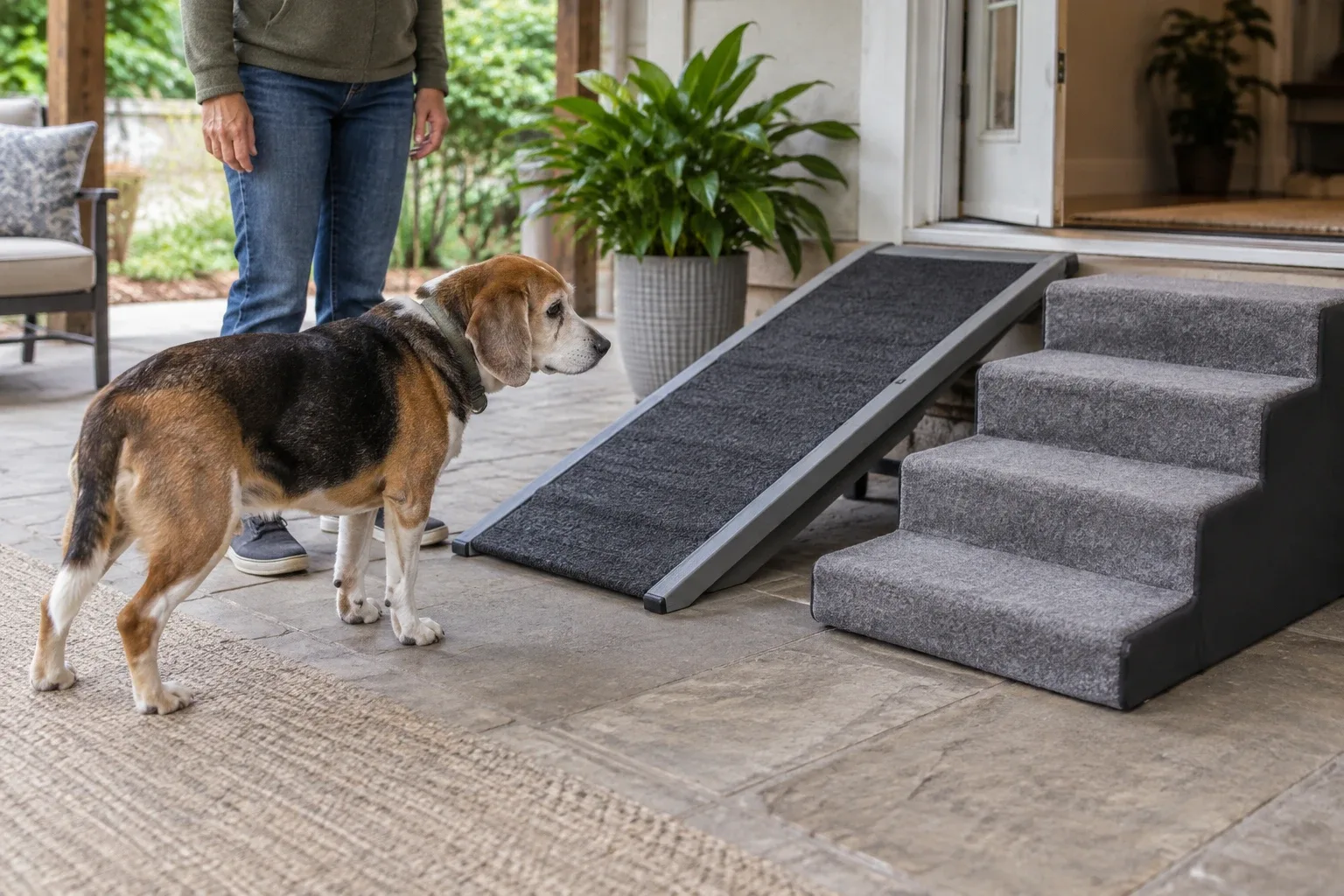
A ramp offers one continuous walking surface. It may suit a dog that can walk forward comfortably but struggles to lift their legs onto individual steps. The tradeoff is length: a gentler slope takes more room, while a short, steep ramp may be difficult to use.
Stairs take up less floor space and can work when a dog is comfortable stepping up and down. Each tread should be deep and wide enough for secure paw placement. Narrow or shallow steps can make the climb awkward, especially if your dog is hesitant or unsteady.
Neither design is automatically safer. Watch how your dog moves on level ground and whether they can approach, turn and step away without slipping or being crowded. If stairs have recently become difficult, note what has changed rather than repeatedly asking your dog to try them. The senior-dog stair difficulty guide explains what to observe.
Compare the Setup, Not Just the Product
Before choosing, compare the ramp or stairs against the place your dog needs to reach: a couch, bed, vehicle or another raised surface.
- Slope or step height: A ramp should not feel sharply inclined. Stairs should have consistent, manageable steps. Compare the actual rise to the intended landing, not just the product’s overall length or height.
- Tread and walking surface: Look for a surface that provides dependable footing. A smooth or loose covering can shift under paws; raised edges should not catch a toe.
- Stability: The unit should stay put when approached and used. Consider what supports it at the top and bottom, and whether it can move on your floor or against the furniture.
- Width: Your dog should have room to walk without balancing close to the edge. Make sure the available floor space allows for that width and a straight approach.
- Entry height: Check the height of the surface your dog is reaching and how the ramp or top step meets it. A large gap or awkward lip can disrupt the transition.
- Location: A vehicle setup has different space and positioning constraints from a bed beside a wall. Measure the available area where the equipment will actually be used.
A useful buying checklist is to write down the destination height, available floor length and width, where the unit can be secured, and whether your dog walks more naturally than they step. If the product’s dimensions do not fit the space or the approach would be cramped, keep looking.
Choose for the Destination
For a bed or couch, check that the ramp or top stair meets the edge without rocking or leaving a difficult gap. Confirm that it does not block the dog’s usual route through the room. If the spot is beside a wall, account for the room needed to turn and get onto the equipment.
For a vehicle, consider how the equipment will sit at the door or cargo area and whether it can be positioned securely on the ground. A ramp that works indoors may be too long for the available space outside. Stairs may be easier to position in a tight area, but only if your dog can manage the individual steps.
Do not choose by the product photo alone. Check its stated dimensions and compare them with measurements at home. For broader home changes that can make everyday routes easier, see the senior-dog home safety guide.
Introduce It Without Forced Climbing
Let your dog investigate the equipment while it is stationary and placed where it will be used. Keep the first interactions low-pressure: allow sniffing, standing nearby or stepping onto the lowest part if your dog chooses. Reward calm interest if your dog is comfortable taking food, and stop if they back away, freeze or seem unsure.
Once your dog is relaxed near the equipment, invite a small step at a time rather than pulling, pushing or carrying them onto it. Keep the route clear and supervise practice. If your dog will not approach, reconsider the slope, surface, stability or location instead of insisting.
When a Gate or Barrier Is Better
A ramp or stairs only helps when the dog can use it safely and the equipment stays in position. If there is not enough room for a suitable setup, if your dog avoids it, or if you cannot supervise access, block the route to the raised surface. A closed door, furniture rearrangement or a secure barrier can prevent an unassisted climb while you decide on a better arrangement.
Do not leave a route open because the equipment is nearby. The dog may choose the familiar jump instead. New or sudden difficulty moving needs prompt veterinary care; ramps and stairs are access aids, not a substitute for diagnosis or treatment.
FAQ
Are ramps always easier for senior dogs?
No. A ramp avoids individual steps but can be too steep, slippery or long for the space. The right choice depends on your dog’s movement and the setup.
Should I use stairs if my dog can still climb them?
Only if the steps are stable, appropriately sized for your dog’s footing and easy to approach. A dog’s ability to climb once does not mean the setup is comfortable or dependable for routine access.
What if my dog refuses to use a ramp or stairs?
Do not force the climb. Check the surface, slope or step dimensions, stability and approach, then try a safer location or block access until you have a workable option.
Related reading
For individual health questions, your veterinarian remains the best partner.