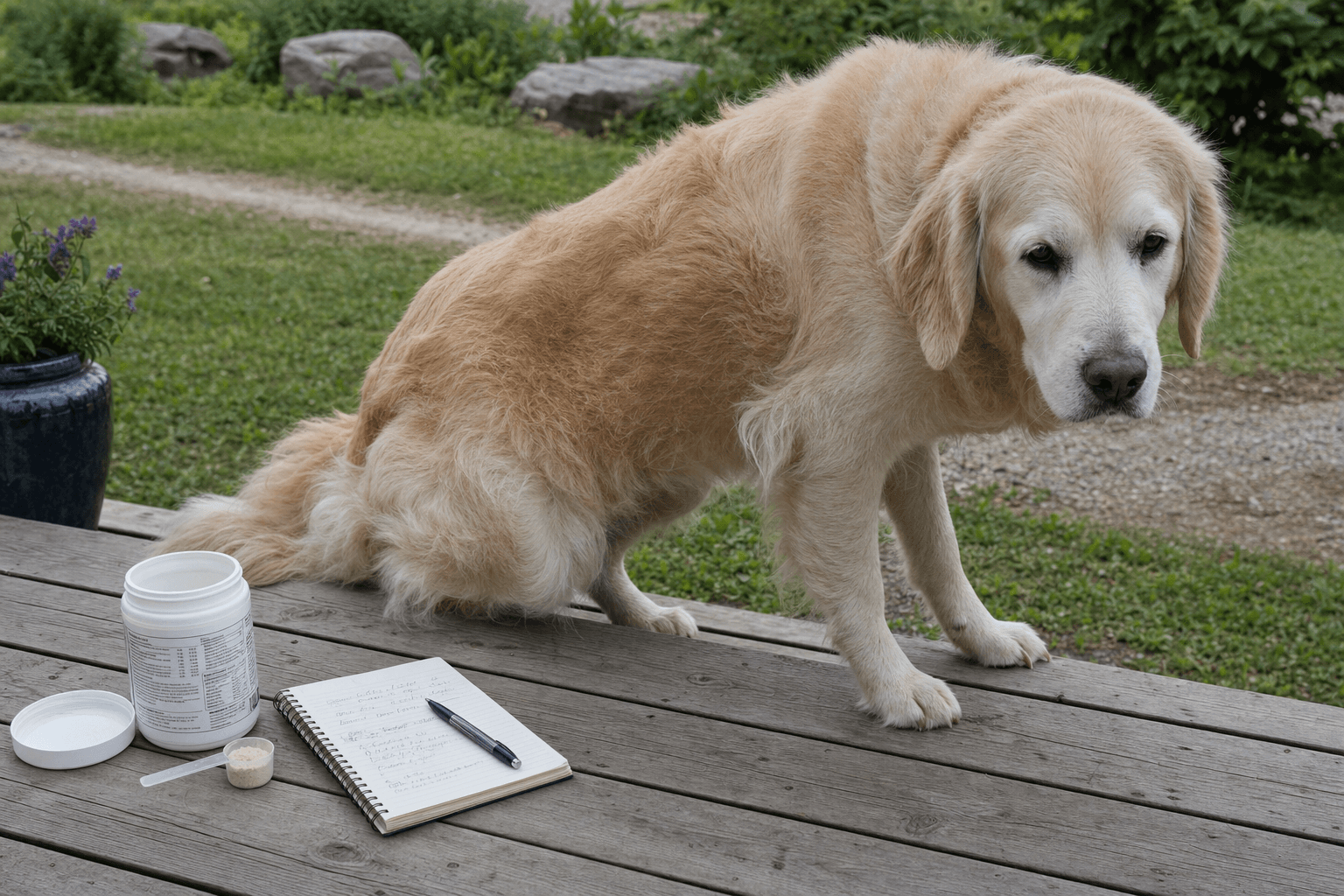
TL;DR
Dog supplements can be worth the money when you can identify a specific reason for using one, calculate the real daily cost for your dog’s size, and observe a practical change that matters in daily life. A lower-priced jar is not automatically the better value if it lasts only a short time for a large dog.
Choose one supplement at a time, keep the rest of your dog’s routine steady, and review your notes after four weeks. If your dog seems unwell after starting a new product, stop using it and contact your veterinarian.
Cost per serving tells you more than price per jar
A jar price can be misleading. One product may appear inexpensive but require more servings for a heavier dog, while another may last longer at your dog’s label-directed serving size.
Before buying, write down these details from the package:
- Price of the container
- Number of servings in the container
- Serving guidance for your dog’s current body size
- Whether the serving changes by weight
- Whether the product has a clear ingredient list and directions
Then divide the container price by the number of days it will last for your dog. That is the cost worth comparing, because it reflects what you would actually spend to keep the routine going.
Large dogs often cost more to supplement because many products use weight-based serving directions. A container that lasts a small dog for a long time may be used much faster by a large dog. Check the label before assuming a large jar represents a month of use.
Label details also help you compare products honestly. A named ingredient alone does not tell you how much is included or how the maker describes its sourcing. Use this guide to read dog supplement ingredient sourcing details before comparing prices.
How do you decide if a supplement has a useful purpose?
Start with one ordinary, observable goal rather than a broad hope that your senior dog will “feel better.” The goal should fit the product and something you can notice without guessing.
For example, a mobility-focused product might lead you to record how your dog rises after resting, approaches a familiar step, or completes a usual walk. A dental product may fit alongside a routine that includes checking your dog’s breath and willingness to eat, but it does not replace oral care or an exam when there is a concern. The evidence and limits of dog joint supplements are especially worth reviewing before treating a joint product as an automatic long-term expense.
Avoid using a supplement as a substitute for basics that already support daily comfort: an appropriate food routine, accessible water, gentle activity suited to your dog, secure footing, and a calm place to rest.
A research finding about one ingredient is not proof that every product using that ingredient is worth its price. In a study of overweight dogs on the same calorie-restricted diet, dogs received Spirulina or placebo tablets in body weight-dependent amounts for 12 weeks. At six weeks, the Spirulina group had weight loss of -6.7 ± 0.6%, while the placebo group had weight loss of -5.9 ± 0.6%; the p value for the difference was 0.276. Those results do not establish that Spirulina causes weight loss or that a general supplement will offer the same value for another dog.
A four-week review makes the decision less emotional
A new jar can feel promising, especially when you want to help an older dog stay comfortable and engaged. A short, organized review helps separate a useful routine from an expensive habit.
Use this four-week process:
Before you start
Pick one behavior or routine to observe. Write a brief baseline note about what happens now. Keep food, walk routes, treats, bedding, and activity as consistent as reasonably possible.
During the four weeks
Give the product according to its package directions. Note whether your dog readily eats it, leaves it behind, or needs a different food-mixing approach. Check the label for potential ingredients that do not suit your dog before starting, particularly if chicken or shellfish has been a concern. The full ingredient panel matters more than the front-of-package claim, as explained in dog supplement allergen guidance.
Write down short observations on the same kind of day when possible. For a senior dog, that might mean noting a familiar morning walk, getting up from the usual bed, or settling after dinner.
At the end of the review
Compare your notes with the baseline. Ask three practical questions:
- Did I notice a repeatable change in the one thing I chose to track?
- Is my dog willingly taking the product and maintaining their usual routine?
- Is the daily cost reasonable for our household if I continue?
If your notes are unclear, that is useful information. Continuing indefinitely because the jar is not empty can turn an uncertain purchase into a permanent expense.
Value includes safety, simplicity, and consistency
The best-priced option is not always the one that fits your home. A powder that is frequently left in the bowl, a chew your dog refuses, or a product with unclear directions may not be a practical value even if its cost per serving looks low.
Choose a format your dog can reliably finish, and introduce only one new supplement at a time. That makes it easier to notice if appetite, stool, scratching, energy, or another routine changes after the new addition. For a simple one-change approach, see what to watch when a dog reacts to a new supplement.
Keep the receipt or order record, the label, and your four-week notes together. If you decide to discuss the product with your veterinarian, those details are more useful than trying to recall the jar name or the day you started it.
FAQ: Are dog supplements worth the money?
Should I buy the biggest jar to save money?
Only if the package will be used within its stated storage and freshness guidance and your dog is likely to keep taking it. Calculate how long it lasts at your dog’s serving size first.
What if I cannot tell whether it is helping after four weeks?
Pause and review the goal you chose. If there is no clear, repeatable difference in your notes, it may not be a worthwhile ongoing cost for your dog. Bring your observations and the label to a veterinary conversation if you are unsure.
Can I start several supplements at once?
Starting one at a time is usually easier for everyday tracking. If your dog’s routine changes, you will have a clearer idea of what was new and what to stop reviewing.
Does a more expensive supplement mean it is better?
Not necessarily. Compare the cost for your dog’s serving size, the completeness of the label, the ingredients, and whether the product fits a specific, observable purpose.
For individual health questions, your veterinarian remains the best partner.