When Walks Start Feeling Harder Than They Used To
Your dog used to trot the whole block without a second thought. Now the last stretch is slower, there's more pausing, and you find yourself cutting the walk short before either of you is really ready to go home. A dog stroller doesn't fix the reason for that slowdown, but it can change what an outing looks like, letting your dog stay in the fresh air, watch the world, and ride through the part of the route that's gotten tiring, without turning every walk into a judgment call about how far is too far.
If you're trying to figure out whether a stroller actually fits your situation, and which features matter once you start comparing models, this checklist walks through the practical details worth checking before you buy.
What a Stroller Can and Can't Do
A stroller is a mobility and comfort tool, not a treatment. It gives a dog with reduced stamina, joint discomfort, or balance changes a way to still get outside, smell the neighborhood, and spend time near you, without demanding the same physical effort as a full walk on foot. It does not improve joint function, slow any underlying condition, or replace a veterinary evaluation of new or worsening mobility changes. Think of it the same way you'd think of a ramp or a non-slip rug at home: it adjusts the environment to the dog you have right now, rather than changing the dog.
If you've noticed your dog hesitating on stairs, slowing down mid-walk, or struggling to get back up after resting, those are worth tracking on their own, separate from the stroller decision. A simple log of when and how often it happens is more useful to a vet than a general impression that "he's slower lately."
Fit: Measure Before You Shop
Strollers are sized by weight capacity and interior dimensions, and getting this wrong is the most common reason a stroller ends up unused in a closet.
- Weight capacity: Check the manufacturer's stated maximum and leave some margin rather than buying right at the limit.
- Interior length and width: Your dog should be able to lie down fully stretched out, not just sit upright. Measure your dog nose to tail and shoulder to shoulder before comparing models.
- Interior height: There should be room for your dog to stand without their back or head brushing the canopy, especially if they like to look out over the side.
- Weight distribution for long-backed or short-legged breeds: A deeper, more cushioned base helps dogs who are less able to brace themselves against turns or stops.
Entry and Exit: The Detail Owners Overlook
How a dog gets in and out matters as much as how they ride once inside, particularly if lifting your dog is uncomfortable for either of you.
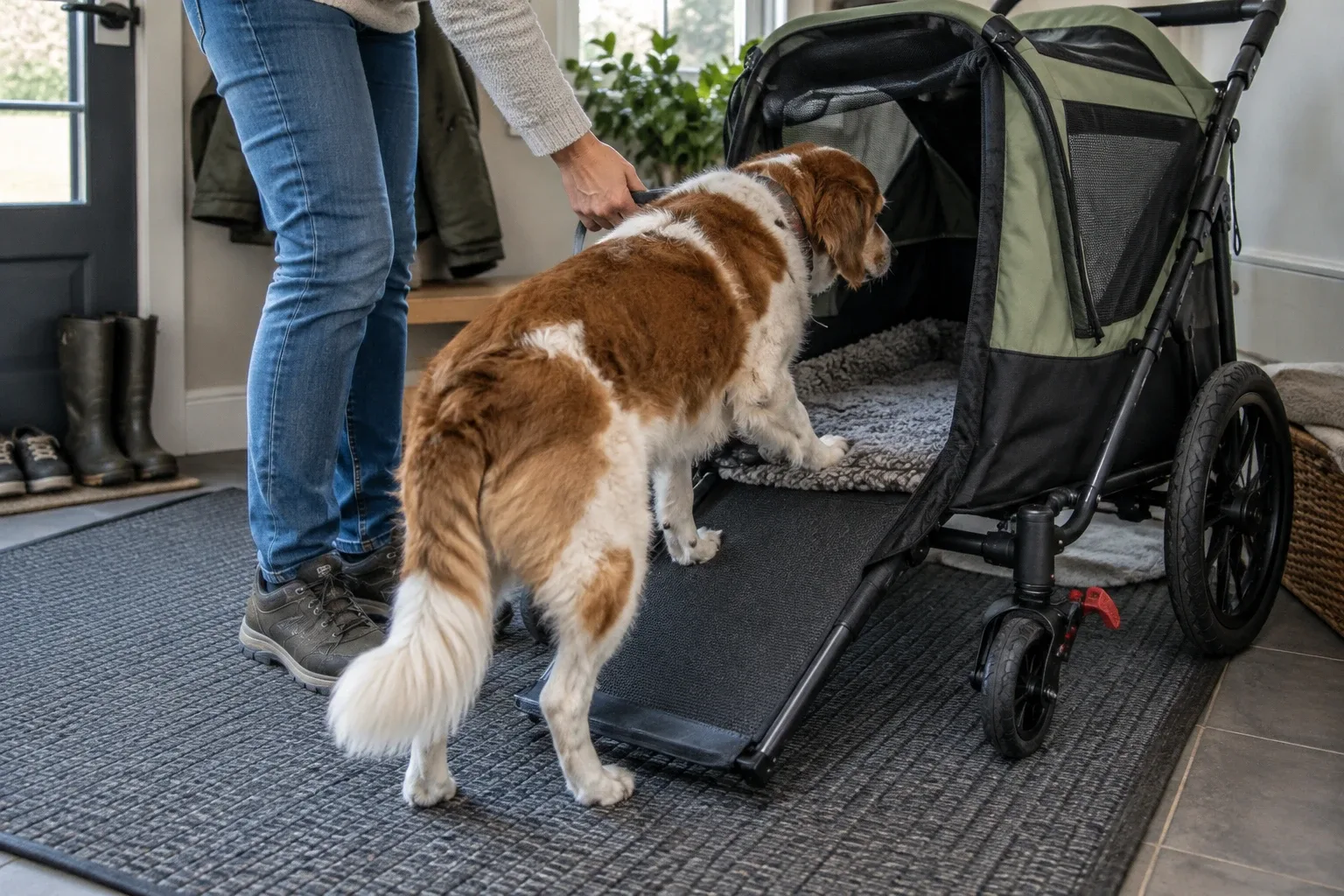
- Low entry height or a ramp-style opening: Look for strollers where the base sits close to the ground, or that include a fold-down ramp, so your dog can step in rather than being lifted.
- Side or rear door access: A door that opens flat, rather than only a top zip opening, makes it easier for a dog who can't jump or climb.
- Non-slip interior flooring: A smooth plastic base can be slick under paws; a removable, textured liner gives more secure footing while loading and unloading.
- Enough clearance for a harness: If your dog wears a harness in the stroller for added security, confirm there's a strap or anchor point and that it doesn't restrict the entry path.
Stability and Ventilation on the Move
Once you're actually out walking, the stroller's build quality determines how comfortable and secure the ride feels for your dog.
- Wheel size and type: Larger wheels with some suspension handle curbs, gravel, and uneven sidewalks more smoothly than small, rigid wheels, which transmit every bump.
- A wide, low center of gravity: This matters most on turns and inclines, where a top-heavy stroller can feel tippy.
- Mesh panels on multiple sides: Airflow on at least three sides helps on warm days and lets your dog see and smell their surroundings instead of riding in a closed box.
- A canopy that fully retracts or opens: Useful for cooler days when your dog wants to look around, and for ventilation when it's warm.
- Reliable brakes: A stroller that stays parked on a slope while you manage a leash, pick up a bag, or chat with a neighbor is a basic safety feature, not an extra.
Storage and Everyday Practicality
Beyond the ride itself, think about how the stroller fits into your actual routine.
- Fold size: Check whether it fits in your car trunk, hallway closet, or apartment entryway when folded, since a stroller that's a hassle to store tends to get used less.
- Underneath storage basket: Useful for water, a bowl, waste bags, or a light blanket, without needing a separate bag.
- Washable or removable liner: Senior dogs may have more accidents or shed more; being able to pull the liner out and wash it keeps the stroller usable long term.
- Weight of the stroller itself: If you'll be lifting it into a car or up stairs regularly, the empty weight matters as much as the dog's weight capacity.
Introducing the Stroller Without Pressure
A new stroller can be unfamiliar enough that some dogs hesitate to get in, especially if balance or vision has changed with age. A gradual introduction tends to go better than expecting immediate comfort:
- Let the stroller sit, unmoving, in a familiar room for a day or two so your dog can sniff and approach it on their own.
- Place a treat or their regular bed liner inside to make the interior feel familiar rather than new.
- Lift your dog in for short, stationary sessions first, a minute or two of calm sitting, before adding movement.
- Push the stroller a short distance indoors or in a quiet driveway before taking it on an actual walk.
- Keep the first few outdoor outings brief, and let your dog walk part of the route if they're able, using the stroller for the portion that's gotten harder.
If your dog resists getting in repeatedly, seems anxious rather than simply unfamiliar, or shows signs of pain when lifted, that's worth mentioning at a veterinary visit rather than pushing through with the stroller alone.
Supporting Comfort Beyond the Stroller
A stroller addresses how your dog gets through an outing, but it's one piece of a broader comfort picture. Joint comfort and daily mobility are often part of the same conversation that leads an owner to consider a stroller in the first place, and ingredient-level details matter there too, the same way they matter when comparing green-lipped mussel capsules by label and format rather than relying on general claims. If joint support is already part of your dog's routine, the New Zealand Green Lipped Mussel Powder for Dogs is worth checking against the same label questions, serving size, ingredient sourcing, and evidence scope, before assuming it changes what kind of walk your dog can manage.
For a wider look at adapting your home and daily routine as mobility changes, a room-by-room approach to senior dog comfort covers footing, rest areas, and access points that work alongside a stroller rather than replacing the need for one.
FAQ
Is a stroller only for dogs who can't walk at all? No. Many owners use a stroller for part of a walk, letting their dog walk the sections they're comfortable with and ride for the rest, rather than using it as a full replacement for walking.
Will a stroller make my dog weaker from not walking? That depends on the individual dog and situation, which is a question for your vet rather than something a stroller's design can answer. The stroller itself is a tool for comfort and outings, not a mobility treatment.
How do I know if the stroller is actually the right size? Measure your dog lying fully stretched out and standing at full height, then compare those numbers directly to the stroller's interior dimensions rather than relying on breed-based size categories.
My dog refuses to get in. What now? Try shorter, lower-pressure introduction steps before assuming the stroller itself is the problem, and mention the resistance to your vet if it continues, since discomfort when being lifted or placed can look like simple reluctance.
As always, a veterinarian is the right source for guidance on your dog's specific mobility or health changes.
For individual health questions, your veterinarian remains the best partner.