When your older dog starts staring, pacing, or forgetting a familiar routine, it is easy to reach for a supplement. A sensible first choice is the product with the clearest label, a feeding format your dog will accept, evidence that matches the finished product, and honest availability terms. A supplement can support a care routine, but it cannot diagnose or cure dementia.
This guide is for shopping and home observation, not diagnosis or treatment; new or urgent changes need prompt professional care.
Start with a four-part buying checklist
Before comparing brands, save a photo of each product label and check these four points:
- Ingredient identity: Does the label name specific ingredients such as DHA, MCT, fish oil, or another compound, rather than relying only on phrases such as “brain support”?
- Declared quantity: Does it state how much of each named ingredient is provided in the serving, or only the total weight of a blend?
- Feeding format: Can your dog take the product as directed without refusing the food or leaving part of the serving behind?
- Evidence and availability: Is there evidence for the same ingredient combination and format, and does the product page clearly say whether it is available now or offered as a preorder?
If a label leaves one of these questions unanswered, place it in the “needs more information” group rather than treating it as equivalent to a clearer product.
For a broader way to observe behavior before changing routines, use Senior Dog Behavior Changes: Observe First, Then Adjust Daily Routines.
Compare ingredients without assuming they are interchangeable
Ingredient names can help you sort products, but a familiar name is not proof that every product has the same evidence.
DHA and fish oil
Look for the exact ingredient named on the label and any declared amount. “Fish oil” does not by itself tell you how much DHA is present. Do not compare a product that lists a specific DHA quantity with another that lists only a broad oil blend as though the labels describe the same thing.
One survey reported that fish oil was the most commonly used dietary supplement among the supplements reported after age-related behavioral changes, at 48%.[1] That describes use, not proof that fish oil prevents, diagnoses, or treats cognitive decline.
MCT
If a product refers to MCT, check whether it identifies the amount and the form used. A canine study cited in the evidence literature compared diets containing different MCT levels over 90 days, with signs re-evaluated at days 30 and 90.[2] That study does not automatically establish that every MCT supplement, chew, oil, or feeding routine will have the same effect.
Other named ingredients
For any additional ingredient, ask:
- Is the ingredient named precisely?
- Is its quantity declared separately?
- Is the research about that ingredient, the finished product, or a different diet?
- Does the label explain how the serving is provided?
The article Cognitive changes in senior dogs: what to notice and what nutrition can realistically do provides the relevant background on cognitive changes and the limits of canine nutrition research.
Read the quantity panel, not just the front label
A front label may emphasize several ingredients without showing how much of each one is in a serving. Turn to the facts panel and record:
- The serving size and serving unit
- The amount of each named cognitive-support ingredient
- Whether amounts are listed for individual ingredients or only for a proprietary blend
- The number of servings in the container
- Any feeding instructions that affect how the serving is provided
Avoid filling in missing amounts from the ingredient order. If the label does not declare a quantity, mark it as unknown rather than estimating it.
Do not copy a quantity from a research paper into a product routine. Research diets, supplements, and soft chews can differ in ingredients, concentration, and feeding instructions.
Choose a format your dog will actually finish
A product is difficult to assess if your dog eats only part of it. Compare formats by daily practicality:
- Soft chews: May be convenient when your dog accepts them as a treat, but check whether the full labeled serving is eaten.
- Powders: Can be mixed with food, but watch for refusal or food left behind. A refused portion means the intended serving was not fully consumed.
- Oils or liquid products: Require careful reading of the product’s own serving instructions and a way to provide the stated amount consistently.
Keep the feeding method consistent while you observe acceptance. The guide Dog Supplement Powder vs Soft Chews: How to Choose expands on the practical differences between these formats.
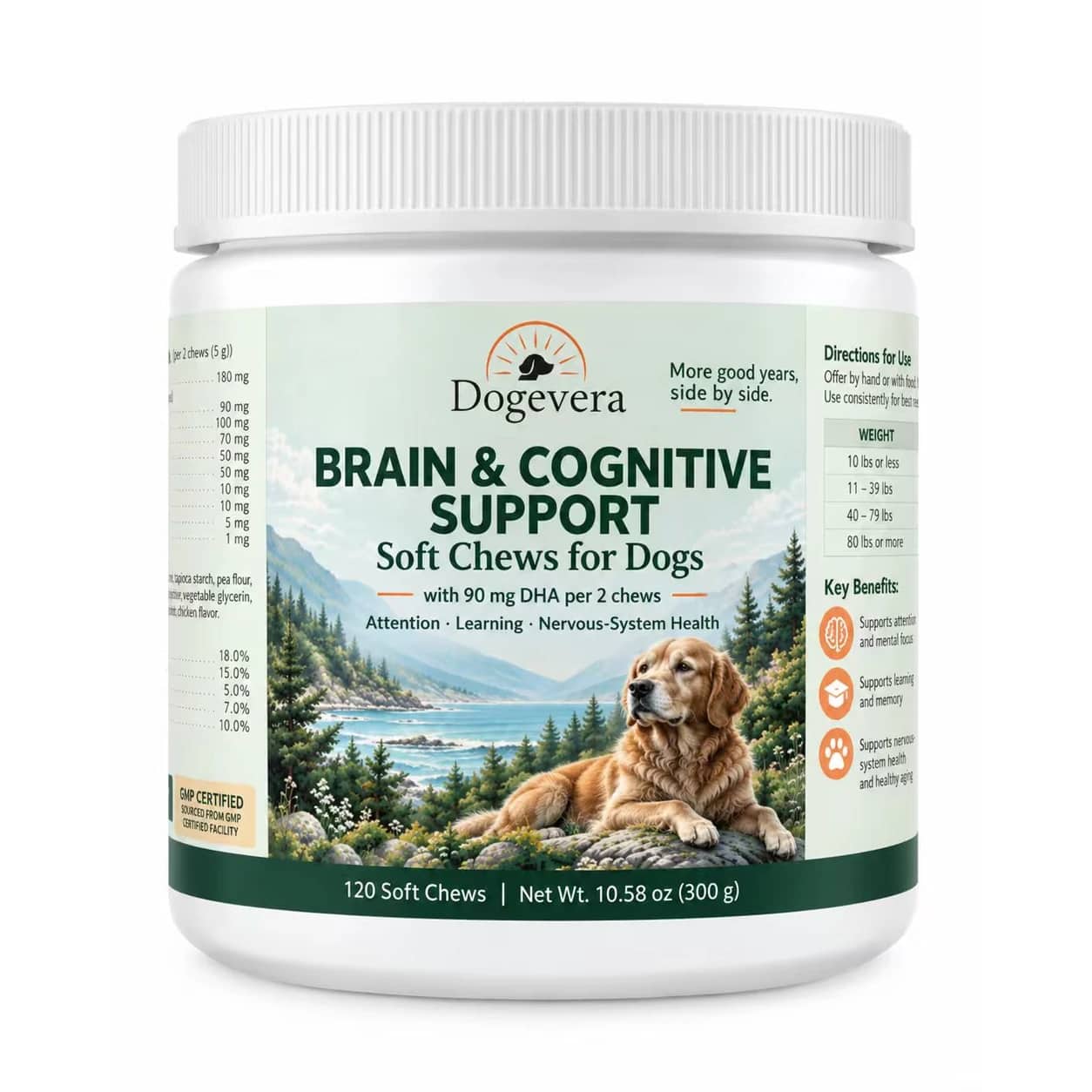
If you are comparing a soft-chew option, inspect the current label and availability for Brain Cognitive Support Soft Chews for Dogs. Do not assume the product contains a particular ingredient or quantity unless the current product information states it.
Check the evidence for the finished product
A product page may mention DHA, MCT, fish oil, or other nutrients, while the research may have examined a different diet or combination. Make a simple comparison list:
- Ingredient match: Does the study involve the same named ingredient?
- Format match: Was it studied as a diet, oil, powder, or chew?
- Quantity match: Is the studied amount declared for the product you are considering?
- Outcome match: Did the research examine behavior observations, a diagnosed condition, or something else?
- Evidence limit: Does the information explain what the study cannot establish?
Canine cognitive dysfunction syndrome is described in the research literature as a progressive, age-related neurodegenerative disorder, and cognitive dysfunction syndrome is also described as common in senior dogs.[2][3] A shopping decision cannot determine whether an individual dog has that condition. New behavior changes still belong in a broader observation and care process rather than being treated as proof that a supplement is needed.
Review preorder and delivery terms before paying
Availability is part of the buying decision. Before placing an order, check:
- Whether the product is in stock or marked as a preorder
- Whether the page gives a confirmed availability statement
- Whether the order terms explain what happens if fulfillment timing changes
- Whether you can cancel or review the order before purchase, according to the posted terms
- Whether the product page identifies the label version you are using for comparison
Do not treat a preorder as a product currently ready to ship, and do not infer a delivery date that the seller has not confirmed. Save the product page and label information at the time you order.
A low-risk next step after choosing
Create a short product record before starting:
- Product name and label date
- Named ingredients and declared quantities
- Feeding format
- Whether your dog finished the serving
- Any noticeable change in appetite, stool, comfort, sleep, or behavior
Record observations for three days before making another change to the routine. Keep the product packaging or a label photo with your notes. If your dog refuses the food, develops a concerning reaction, or shows a sudden or urgent behavior change, stop treating the supplement as a solution and seek appropriate professional guidance.
FAQ
Are senior dog cognitive supplements a treatment for dementia?
No. They are products marketed for nutrient or cognitive support, not a home diagnosis or cure for dementia. A supplement should not replace evaluation of new or worsening behavior changes.
Is a product better because it lists DHA or MCT?
Not automatically. Check the declared quantity, the complete ingredient list, the feeding format, and whether evidence applies to the finished product.
What if a product is available only as a preorder?
Treat it as a preorder, not as currently available stock. Review the posted terms and any confirmed availability information before paying.
How should I compare two labels?
Use the same checklist for both: ingredient identity, declared quantities, format, evidence match, and availability terms. If one label does not provide key information, record that limitation instead of guessing.
References
[1] Europe PMC, study reporting dietary supplement use after age-related behavioral changes: https://europepmc.org/article/MED/37835662
[2] Europe PMC, canine cognitive dysfunction and MCT diet study: https://europepmc.org/article/MED/30619873
[3] Europe PMC, review of canine cognitive dysfunction syndrome: https://europepmc.org/article/MED/37443999
Related reading
For individual health questions, your veterinarian remains the best partner.