TL;DR
When your older dog pauses before the stairs, choosing among glucosamine supplements for senior dogs can feel like the next practical step. Favor a product that names its glucosamine form, declares every active ingredient’s amount, provides evidence relevant to the actual formula, and has a manageable daily cost. A chew, tablet, or powder should fit your dog’s routine, but neither a convenient format nor a longer ingredient list proves better joint support.
Choose the glucosamine form and serving format separately
“Form” means two different things when shopping: the type of glucosamine and the way you give it.
A label may name glucosamine hydrochloride, often shortened to glucosamine HCl, or glucosamine sulfate. Record the exact name rather than treating every glucosamine listing as interchangeable. If a manufacturer cites research, the ingredient form is one detail to match against the studied formula. The name alone does not establish that one option will work better for your dog.
Then consider the serving format:
- Soft chews: Check whether your dog comfortably accepts the texture and how many chews the directions require.
- Tablets or capsules: Consider whether giving the labeled serving will be practical every day.
- Powder: Consider whether your dog reliably finishes the food containing the serving and whether measuring it is manageable.
Choose for the dog in front of you, not the format that looks easiest on the package. The guide to hip and joint dog chews expands on comparing chew ingredients without assuming the format carries its own evidence.
Compare active ingredients, not blend totals
A large number on the front of a package may describe a whole blend rather than its glucosamine content. Those are different pieces of information.
For each candidate, write down:
- The exact glucosamine form and its amount per labeled serving.
- Every other active ingredient and its individual amount.
- Whether the amounts apply to one chew, one scoop, or the complete daily serving.
- Other ingredients that matter for your dog’s dietary restrictions or acceptance.
Chondroitin, hyaluronic acid, and other ingredients may appear alongside glucosamine. Their presence does not tell you how much glucosamine the product supplies, and a longer list does not establish greater benefit. Compare the formula as a whole rather than counting ingredients.
A proprietary blend that gives only a combined weight prevents a meaningful ingredient-by-ingredient comparison. Dogevera’s standard is to state every active ingredient and its amount per serving in plain text, without proprietary blends; apply that same standard to any brand you consider.
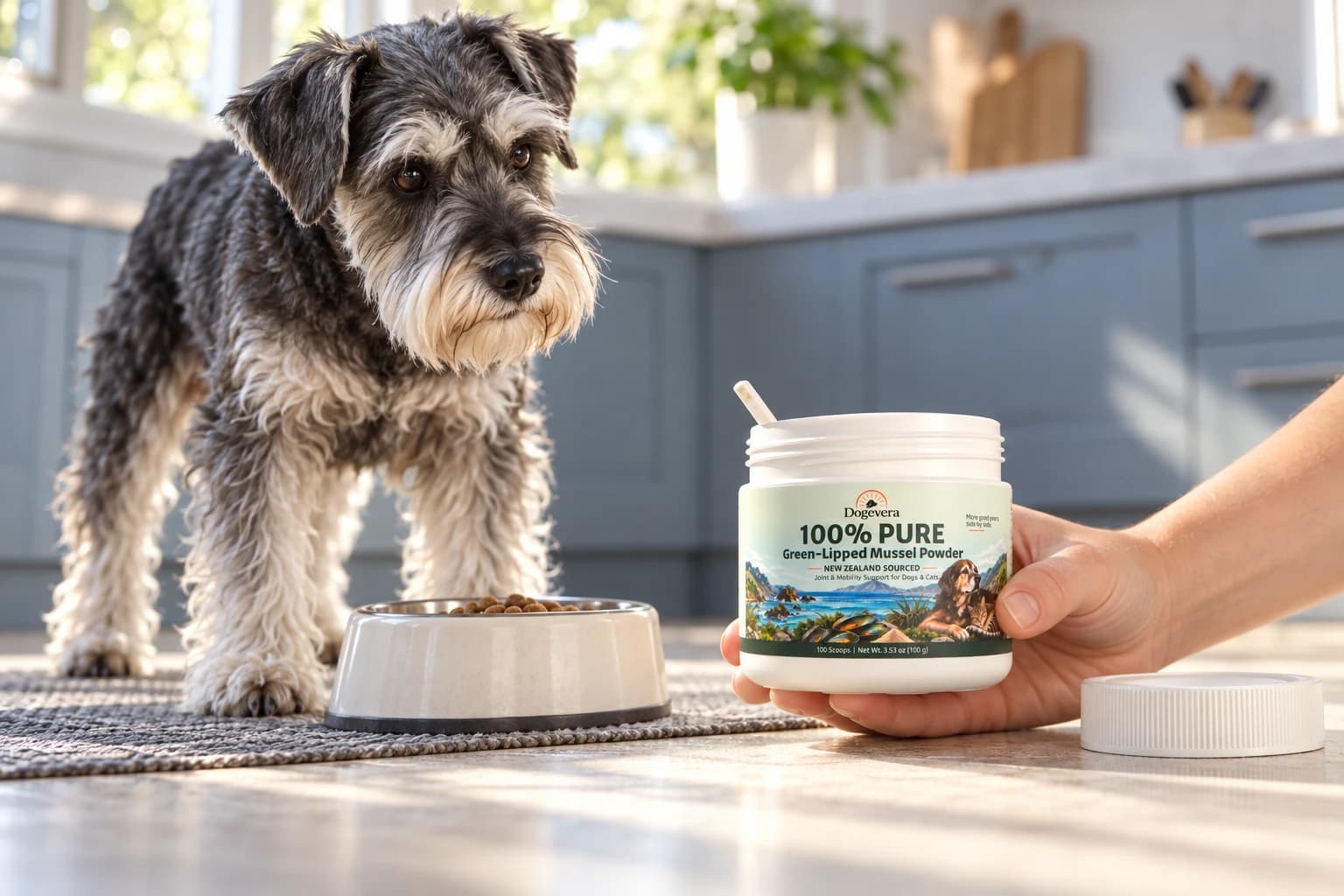
If your shortlist also includes New Zealand Green Lipped Mussel Powder for Dogs, keep it as a separate product category in your notes rather than assuming its powder weight equals a declared glucosamine amount.
Ask whether the evidence matches the finished product
“Contains researched ingredients” and “this finished formula was studied” are not equivalent claims.
When a product cites research, look for a match between the study and the item you would buy: the named ingredients, their forms, declared quantities, and the finished formulation. If the match is unclear, the research does not establish that the product will deliver the same findings.
Evidence also needs its limits stated. A study comparing an oral joint supplement with carprofen in working dogs with hip osteoarthritis found some improvements in individual scores but no improvement when overall results were considered. That is not a basis for promising that a glucosamine product will restore an older dog’s mobility or replace treatment.
For a purchasing decision, separate these claims:
- Ingredient research: Relevant background, but not proof for every product containing that ingredient.
- Finished-product research: More directly relevant when it concerns the formula being sold, though the findings and limitations still matter.
- Quality documentation: Useful for understanding what was checked, but not itself evidence of a joint-support benefit.
For more context on interpreting these distinctions, see whether dog joint supplements actually work.
Calculate daily cost before comparing prices
The less expensive container is not necessarily the less expensive routine. Use the package directions for your dog rather than comparing price per chew or scoop alone.
Daily cost = container price ÷ number of labeled daily servings in the container.
If directions specify different introductory and ongoing servings, calculate their costs separately. Do not stretch a container by reducing the serving below its directions or copy a serving from another brand.
Use this short comparison process for each candidate:
- Identity: Can you name the glucosamine form?
- Disclosure: Is every active ingredient individually quantified?
- Evidence: Does the cited research match the formula, and what did it actually find?
- Practical fit: Can your dog comfortably take the full labeled serving?
- Cost: What does that serving cost per day?
An unclear formula remains unclear even at a low price. A higher price, meanwhile, is not evidence of better support. If essential details are missing, request them before buying rather than filling in the gaps yourself.
Start with everyday mobility, not a purchase deadline
Supporting joints and muscles while your dog still moves comfortably is a better approach than waiting for everyday tasks to become difficult. Early maintenance is the right thing for the dog and an economical approach for the owner, but that does not mean a glucosamine purchase guarantees lower future medical bills.
You can begin a mobility routine before deciding on a supplement: provide secure footing, keep comfortable activity consistent, and notice changes in ordinary movements. Record whether your dog rises easily after rest, keeps their usual walking pace, or hesitates at steps. Do not repeatedly ask for difficult movements to test a product.
Supplements do not replace diagnosis or treatment; new or sudden movement changes need prompt veterinary care, especially an inability to stand or walk.
If you choose a supplement, keep its label and note when you started it alongside your everyday observations. That gives you something more useful to review than a general impression that your dog seems older.
FAQ
Is glucosamine HCl better than glucosamine sulfate?
The form name alone is not enough to choose a winner. Compare the complete formula and whether the evidence cited applies to that form and finished product.
Is more glucosamine always better?
A larger declared amount does not, by itself, establish a better product. It is information needed for comparison, not permission to increase the labeled serving.
Should I choose glucosamine alone or a combination?
Do not choose solely by ingredient count. A combination should disclose each active amount, and any evidence claim should match the combination rather than being borrowed from one ingredient.
When should a senior dog start taking glucosamine?
There is no purchase deadline established simply by the word “senior.” Start paying attention to mobility before difficulties develop, then decide whether a clearly labeled supplement has a sensible role in your dog’s existing care routine.
References
For individual health questions, your veterinarian remains the best partner.