
In this article
TL;DR
*New Zealand green-lipped mussel (Perna canaliculus) is a large shellfish found only in New Zealand's coastal waters, named for the bright green edge on its shell. It is sold as seafood under the trade name Greenshell™ mussel and farmed on a large scale: a 2023 study valued the industry at NZ$336 million a year, and about 80% of the young mussels (spat) used to stock the farms are collected wild at a single beach, Ninety Mile Beach in the far north. Interest in its health effects began when coastal Māori communities who ate the mussels were observed to have less arthritis than inland communities, and research and commercial farming both started in the early 1970s. Today it is dried and milled into a powder used for joint support in people and dogs: in a 2002 dog study, 83% of dogs given green-lipped mussel powder with their food improved their arthritis score by 30% or more within 6 weeks, against 7%* on the same food without it.
Green-lipped mussel at a glance
| Scientific name | Perna canaliculus |
| Also called | Greenshell™ mussel, New Zealand mussel, GLM |
| Where it lives | Only in New Zealand's coastal waters |
| How it's grown | On ropes hanging from floating lines in sheltered bays |
| Where farmed | Mainly the Marlborough Sounds, with farms in Coromandel and Golden Bay |
| Seed stock | About 80% of spat collected wild at Ninety Mile Beach |
| Industry value | About NZ$336 million a year (2023) |
| Main uses | Seafood; dried powder and oil extracts for joint support |
| Lookalikes | Asian green mussel (Perna viridis) and blue mussel (Mytilus) |
Where green-lipped mussels come from
The green-lipped mussel is endemic to New Zealand: it grows naturally nowhere else. It has been part of the diet of Māori for hundreds of years. The shell is dark brown to green with a vivid green rim, the "green lip" in its name, and inside, females are apricot-orange and males creamy white.
Almost the whole farming industry starts on one stretch of sand. Storms wash seaweed carrying tiny young mussels onto Te Oneroa-a-Tōhē, Ninety Mile Beach, where it is gathered and trucked to farms around the country. A 2023 study found the industry is about 80% reliant on this single natural supply, which is why researchers are now mapping where those larvae come from and why hatcheries are breeding mussels too.
How they are farmed
- Seeding. The young mussels are wrapped onto long ropes with a biodegradable cotton sock that holds them until they attach.
- Growing. The ropes hang in the water from floating lines in sheltered bays. The mussels filter seawater for their food, so nothing is fed to them.
- Thinning. As they grow, the mussels are stripped off and re-socked at lower density so they have room.
- Harvest. It typically takes one to two years for a mussel to reach harvest size.
Because mussels filter seawater, growing areas are monitored for natural algal toxins and harvest is closed when levels rise. That is also why you should never feed your dog shellfish picked up on a beach: see can dogs eat mussels?
From mussel to powder
For supplements, the meat is separated from the shell, dried and milled into a fine powder. Processing matters, because the mussel's fats are sensitive to heat, light and air. Powders are described as low-temperature dried, freeze-dried or cold processed, and a good powder smells of the sea, not sharp or rancid.
There are two main forms:
- Whole mussel powder, given in grams. This is the form used in most dog trials.
- Oil extracts such as PCSO-524, concentrated from the mussel's fat and given in milligrams.
They are different products, and results from one don't carry over to the other: see green-lipped mussel powder vs oil for dogs.
Why it is used for joints
The story starts with an observation. Researchers noted that coastal Māori who ate green-lipped mussels regularly had less arthritis than Māori living inland or New Zealanders of European descent. That led to research in the early 1970s, and a 2018 review counted about 150 publications on its effects over 40 years.
What is in it:
- Omega-3 fatty acids, including types that are uncommon in fish oil
- Glycosaminoglycans, the family of compounds that includes chondroitin, part of normal cartilage
- Protein, minerals and antioxidant pigments
In dogs, the strongest results come from whole powder mixed into food: in the 2002 study, 83% vs 7% improved by 30% or more in 6 weeks, and in a 2009 placebo-controlled trial significantly more dogs improved on mussel powder than on placebo. For every trial and what it found, see green-lipped mussel for dogs: benefits and evidence.
How to tell real New Zealand green-lipped mussel
Lookalikes are a real problem. In a 2026 study, researchers tested 15 restaurant dishes sold as New Zealand mussel: *2 of the 15 were actually Asian green mussel (Perna viridis)*, which looks similar once shelled and cooked. In supplements, you can't see the mussel at all, so check:
- *The scientific name Perna canaliculus*** on the label, not just "mussel" or "green mussel"
- A single ingredient, or the exact amount of mussel in a blend
- Origin and quality documents, such as import records and a certificate of analysis or specification
Our guide to the best green-lipped mussel supplements for dogs compares nine products on exactly these points.
Our powder
Our New Zealand green lipped mussel powder for dogs is 100% Perna canaliculus, low-temperature dried and milled, with nothing added. You give about 1 g per 25 lb of body weight a day, stirred into food. Our Quality & Sourcing page shows the import records, specification limits and facility registration behind it.
Morty's Corgi, now 6, has had no joint problems so far and takes it every day as prevention.
FAQ
What is green-lipped mussel?
A large shellfish, Perna canaliculus, found only in New Zealand. It is eaten as seafood and dried into a powder that is used for joint support in people and dogs.
Why is it called green-lipped?
Because of the bright green rim around the edge of its shell.
Is green-lipped mussel the same as Greenshell mussel?
Yes. Greenshell™ is the trade name used by the New Zealand industry for the same species.
Do green-lipped mussels only come from New Zealand?
Yes. The species grows naturally only in New Zealand, and almost all of it comes from New Zealand farms. Similar-looking green mussels from Asia are a different species.
Is green-lipped mussel the same as a regular mussel?
No. The blue mussels sold in most supermarkets are Mytilus species. The dog joint trials used Perna canaliculus.
Is green-lipped mussel safe for dogs?
For most dogs, yes. Dogs with a shellfish allergy should not have it. See green-lipped mussel for dogs: side effects.
References
- Eason CT, et al. Greenshell™ mussels: a review of veterinary trials and future research directions. Veterinary Sciences. 2018.
- Identifying the source populations supplying a vital economic marine species for the New Zealand aquaculture industry. 2023. PMID: 37291180
- Duplex recombinase-aided amplification-lateral flow dipstick (dRAA-LFD) assay for New Zealand green-lipped mussel authentication. 2026. PMID: 41892031
- Bierer TL, Bui LM. Improvement of arthritic signs in dogs fed green-lipped mussel (Perna canaliculus). Journal of Nutrition. 2002.
Joint & Mobility Supplements for Senior Dogs
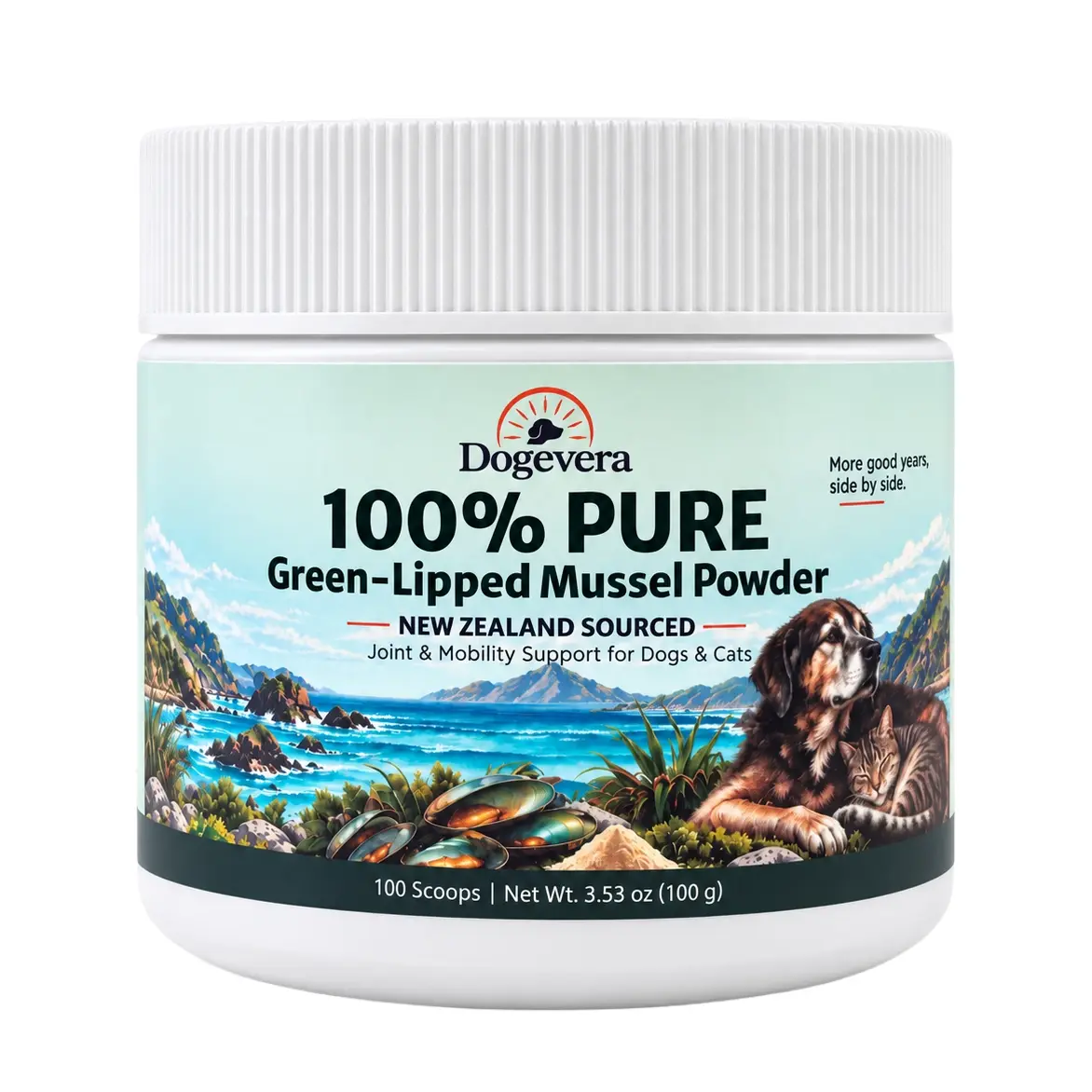
Put this into practice
Daily joint support for senior dogs
100% New Zealand Green-Lipped Mussel Powder for Dogs4.5142 reviews
- 100% New Zealand green-lipped mussel. No fillers, no blends.
- Naturally rich in ETA omega-3s and GAGs for hips and joints
- One scoop on food, dosed by your dog’s weight
Black Friday40% off your first subscription order
Free shipping · 100-day money-back guarantee