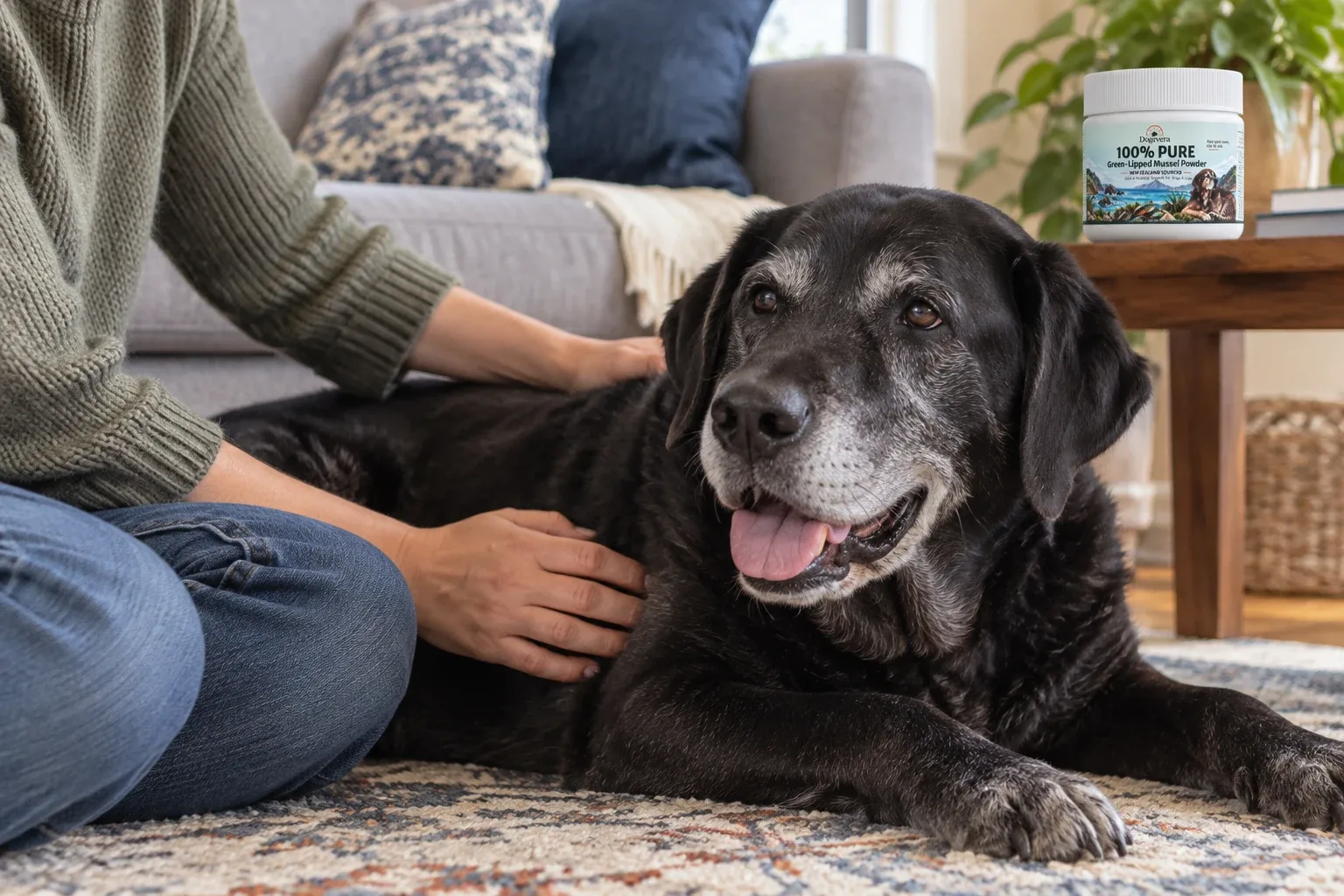
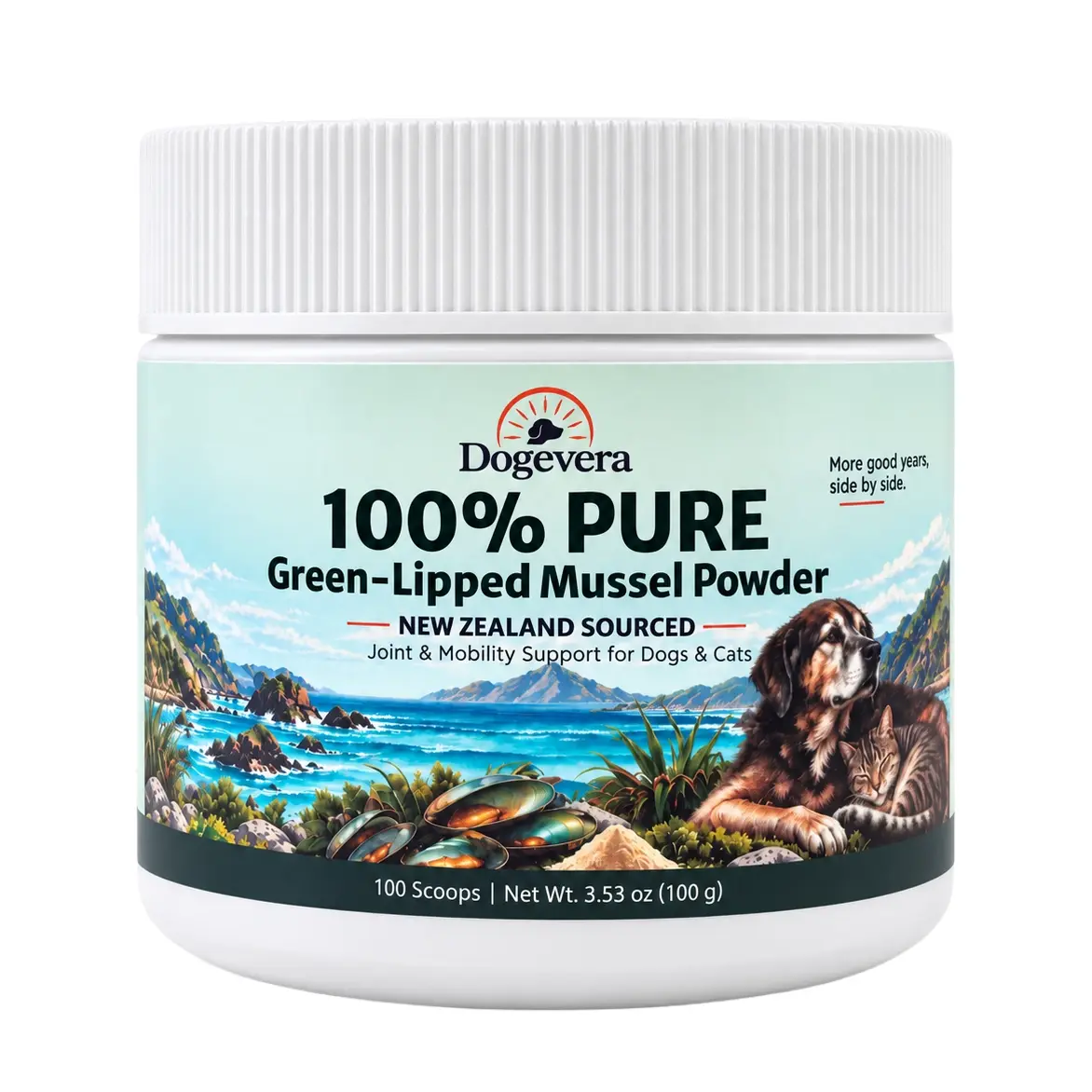
We sell this powder. It was not the product tested in the studies discussed here.
TL;DR
Green-lipped mussel is generally well tolerated by dogs. The possible side effects are mostly mild stomach upset: nausea, diarrhea, gas and abdominal discomfort. The real risks are an allergic reaction in dogs sensitive to shellfish, and use in pregnant or nursing dogs, where it should not be given. Clinical trials found no serious side effects, but none of them counted how often each mild symptom happened, so nobody can give you a percentage.
Common side effects
VCA Animal Hospitals lists these possible side effects for green-lipped mussel (sold as "perna"):
- Nausea
- Diarrhea
- Gas
- Abdominal discomfort
These are the kind of effects many dogs show when anything new is added to their food. Two simple steps lower the chance of them:
- Give it with food. VCA recommends giving perna with a meal.
- Start low. Our green-lipped mussel powder label says to begin with half the suggested amount, then build up.
If soft stool or gas lasts more than a few days at the full amount, go back to the lower amount and tell your vet.
Allergic reactions: stop and call your vet
Green-lipped mussel is a shellfish, and any shellfish can cause an allergic reaction. VCA advises stopping the supplement and contacting your vet immediately if you see:
- Irregular breathing
- A rash
- Fever
- Puffiness or swelling around the face
VCA also notes that a sensitivity can develop over time. A dog that handled the first few doses fine can still react later, so keep watching for these signs for as long as your dog takes it.
What the clinical trials found
Three studies looked at safety directly:
- Pollard and colleagues, 2006: 81 dogs with joint disease took a green-lipped mussel extract or a placebo for 56 days, then all took the extract for another 56 days. Blood tests and owner reports showed no signs of toxicity.
- Hielm-Björkman and colleagues, 2009: in an 8-week trial with 45 dogs, owners were asked about changes in appetite, vomiting, diarrhea and skin reactions. The side effects and blood-test changes that did occur were not severe and were not linked to any one group, mussel or placebo. Palatability was never a problem.
- Jamikorn and Kongpanna, 2025: 12 healthy young Beagles took a mussel and krill extract blend for 56 days at up to 10 times the test dose. Blood counts and blood chemistry stayed within normal ranges and no dog showed abnormal signs. This was an extract, not whole mussel powder.
What these studies cannot tell you is how often each mild side effect happens. None of them published a count per symptom. "No serious side effects in trials" is accurate; "0% side effects" is not.
Dogs that should not take it
VCA lists two groups that should not be given green-lipped mussel:
- Dogs allergic to shellfish, or to any other ingredient in the product.
- Pregnant or nursing dogs. No study has tested green-lipped mussel in pregnant dogs. The 2019 Vijarnsorn trial specifically excluded pregnant and nursing females, so there is no data to say it is safe or harmful.
Dogs that need their vet's OK first
VCA advises caution for:
- Dogs with liver or kidney disease
- Dogs in heart failure
Talk to your vet before starting green-lipped mussel in these dogs. A dog with any of these conditions is usually already on a careful diet or medication plan, and the vet should know about every supplement.
Can it be given with NSAIDs or other medicines?
VCA states that no drug interactions are documented, while adding that information is limited.
One trial looked at this directly. In the 2019 Vijarnsorn study, 79 dogs with arthritis took the extract PCSO-524, the NSAID firocoxib, or both, for 28 days. Kidney values rose in the groups taking firocoxib but stayed within the normal range in all dogs at all time points. That covers one extract with one NSAID for four weeks, not every combination.
Tell your vet about green-lipped mussel and any other supplements before your dog starts a new medication, and the other way round.
Check what else is in the product
The mussel itself is not the only thing that can cause a problem:
- Blends: joint chews often combine green-lipped mussel with glucosamine, turmeric, fish oil or flavorings. Each extra ingredient is another possible cause of an upset stomach.
- Human supplements: the U.S. Food and Drug Administration warns that some supplements and chewable vitamins contain xylitol, which is dangerous for dogs. Never give a human green-lipped mussel chew without checking the label.
- Storage: green-lipped mussel is rich in unsaturated fats that can spoil with heat, air and light. Our powder's storage directions are sealed, dry, out of light and below 77°F (25°C), refrigerated after opening.
Single-ingredient powders make it easier to tell what your dog is reacting to. Our buyer's guide explains how to compare labels.
FAQ
Can green-lipped mussel upset a dog's stomach?
Yes. Nausea, diarrhea, gas and abdominal discomfort are the side effects VCA lists. Giving it with food and starting at half the amount usually helps.
Is green-lipped mussel safe with Rimadyl or other NSAIDs?
One 28-day trial gave an extract together with firocoxib and kidney values stayed normal. VCA lists no documented interactions but notes the information is limited. Ask your vet before combining them.
Can pregnant dogs have green-lipped mussel?
No. VCA advises against it in pregnant or nursing dogs, and no study has tested it in pregnancy.
Is it safe long term?
The longest trials ran for about 16 weeks, and the Pollard study followed dogs for 112 days in total. There is no long-term safety data beyond that.
What if I miss a dose?
Give it when you remember. If it is almost time for the next dose, skip the missed one. VCA advises never giving two doses at once.
How much is too much?
There are no overdose studies of whole mussel powder in dogs. In one study, an extract blend at 10 times the test dose for 56 days caused no abnormal blood results, but that cannot be applied to powder. Stick to the label. See our green-lipped mussel dosage guide for amounts by weight, and our complete guide to green-lipped mussel for dogs for what the research shows about benefits.
References
- VCA Animal Hospitals. Perna.
- Pollard B, Guilford WG, Ankenbauer-Perkins KL, Hedderley D. Clinical efficacy and tolerance of an extract of green-lipped mussel (Perna canaliculus) in dogs presumptively diagnosed with degenerative joint disease. New Zealand Veterinary Journal. 2006. PMID: 16751841
- Hielm-Björkman A, Tulamo RM, Salonen H, Raekallio M. Evaluating complementary therapies for canine osteoarthritis Part I: Green-lipped mussel (Perna canaliculus). Evidence-Based Complementary and Alternative Medicine. 2009. DOI: 10.1093/ecam/nem136
- Jamikorn U, Kongpanna P. Safety study of polyunsaturated fatty acids extracted from New Zealand green lipped mussel and krill on hematology and blood chemistry profiles of healthy dogs and cats. Thai Journal of Veterinary Medicine. 2025. DOI: 10.56808/2985-1130.3770
- Vijarnsorn M, et al. The effectiveness of marine based fatty acid compound (PCSO-524) and firocoxib in the treatment of canine osteoarthritis. BMC Veterinary Research. 2019. DOI: 10.1186/s12917-019-2110-7
- U.S. Food and Drug Administration. Paws off xylitol; it's dangerous for dogs.
For individual health questions, your veterinarian remains the best partner.