
We sell this powder. It was not the product tested in the studies discussed here.
TL;DR
Use a dog dental powder once a day, every day, mixed into a moist meal, at the amount the label gives for your dog's weight. Start with half that amount and build up over about a week. It works best when started on clean teeth, right after a professional cleaning, and it does not remove tartar that is already there. Judge it over months, with a photo of the same tooth taken each month, not by how breath smells after a few days.
Step 1: Start on clean teeth if you can
The published dental powder and seaweed trials started with a professional cleaning under anesthesia, then measured how quickly plaque and tartar came back. A 2023 review by the researchers behind most of this work recommends giving Ascophyllum nodosum after a professional cleaning to reduce the recurrence of plaque and tartar. A powder is a way to keep a clean mouth cleaner for longer.
If your dog already has visible brown tartar or red gums, book a vet exam first. VCA notes that once tartar has formed, it needs scaling and polishing under general anesthesia.
Step 2: Measure by weight
Dental powders are dosed by body weight, and serving sizes vary a lot between brands. Use the scoop that comes with the product and the chart on the label.
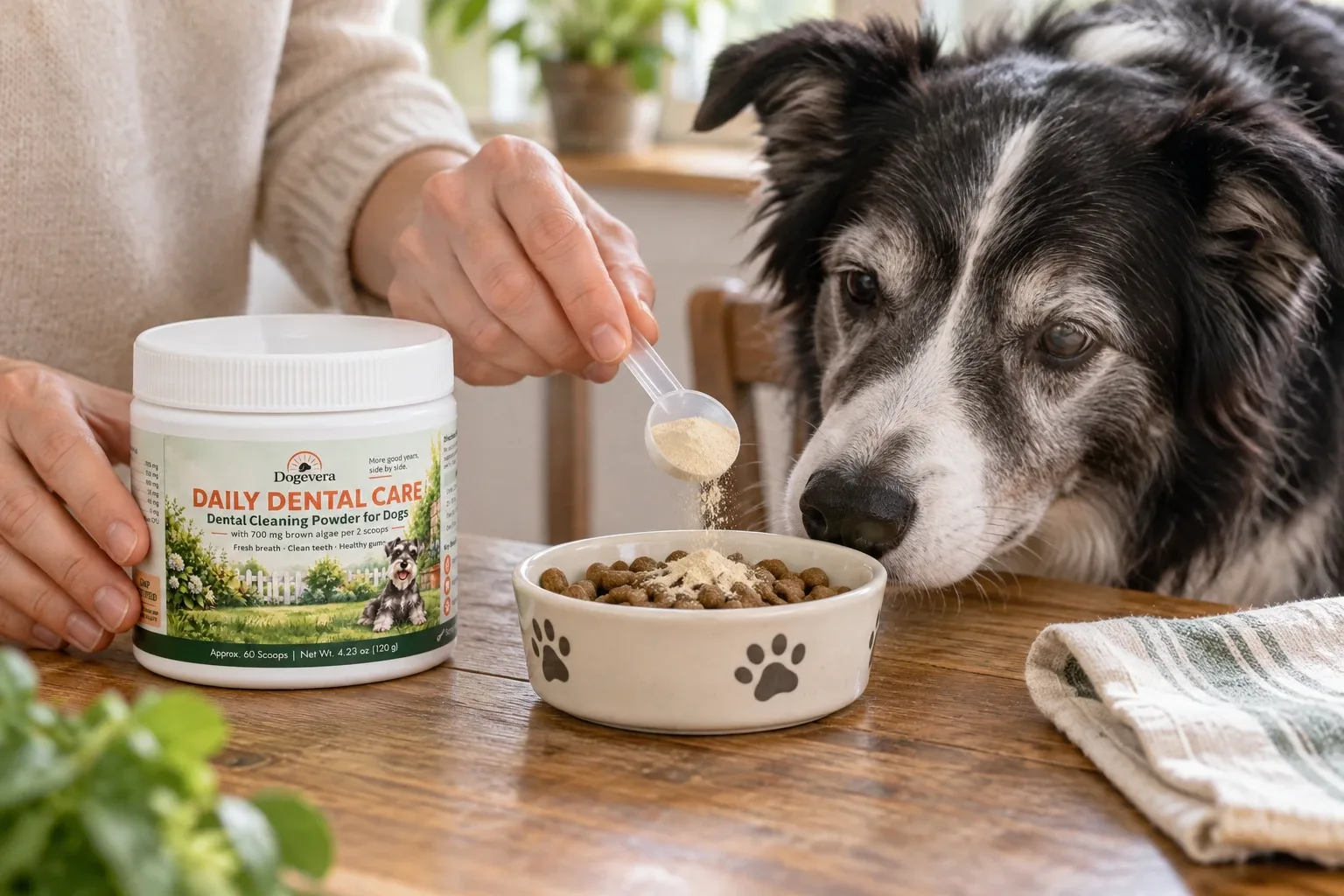
For our Daily Dental Cleaning Powder, one scoop is about 2 g, and the label amounts are:
- Under 25 lb: ½ to 1 scoop (1 to 2 g) a day
- 25 to 50 lb: 2 scoops (4 g) a day
- Over 50 to 75 lb: 3 scoops (6 g) a day
- Over 75 lb: 4 scoops (8 g) a day
For comparison, the 2021 trial of a seaweed powder (ProDen PlaqueOff) listed doses for dogs weighing 2 to 14.9 kg (about 4 to 33 lb): 0.5 to 1.5 scoops of 330 mg a day by weight, which worked out to 33.2 to 82.5 mg of product per kg. That is what one study used for one product, not a recommendation for any other.
Step 3: Start with half and build up
Our label advises starting at half the amount for your dog's weight and increasing to the full amount over 5 to 7 days. This gives your dog's stomach time to adjust and lets you spot any problem early.
Step 4: Mix it into something moist
Dental powders are taken with food, not brushed onto the teeth. Sprinkled on dry kibble, powder tends to settle at the bottom of the bowl. Mix it into:
- Wet food
- A spoonful of water or low-salt broth stirred into kibble
- Your dog's usual topper
Give it with one meal a day, at the same time, so it becomes part of the routine. If your dog leaves food behind, it is not getting the full amount.
Step 5: Keep doing the other things
A powder adds to good dental care. It does not replace it.
- Keep brushing if your dog allows it. In a 2019 randomized trial, daily brushing controlled plaque more than three times as well as a daily dental chew or a dental diet. No study shows a powder beating brushing.
- Keep vet checks. The AAHA dental guidelines consider an awake oral exam every 6 months appropriate.
Step 6: Track it properly
Tartar builds slowly, so short-term impressions are unreliable. The seaweed trials measured results at 30, 60 and 90 days. A simple way to track at home:
- Before you start, photograph the outside of the same upper back tooth in daylight. Lift the lip gently.
- Note how close you need to be before you notice your dog's breath.
- Repeat both every 30 days, on about the same day each month.
Comparing photos is far more reliable than memory. Bring them to your next vet visit.
Who should check with a vet first
- Dogs with thyroid disease or on thyroid medication. Seaweed and kelp contain iodine; the 2018 trial excluded dogs with raised thyroid hormone.
- Dogs with egg allergy, if the product contains lysozyme, as ours does.
- Dogs with painful mouths: dropping food, chewing on one side, pawing at the mouth.
- Dogs on a therapeutic diet or with chronic illness.
See dog dental powder side effects.
Multi-dog households
Measure separately for each dog by its own weight, and feed in separate bowls so each dog eats its own portion.
FAQ
Can I sprinkle dental powder on dry food?
You can, but much of it may end up at the bottom of the bowl. Mixing it into something moist is more reliable.
Should I give it morning or evening?
Either works. Consistency matters more than timing.
What if I miss a day?
Just carry on the next day. Do not double the amount.
How long until it works?
Expect to judge it over months. The trials measured at 30 to 90 days. Breath may change sooner, but tartar takes time to build or not build.
Can I use it with other dental products?
Generally yes. Use one new product at a time so you can tell what is working. See how to clean dog teeth without brushing.
References
- Gawor J, Jank M. Ascophyllum nodosum as a nutrient supporting oral health in dogs and cats: a review. Polish Journal of Veterinary Sciences. 2023. PMID: 37727971
- Gawor JP, Wilczak J, Svensson UK, Jank M. Influence of dietary supplementation with a powder containing A.N. ProDen (Ascophyllum nodosum) algae on dog saliva metabolome. Frontiers in Veterinary Science. 2021. PMID: 34239914
- Gawor J, Jank M, Jodkowska K, Klim E, Svensson UK. Effects of edible treats containing Ascophyllum nodosum on the oral health of dogs. Frontiers in Veterinary Science. 2018. PMID: 30109236
- Allan RM, Adams VJ, Johnston NW. Prospective randomised blinded clinical trial assessing effectiveness of three dental plaque control methods in dogs. Journal of Small Animal Practice. 2019. PMID: 30575038
- American Animal Hospital Association. 2019 AAHA Dental Care Guidelines: regular oral healthcare.
- VCA Animal Hospitals. Dental Disease in Dogs.
- Dogevera. Daily Dental Cleaning Powder for Dogs label.
For individual health questions, your veterinarian remains the best partner.