
We sell this powder. It was not the product tested in the studies discussed here.
TL;DR
A dog limping on a front leg is showing pain or weakness in that leg, the shoulder, the neck or the paw. Sudden front leg limps are most often a paw injury, a broken nail, a sprain or strain, or a fracture. Gradual limps in middle-aged and older dogs are most often elbow or shoulder arthritis, but a pinched nerve in the neck and bone cancer, which in a study of 744 dogs was found in a front leg in 64% of cases, are important causes not to miss. Check the paw first. Go to a vet the same day if your dog will not put any weight on the leg, the leg is swollen or at an odd angle, there is a wound, or your dog cries out. A milder limp that has not cleared up within a day or two also needs a vet visit.
Is it an emergency?
Go now (emergency or same-day vet) if your dog:
- will not put any weight on the leg at all
- holds the leg at an odd angle, or the leg looks deformed
- has a swollen leg, a deep wound, heavy bleeding or visible bone
- cries out or snaps when the leg is touched
- drags the paw or stands on the top of the foot (knuckling), which can mean a nerve or spinal problem
- is also weak, feverish, off food, or has pale gums or fast breathing
Book a vet visit within a day or two if your dog:
- is still limping after a day or two of rest; Cornell University's veterinary college advises not waiting longer than that
- has a limp that comes and goes, or keeps coming back
- limps on more than one leg, or the limp moves from leg to leg
Watch carefully at home for a day if your dog is putting some weight on the leg, the limp is mild and improving with rest, the leg is not swollen or sore to touch, and your dog is otherwise eating and acting normally.
How to tell which front leg is sore
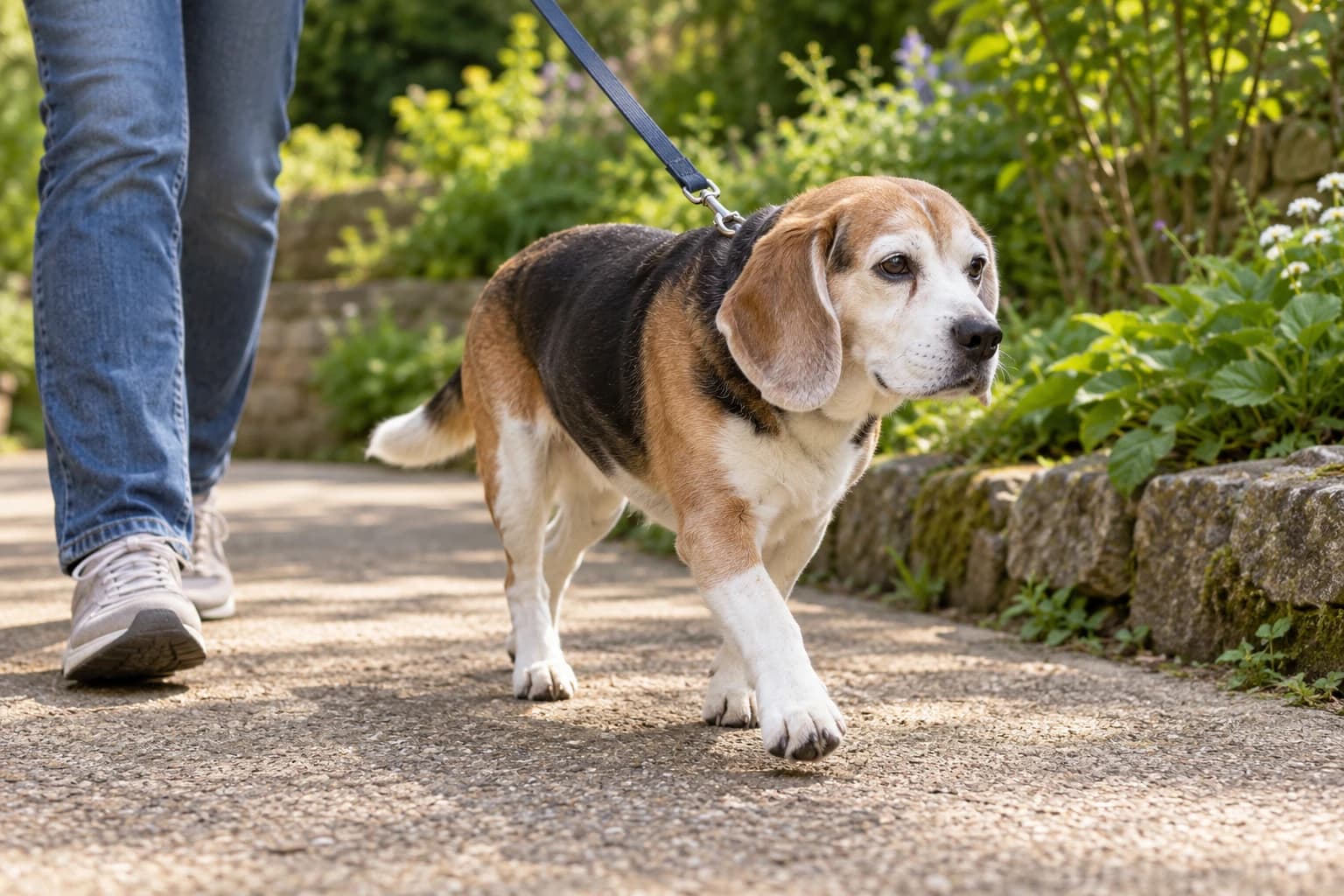
It is surprisingly easy to pick the wrong leg. The Merck Veterinary Manual describes a "head bob": when a dog steps onto a painful front leg, its head lifts to take weight off that leg, and the head drops when the sound leg lands. Vets say "down on sound".
- Walk your dog slowly toward you on a flat surface and watch the head.
- The head goes up as the sore leg lands and down as the good leg lands.
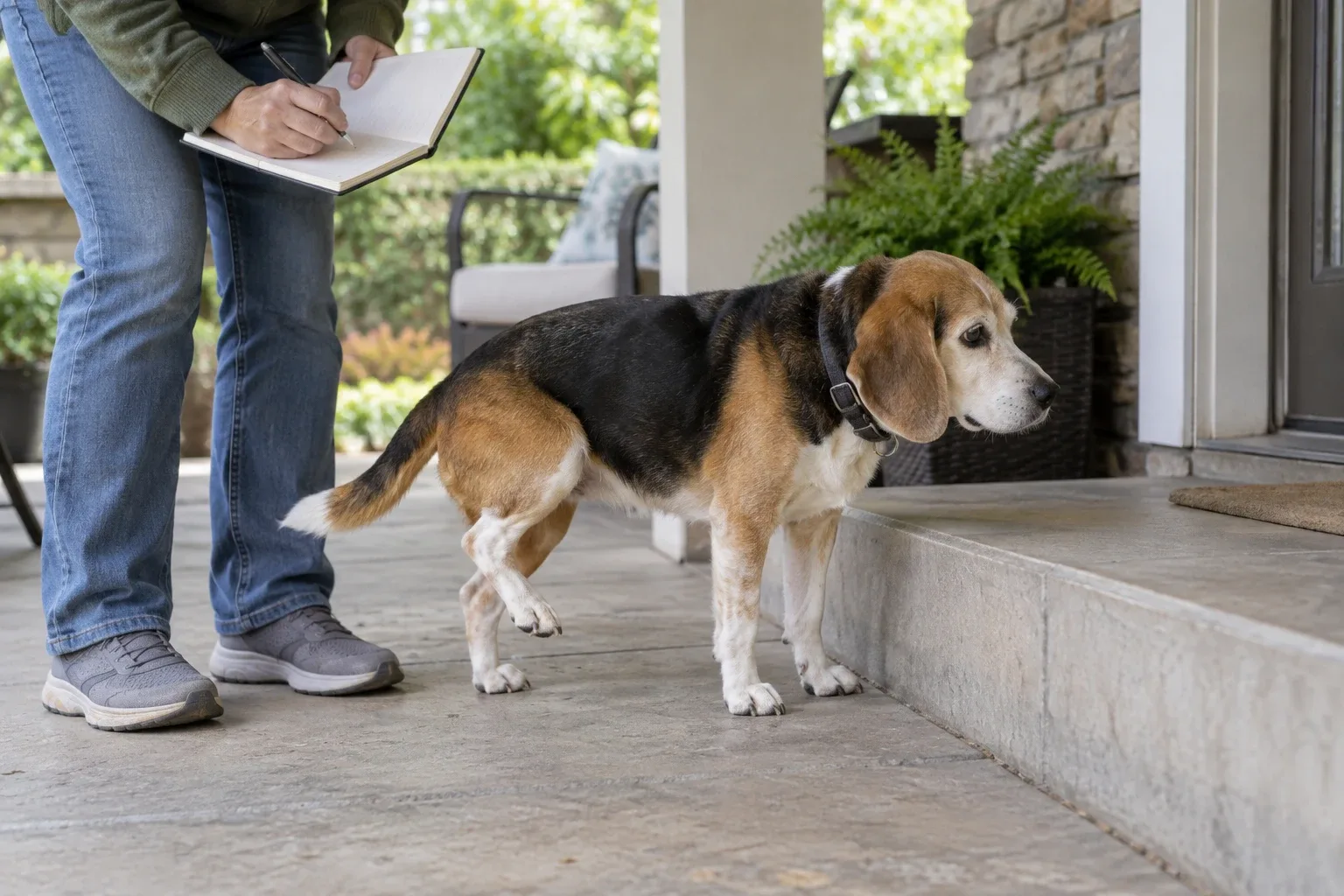
- Look at how your dog stands: Cornell notes dogs shift weight away from a painful limb.
- Film it. Cornell calls videos of the limp at home "extremely helpful".
Check the paw first
Many front leg limps start at the foot. In good light:
- Spread the toes and look between the pads for thorns, grass seeds, glass or cuts.
- Look at each nail, including the dew claw on the inner side of the leg, for cracks, tears or a nail growing into the pad.
- Feel for heat, swelling or a spot your dog pulls away from.
- Check for an insect sting or a tick.
Remove an obvious, shallow splinter or seed only if it comes out easily. Anything deep, a torn nail that is bleeding, or a swollen toe needs a vet.
Common causes of a front leg limp
Sudden limping
VCA Animal Hospitals lists the most common causes of sudden lameness as:
- broken nails
- soft-tissue injury (sprains and strains)
- joint injury
- bone fracture
- dislocation
Other sudden causes include a cut or something stuck in the paw, an insect sting, and a disc in the neck pressing on a nerve.
Gradual or on-and-off limping
VCA lists osteoarthritis, limb or spinal deformities, neurological disorders, chronic soft-tissue injury and cancer. For the front leg specifically:
- Elbow disease. In a UK study of 455,069 dogs under veterinary care, the most common elbow problems were osteoarthritis (76% of cases) and elbow dysplasia (31%), and the most common sign owners noticed was lameness. Rottweilers (6.2 times the odds of crossbreeds), Labrador Retrievers (5.9), German Shepherds (4.1) and Golden Retrievers (3.1) were most at risk, along with older, heavier and male dogs. Cornell notes that in mild elbow dysplasia, dogs may not limp until 7 or 8 years old, when arthritis sets in.
- Shoulder problems. Cornell lists shoulder arthritis and chronic soft-tissue injuries of the shoulder among front leg causes in older dogs.
- Neck problems. A disc pressing on a nerve root in the neck can cause a front leg limp with no injury to the leg itself, sometimes with the leg held up (a "root signature"). In a study of 47 dogs with this problem, three-quarters were 7 or older and Dachshunds were the most common breed. A review of neurological causes of front leg lameness also lists wobbler disease, nerve inflammation and nerve sheath tumors; these need MRI to diagnose.
- Bone cancer. In a study of 744 dogs with bone cancer of the limbs (osteosarcoma), most were diagnosed between 7 and 10 years old, 78% were large or giant breeds, 64% of tumors were in a front leg, and the upper arm bone (humerus) was the single most common site. Cornell warns that a persistent limp in an older large dog is not automatically arthritis. A firm swelling on the leg or a limp that keeps getting worse despite rest and pain relief needs X-rays.
- Tick-borne disease and joint inflammation. VCA describes Lyme disease as painful lameness that may shift from leg to leg, with swollen joints and fever. Limping with fever, tiredness or poor appetite needs a vet promptly.
Dog limping on a front leg with no pain or swelling
A limp without visible swelling or crying out is still a sign of pain or weakness; Cornell notes limping usually indicates pain or weakness and deserves veterinary attention. The 2022 AAHA pain management guidelines note that dogs shift weight off a painful limb when standing and walking, and that owner videos help vets assess a limp that comes and goes. A painless-looking limp can also be neurological: watch for knuckling, scuffing the nails or wearing them down unevenly.
Old dog limping on a back leg
Back leg limping in older dogs has its own common causes:
- Cruciate ligament disease. The knee ligament weakens gradually. VCA lists early signs as slight or intermittent limping, difficulty getting up, hesitating at stairs and sitting with the back legs to one side. A full tear can make a dog suddenly very lame and only toe-touching. Overweight dogs are at greater risk.
- Hip arthritis and hip dysplasia: stiffness after rest, reluctance to rise or climb stairs, and loss of muscle over the hips.
- Kneecap (patellar) luxation: in a study of 210,824 dogs in England, Pomeranians, Chihuahuas, Yorkshire Terriers and French Bulldogs had about 5 to 6.5 times the odds of crossbreeds. New diagnoses were less common in dogs aged 12 or older than in dogs under 3, so it usually shows up earlier in life.
- Spine problems: disc disease and lumbosacral disease can cause a back leg limp or weakness.
See also old dog weak back legs and senior dog sudden stiffness.
What to do while you wait for the vet
- Rest. Keep your dog quiet in one room with non-slip flooring. Use short lead walks for toileting only, and no stairs, jumping or play.
- Do not give human pain relievers. VCA warns many cause serious harm in dogs. Your vet can prescribe a dog-safe anti-inflammatory.
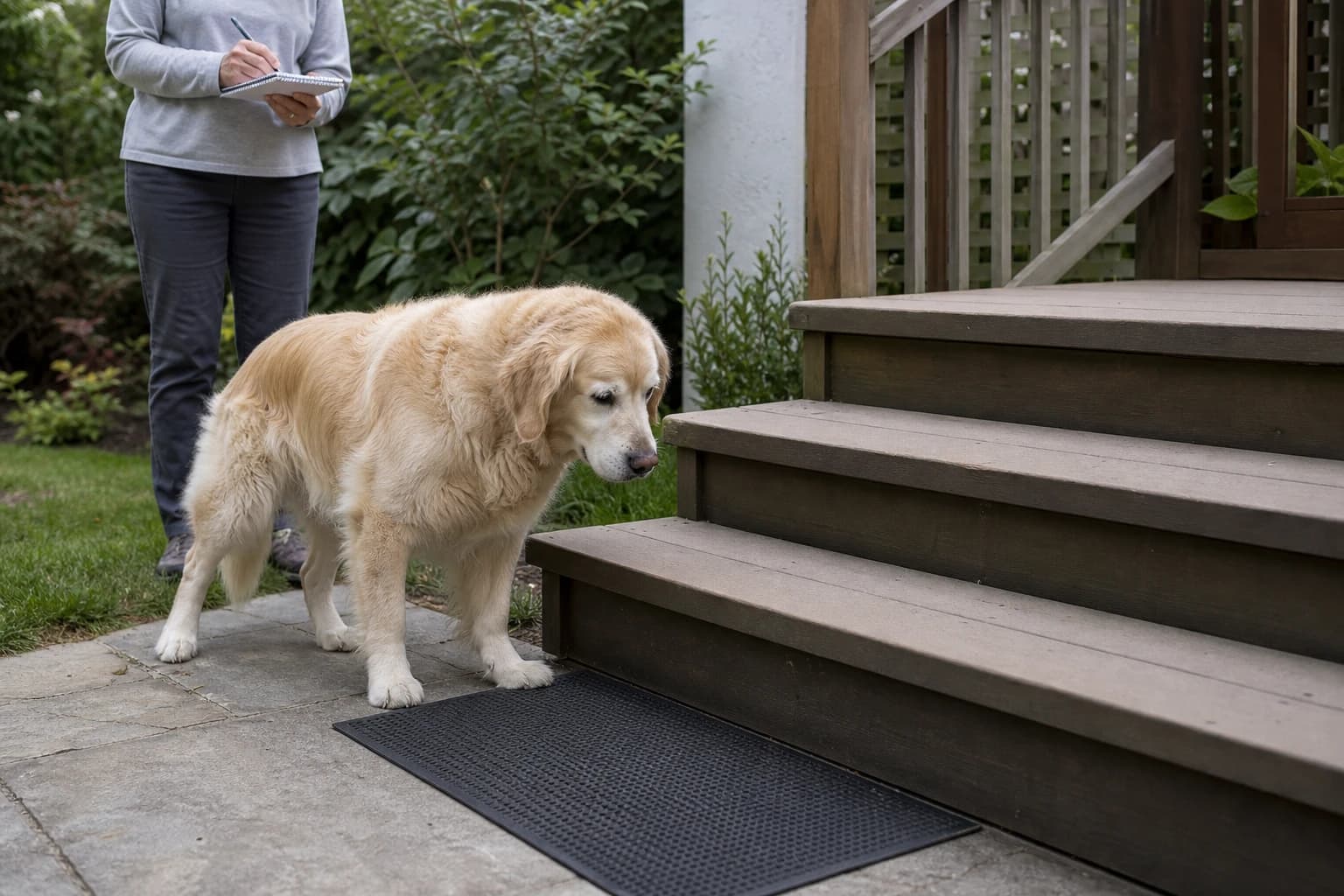
- Write down when the limp started, what your dog was doing, whether it is better or worse after rest, and whether it has moved between legs. Cornell lists these as the questions your vet will ask.
- Film your dog walking toward and away from you.
Can a dog's limp heal on its own?
Some limps from a minor knock or a sore paw settle with a short rest, but you cannot tell from home which ones will. Cornell advises not waiting if a limp has lasted more than a day or two. Arthritis, elbow disease, nerve problems and cancer do not go away with rest, and pain relief from a vet is part of treating them. If a limp clears up but returns after exercise, that pattern is useful to tell your vet.
What the vet will do
VCA describes:
- a history, and orthopedic and neurological exams
- X-rays, often with sedation, which can identify many conditions including fractures
- blood and urine tests, including tick-borne disease tests
- joint fluid analysis when infection or immune disease is possible
- ultrasound, CT or MRI for soft tissues, the neck and the spine
If no cause is found at first, VCA notes your vet may recommend anti-inflammatory medication with rest or restricted exercise, and a recheck.
Helping a dog with an arthritis limp
When the limp is arthritis, the best results come from combining treatments: pain relief from your vet, a lean body weight, controlled daily exercise, and joint support.
- Fish oil. In a 2010 trial, 82% of dogs with arthritis fed a high fish oil food put more weight on their worst leg after 90 days.
- Green-lipped mussel. In a 2006 trial, 67% of dogs given a green-lipped mussel extract had improved by day 56, against 41% on placebo. Our green-lipped mussel powder is a single-ingredient daily food topper.
- Home changes. Rugs on slippery floors, a ramp instead of jumping, and short, frequent walks.
See arthritis in dogs: treatment and home care and do dog joint supplements work?.
FAQ
Why is my dog limping on a front leg but not crying?
Not crying does not mean no pain. A quiet limp can still mean a sprain, a sore paw, elbow or shoulder arthritis, or a nerve problem in the neck. If it lasts more than a day or two, see a vet.
When should I take my dog to the vet for a limp?
Straight away if your dog will not bear weight, the leg is swollen or misshapen, there is a wound, or your dog cries out. Otherwise, if the limp has not cleared within a day or two.
How do I know if my dog sprained a front leg?
A sprain usually follows play, a jump or a slip, the dog still puts some weight on the leg, and it improves day by day with rest. Swelling, no weight-bearing or no improvement after a day or two need X-rays to rule out a fracture or ligament damage.
Why is my old dog suddenly limping?
Usually an injury, a ligament tear or a flare of arthritis. In older large dogs, bone cancer must also be ruled out. If your dog will not bear weight for more than a few hours, see a vet.
Should I walk my dog if it is limping?
Keep to short lead walks for toileting until your vet has examined the leg.
Can arthritis cause sudden limping?
Arthritis usually comes on gradually, so a sudden change deserves a check: an injury or ligament tear may be adding to it.
References
- VCA Animal Hospitals. Lameness in Dogs, Senior Dog Care, Cruciate Ligament Rupture in Dogs, Lyme Disease in Dogs, Degenerative Joint Disease in Dogs.
- Cornell University College of Veterinary Medicine. What to expect when taking your limping dog to the veterinarian, Elbow dysplasia, Osteosarcoma in dogs.
- Merck Veterinary Manual. The Lameness Examination in Small Animals.
- O'Neill DG, et al. Epidemiology and clinical management of elbow joint disease in dogs under primary veterinary care in the UK. Canine Medicine and Genetics. 2020. PMID: 32835227
- Tuohy JL, et al. Demographic characteristics, site and phylogenetic distribution of dogs with appendicular osteosarcoma: 744 dogs (2000-2015). PLoS One. 2019. PMID: 31887114
- O'Neill DG, et al. The epidemiology of patellar luxation in dogs attending primary-care veterinary practices in England. Canine Genetics and Epidemiology. 2016. PMID: 27280025
- Schachar J, et al. Clinical and imaging findings in dogs with nerve root signature associated with cervical intervertebral disc herniation. Journal of Veterinary Internal Medicine. 2024. PMID: 38216520
- Kerwin SC, Taylor AR. Neurologic causes of thoracic limb lameness. Veterinary Clinics of North America: Small Animal Practice. 2021. PMID: 33558012
- American Animal Hospital Association. 2022 Pain Management Guidelines: chronic pain assessment in dogs.
- Roush JK, et al. Evaluation of the effects of dietary supplementation with fish oil omega-3 fatty acids on weight bearing in dogs with osteoarthritis. Journal of the American Veterinary Medical Association. 2010. PMID: 20043801
- Pollard B, et al. Clinical efficacy and tolerance of an extract of green-lipped mussel in dogs presumptively diagnosed with degenerative joint disease. New Zealand Veterinary Journal. 2006. PMID: 16751841
For individual health questions, your veterinarian remains the best partner.