
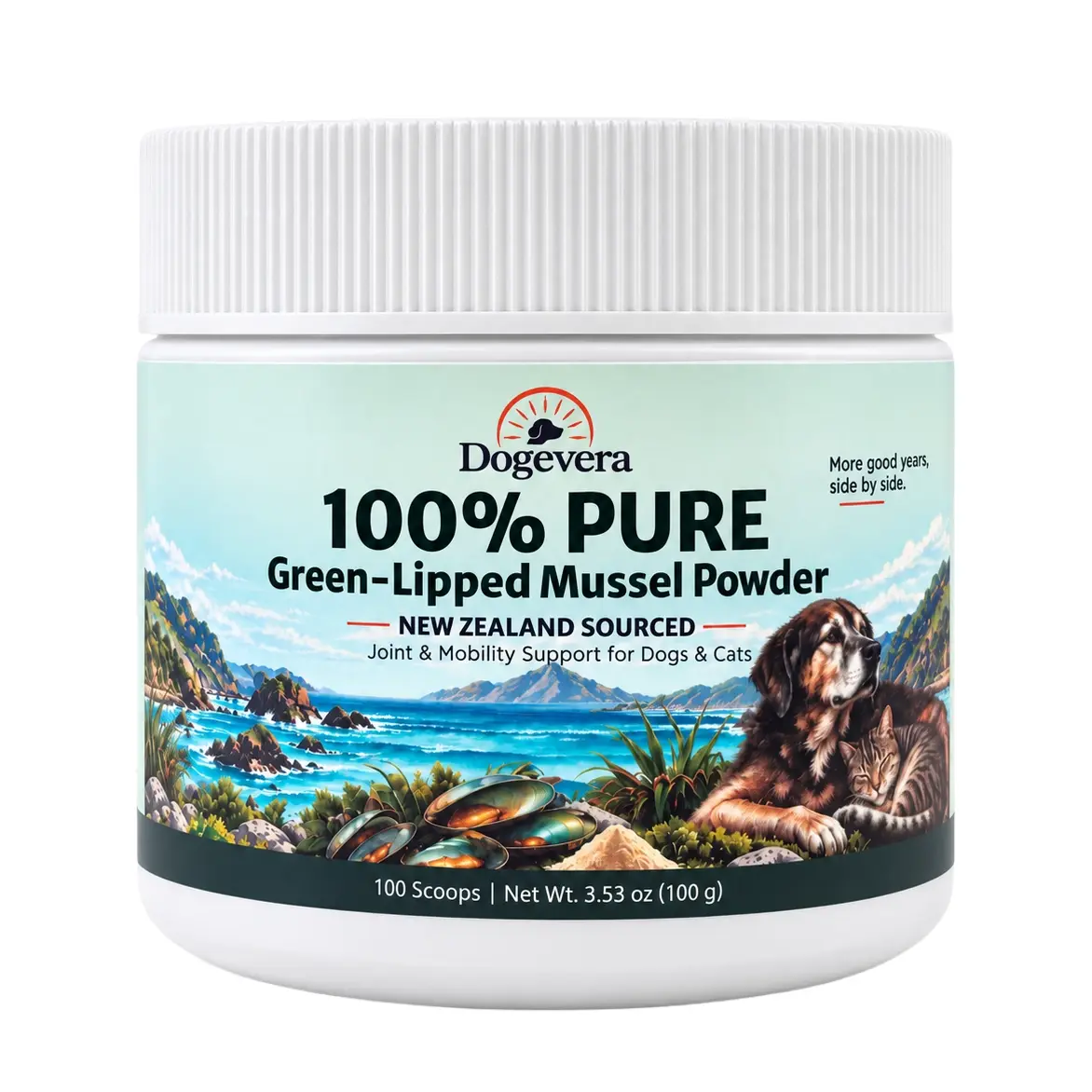
What we sell
Green Lipped Mussel Powder for Dogs - Dogevera, 100% New Zealand Green Lipped Mussel, Hip & Joint Support, 100g$29.99
We sell this powder. It was not the product tested in the studies discussed here.
TL;DR
Glucosamine, chondroitin and MSM appear alone or combined in dog joint supplements. An ingredient list does not establish that a product relieves arthritis pain. Compare the exact ingredient form, the amount per labeled serving, the complete formula and the canine evidence for that preparation. Green-lipped mussel is also shellfish; it is not a shellfish-free alternative for a dog with a known shellfish allergy.
What Are Glucosamine, Chondroitin and MSM?
Glucosamine is an amino sugar; chondroitin sulfate is a cartilage-associated compound; MSM is short for methylsulfonylmethane, an organic sulfur compound. These names identify different ingredients, not interchangeable amounts of one active substance. They are sold alone and in combinations for joint support, but that purpose on a label is separate from evidence of a clinical benefit.
Sources can differ between products. A label may identify shellfish-derived or fermentation-derived glucosamine, animal-source chondroitin, or a manufactured MSM ingredient. Ask the manufacturer to confirm the actual source and allergen controls when this matters for your dog; do not infer them from the ingredient name or the word marine.
Chemical Forms and Label Disclosure
Glucosamine labels may name hydrochloride (HCl) or sulfate. Record the stated form and whether the declared amount refers to the salt or another stated basis. Do not make a home substitution or calculate an equivalent dose from the chemical name alone: formulations and declaration conventions can differ. Ask the manufacturer to clarify the basis before comparing unlike numbers.
For chondroitin, record whether the label specifies chondroitin sulfate and the amount per serving. For MSM, look for methylsulfonylmethane or dimethyl sulfone and the declared amount. If the form or quantity is not available, mark it as unknown rather than assuming a value or treating the brand as proof of disclosure.
Proprietary blends that group these ingredients under a single total without individual amounts make comparison impossible. For example, a label that reports only a combined blend weight does not tell you how much chondroitin, glucosamine or MSM is in the serving. This is a disclosure problem, not evidence that a larger number would necessarily work better.
Research on Individual Ingredients vs Finished Products
A small study in working dogs with hip osteoarthritis compared a glucosamine HCl, chondroitin sulfate and hyaluronic acid product with carprofen. Some individual scores improved, but the study did not demonstrate an overall group-level benefit. It did not test MSM or establish that another combination would perform similarly.
A systematic review and meta-analysis published in 2022 found no convincing analgesic benefit for the chondroitin-glucosamine nutraceutical category it assessed. It does not establish the response to every future formula or answer the evidence question for MSM alone. Treat ingredient popularity, laboratory reasoning and clinical outcomes as different kinds of information.
The working-dog trial tested a specific finished product. Research on glucosamine alone, chondroitin alone or MSM alone does not predict how a three-ingredient combination will perform, because the dose of each component, the ratios between them, the carrier ingredients and the study population all differ. When evaluating a supplement, ask whether the exact formulation in the bottle has been studied, not just whether its ingredients have research behind them individually.
Comparing Products: A Practical Checklist
Use this list when comparing joint supplements:
- Chemical form: Does the label specify glucosamine HCl or sulfate, chondroitin sulfate, and MSM by full name?
- Declared amounts: Are milligram quantities given for each active ingredient individually, not hidden in a blend?
- Serving directions: Does the label provide weight-based serving instructions, and do those instructions match your dog's weight?
- Carrier ingredients: What else is in the product, added flavors, binders, oils? Check for ingredients your dog cannot tolerate.
- Finished-product evidence: Has this exact combination been studied in dogs, or are you relying on research from separate ingredients?
- Daily cost: Calculate the cost per day based on your dog's actual serving size, not the package price alone.
If you are considering glucosamine supplements for senior dogs, apply the same checklist to glucosamine-only products before deciding whether a combination formula serves your dog better.
Powder, Tablets or Liquid
Joint supplements come in multiple formats, and each has practical trade-offs beyond the active ingredients. Powders can be mixed with food when the label permits, but use the specified measure and check whether your dog finishes the meal. Tablets and soft chews may be convenient if your dog takes them willingly; include the chew base, calories and allergens in the comparison. Liquids need their own measuring device and storage directions. No format automatically guarantees an exact consumed serving.
Read more about practical format differences in dog joint supplements: powder vs tablets vs liquid.
Overlap With Other Supplements or Diets
If your dog already takes another supplement or eats a diet labeled for joint support, check whether you are duplicating ingredients. Some senior dog foods include glucosamine and chondroitin in declared amounts. Adding a standalone supplement on top of that food may push the total higher than you intended, or it may still leave you uncertain about the combined effect because you are mixing two different formulations.
Write down every ingredient your dog receives from food, treats and supplements before adding a new product. If you see glucosamine listed twice, note the form and amount from each source. This prevents accidental overlap and helps you judge whether the new product offers something the current routine does not.
When to Seek Veterinary Guidance
These products are marketed for joint support; that wording does not demonstrate relief of disease-related pain or replace veterinary treatment. If your dog shows sudden limping, persistent difficulty rising, swelling around a joint, or pain when you touch a specific area, arrange a veterinary examination rather than starting a supplement on your own. New or worsening mobility changes need an individual assessment, not a product from a shelf.
If your veterinarian considers a supplement appropriate, discuss it as a possible addition to the current care plan. Bring the full label, ingredient amounts, current medicines and diet; do not replace prescribed treatment with a supplement trial. The AAHA pain-management guidance emphasizes coordinated care and reassessment rather than reliance on one approach.
FAQ
Do glucosamine, chondroitin and MSM have to be taken together? No. A product does not become necessary or more effective simply because all three names appear together. The relevant question is what the evidence shows for the exact preparation and intended outcome. Evidence for one combination cannot establish the benefit of another.
How long before I see a difference? Do not use a fixed waiting period to postpone care for limping, difficulty rising or worsening comfort. If a product is included in the care plan, agree on what to monitor and when to review it. Record ordinary movements without forcing painful activity; a change in one dog does not identify which part of a combined plan caused it.
Can I compare milligram amounts directly between glucosamine HCl and glucosamine sulfate? Not from the ingredient names alone. Record the form, the amount, the label's declaration basis and the serving directions, then ask the manufacturer about unclear figures. Do not use a molecular-weight calculation to substitute one product's serving for another.
Is there a difference between marine-source and shellfish-source glucosamine? Marine is a broad source description, not a shellfish-free statement. Confirm the actual organism and the manufacturer's allergen information. Green-lipped mussel is itself a shellfish, so mussel powder is not an appropriate suggestion for avoiding a known shellfish allergy. Discuss a suitable alternative with the treating veterinarian rather than substituting another marine ingredient.
What if the product does not list chondroitin or MSM amounts? Ask for the missing information and leave the quantity marked unknown if it is not provided. Prefer a product whose labeled amounts can be checked, while remembering that clear disclosure alone is not proof of clinical effectiveness.
References
- Alves, Santos and Jorge: Effect of an Oral Joint Supplement When Compared to Carprofen in the Management of Hip Osteoarthritis in Working Dogs. PMID 29525231; DOI 10.1053/j.tcam.2017.10.003. A study of a particular preparation and working-dog population.
- Barbeau-Grégoire and colleagues: 2022 systematic review and meta-analysis of enriched diets and nutraceuticals in canine and feline osteoarthritis. The chondroitin-glucosamine category is relevant here; this is not a trial of Dogevera or MSM alone.
- AAHA: Acute vs. Chronic Pain. Guidance on multimodal care and reassessment.
For individual health questions, your veterinarian remains the best partner.