
We sell this powder. It was not the product tested in the studies discussed here.
TL;DR
Dog stairs or a ramp for the bed let a dog get up and down without the jump, which matters most for senior dogs, dogs with arthritis or back problems, dogs recovering from surgery and small dogs facing a tall mattress. Stairs are compact and suit agile dogs; a ramp is easier for dogs with stiff joints, because walking down a slope needs less joint bending than stepping down stairs. Measure your bed, pick a step height or slope your dog can manage without hopping, insist on grip and stability, and spend a few days teaching your dog to use it.
Which dogs need stairs or a ramp for the bed?
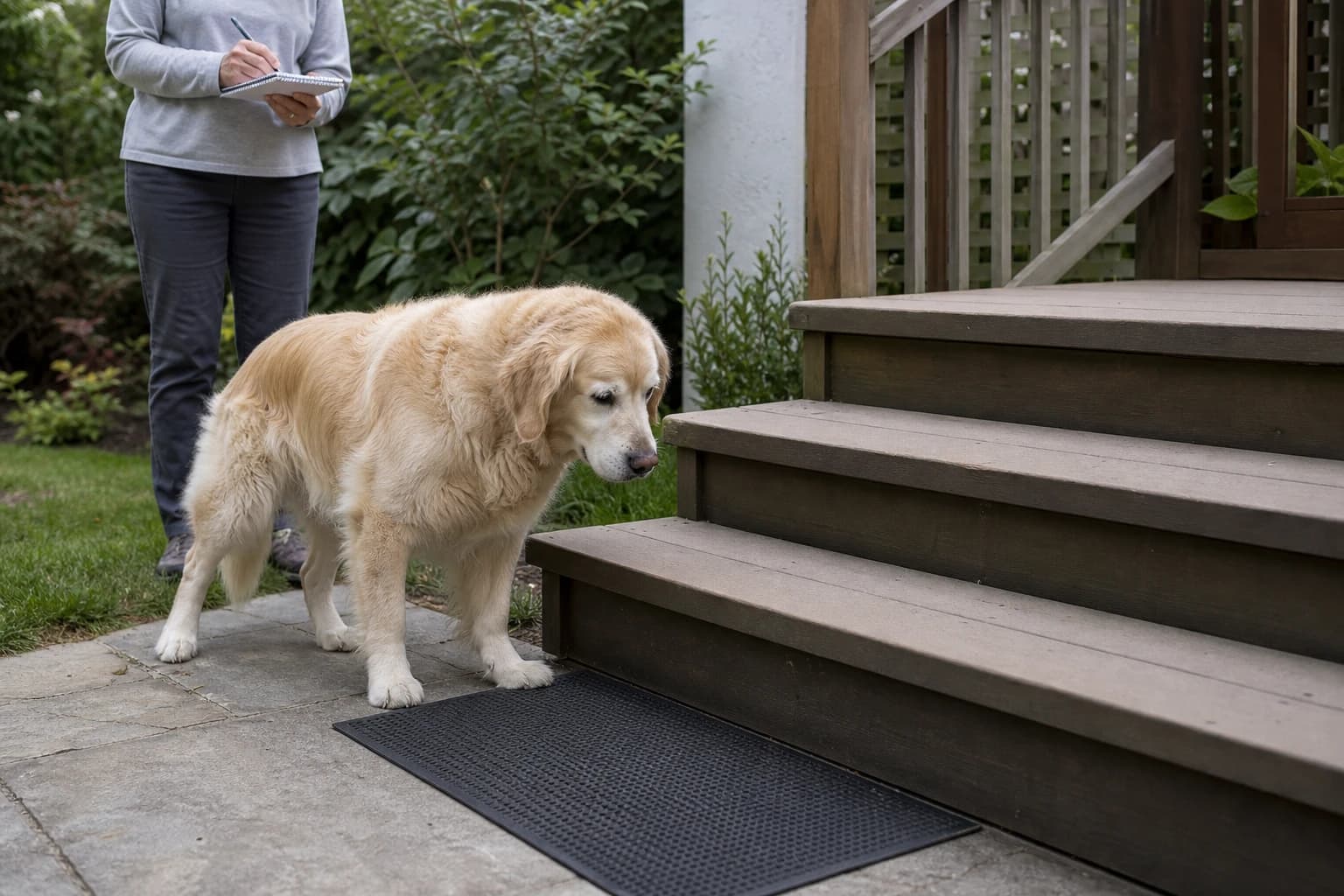
Jumping down is the hard part. In a study of 15 healthy dogs jumping down from platforms 55, 65 and 75 cm high (about 22 to 30 inches, the height of car boot sills), the peak force through the front legs rose with every step up in height, from about 2.8 to 3.5 times body weight. For a healthy dog this is normal loading; for a dog with sore elbows, shoulders or a bad back, it is a jolt several times a day.
Dogs that benefit most:
- Senior dogs and dogs with arthritis. The 2023 AAHA senior care guidelines include ramps and better footing among home changes for older dogs with mobility problems, and VCA advises giving older dogs that like the couch or bed a ramp or stairs to get there.
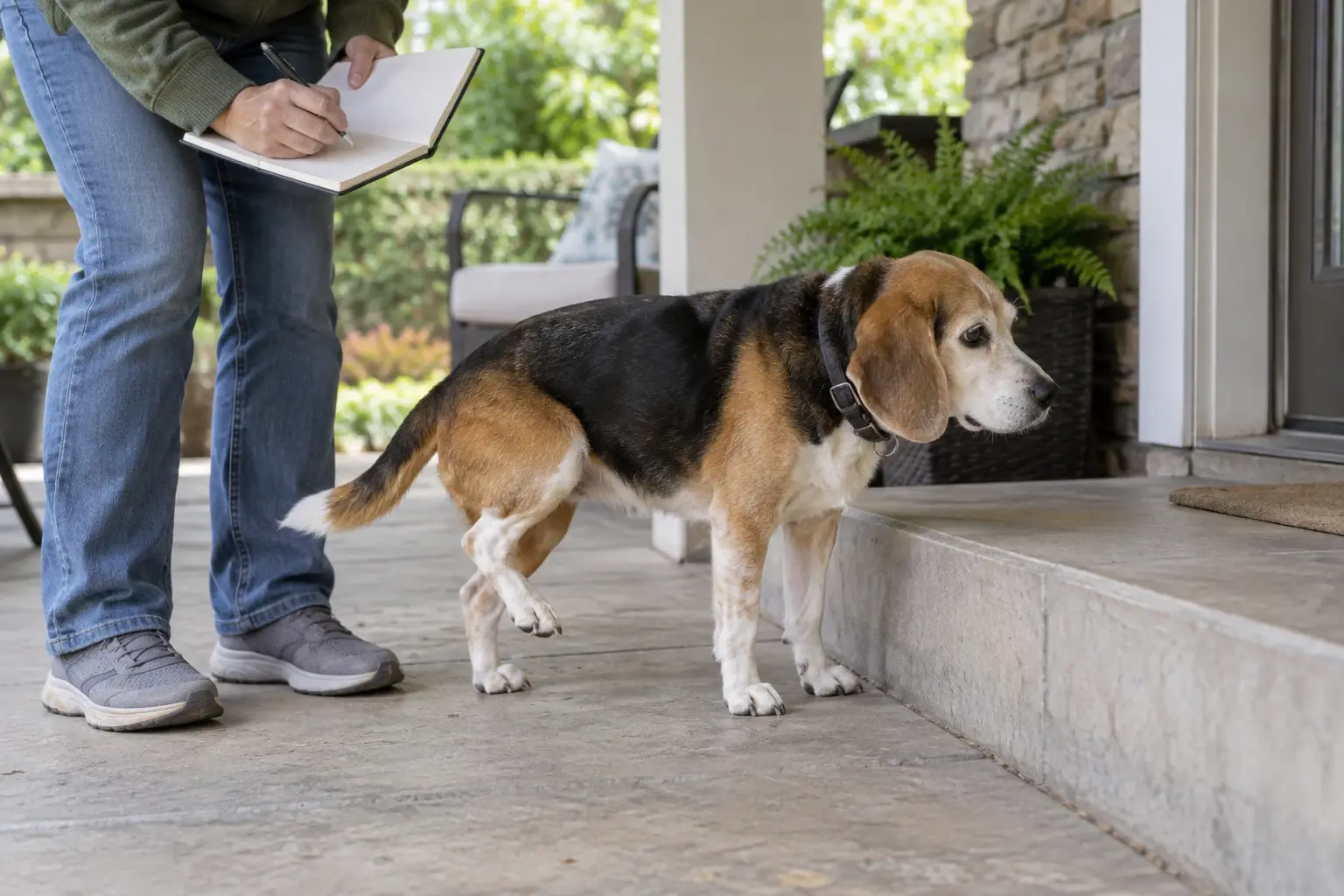
- Dogs with back disease, or high-risk breeds that already had an episode. VCA notes that a disc rupture can follow a minor fall or a small jump when the discs are already degenerating, and lists Dachshunds, Beagles, French Bulldogs and Cocker Spaniels among high-risk breeds.
- Dogs recovering from surgery. Follow your vet's activity plan; after hip surgery, for example, the American College of Veterinary Surgeons advises avoiding stairs during healing, so ask whether a ramp is allowed.
- Small dogs and tall beds. A Chihuahua facing a high mattress is jumping several times its own height.
- Any dog that hesitates, circles or asks to be lifted before jumping. Hesitation is one of the early signs of joint pain listed in the AAHA pain guidelines.
What about healthy young dogs? Stopping them from jumping on furniture has not been shown to prevent back problems. In a survey of 2,031 Dachshunds, dogs that were not allowed to jump on furniture actually had higher odds of disc disease, and in 43,517 US dogs in the Dog Aging Project, regular use of a staircase went with lower odds; both studies show associations, not cause and effect. For a fit young dog, stairs are a convenience. For a dog with pain or a weak back, they are a real help.
Dog stairs or a ramp?
In a study of 7 healthy dogs, walking down stairs made the hip, knee and ankle bend through a significantly bigger range than walking down a ramp of the same slope. The researchers concluded that stair descent can be useful rehab exercise, while ramp descent may be easier for dogs with limited joint motion. A second study found walking down stairs also increased shoulder and elbow motion compared with flat ground.
In practice:
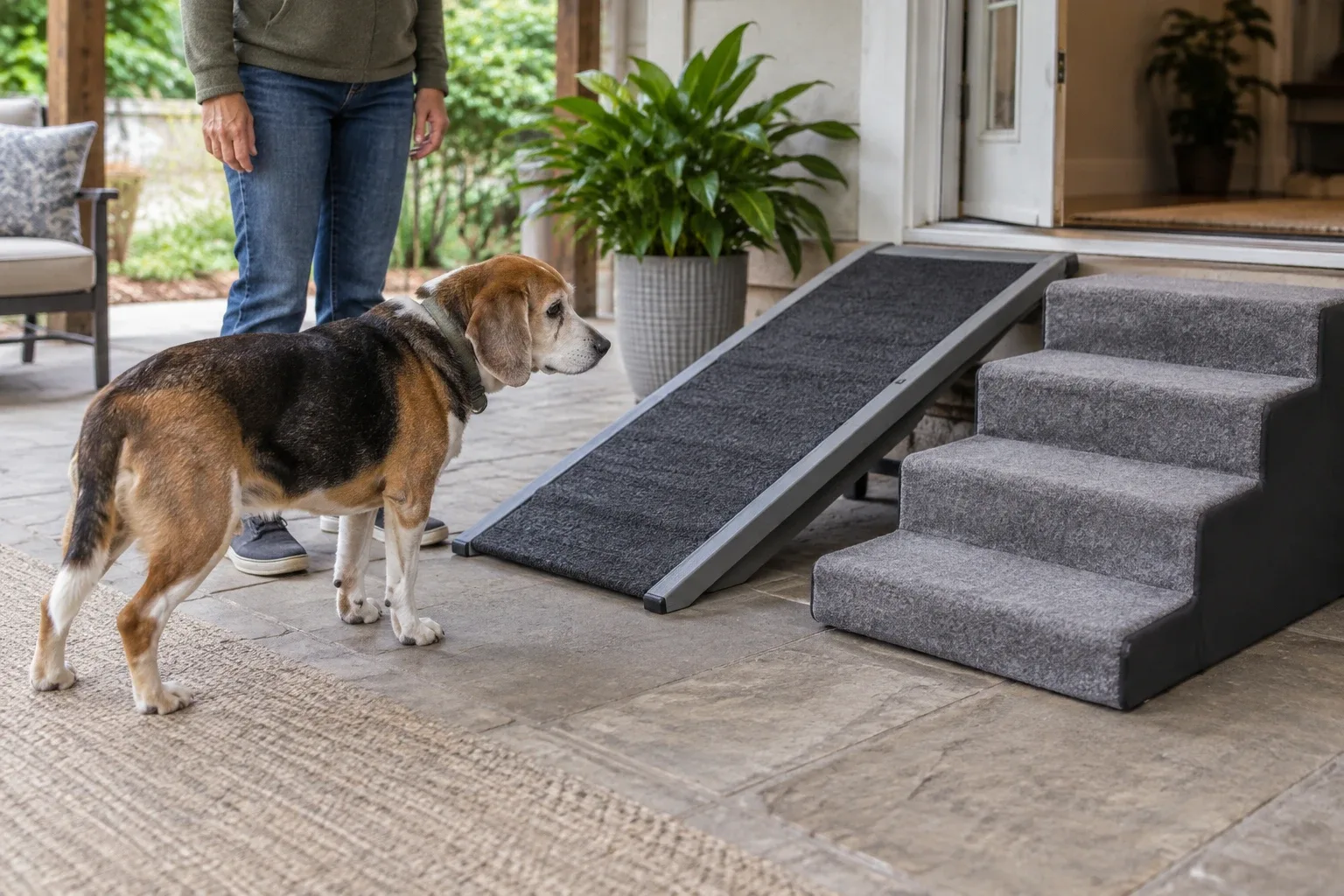
- Choose stairs for agile small dogs, dogs with healthy joints, and rooms with little floor space. Stairs reach a tall bed in a much shorter footprint.
- Choose a ramp for dogs with arthritis, weak back legs, back disease, poor eyesight or after surgery (with your vet's OK). A ramp needs more floor space, and a steep one is harder than stairs: animal physiotherapist Laurie Edge-Hughes points out that dogs often refuse a ramp that is too steep, or jump off it.
- Stair-ramp combinations and foam steps with a curved profile sit in between and can suit small seniors.
How to choose dog stairs for your bed
- Measure the bed from the floor to the top of the mattress, where your dog actually lands.
- Check the total height of the stairs. The top step should be at or just below the mattress. Many pet stairs are made for sofas and are too short for a bed; a set that stops well short still leaves a jump.
- Check the rise of each step. Divide the bed height by the step height to see how many steps you need: a 24-inch bed with 6-inch steps needs 4 steps. Choose a rise your dog can step up without hopping; lower rises suit toy breeds and seniors.
- Tread depth and width. Your dog should be able to stand with all four feet on a step, or at least both front feet and pause. Large dogs need extra-wide steps, because a narrow set can tip if the dog comes down at an angle.
- Grip. Carpet, rubber or a textured fabric cover on every step, and non-slip feet underneath, especially on wood, laminate or tile.
- Stability and weight rating. The stairs must not shift or flex when your dog steps on the edge. Choose a weight rating well above your dog's weight.
- Material. Plastic with carpet treads is light and sturdy; high-density foam is soft on sore joints but can slide on slick floors; wood is solid and attractive but needs a non-slip cover; metal folds for travel. A removable, washable cover is worth paying for.
- Footprint. Mark the stairs' size on the floor with tape before buying, and keep the bottom step clear of rugs that can slide.
How to choose a dog ramp for the bed
- Work out the slope. Ramp length = bed height ÷ the sine of the angle. As a guide:
- 18-inch bed: about 53 inches long at 20°, 43 inches at 25°, 36 inches at 30°
- 24-inch bed: about 70 inches at 20°, 57 inches at 25°, 48 inches at 30°
- 30-inch bed: about 88 inches at 20°, 71 inches at 25°, 60 inches at 30°
There is no veterinary standard for a dog ramp angle; the gentler the slope, the easier for a stiff dog, so buy the longest ramp your room allows.
- Width: wide enough for your dog to walk with all four feet without stepping off.
- Surface: carpet, rubber or another non-slip cover along the full length. A slippery ramp is the most common reason dogs refuse one.
- Side edges: raised rails or lips, so a paw cannot slip off the side. VCA stresses that a ramp must be built so the dog cannot fall over the side.
- Stability: the top should rest firmly on the bed frame or mattress and the base should not slide; rubber feet help on hard floors.
- Top landing: a flat platform at the top makes the step onto a soft mattress easier.
- Weight rating above your dog's weight; for large dogs, look for a heavier frame and wider walkway.
If a ramp long enough for a gentle slope will not fit, a lower bed, a sturdy bench at the foot of the bed, or an orthopedic dog bed on the floor beside yours may work better. See how to choose a dog bed for senior dogs.
DIY dog ramp or stairs for the bed
A homemade ramp works if it is solid, covered in non-slip carpet or rubber matting along its whole length, has raised side edges, and is fixed so it cannot slide or tip. Test it by pressing hard on the top, middle and edges before your dog uses it. Sturdy furniture, such as a low bench or storage ottoman, can act as one big step for a medium dog.
How to train your dog to use dog stairs or a ramp
VCA notes that most dogs learn quickly but advises taking time to help them get comfortable. Use treats and keep sessions short:
- Start flat. Lay the ramp on the floor, or set the stairs in the middle of the room, and reward your dog for stepping on.
- One step at a time. Lure your dog up the first step or a short way up the ramp, reward, and let them step off. Build up over several sessions.
- Move it to the bed. Guide with a treat, with a hand on a harness at first, never pushing or pulling.
- Practice coming down, which most dogs find harder. Go slowly and reward at the bottom.
- Make it the only way. Block other ways up so the stairs or ramp become the habit, and invite your dog up only via the stairs.
Why won't my dog use the stairs or ramp?
- It slips or wobbles. Add grip, fix it in place, check it does not shift.
- The steps are too high or the ramp too steep. Lower rises or a longer ramp solve this.
- It stops short of the mattress, leaving an awkward last hop.
- Pain. A dog that used to manage and now refuses may be sore; a vet check is worth it.
- Fear of the new thing. Go back to the flat stage and build up slowly.
Make the bedroom safer too
- Non-slip rugs at the bottom of the stairs or ramp
- Nails trimmed short for grip; VCA says most dogs need a trim at least once a month
- Fur between the toes trimmed
- A night light for dogs with poor eyesight
See senior dog struggling with stairs and senior dog back leg weakness.
Joint care beyond the stairs
Stairs and ramps take the impact out of the day; daily joint care helps keep a dog moving. Our green-lipped mussel powder mixes into food once a day. In a 2002 study, 83% of dogs with arthritis given mussel powder on their food improved their total arthritis score by 30% or more within 6 weeks, against 7% without it.
FAQ
Are dog stairs or ramps better for older dogs?
For an older dog with stiff joints, a ramp with a gentle slope is usually easier, because walking down a slope needs less joint bending than stepping down stairs. An agile senior with healthy joints can manage stairs.
What size dog stairs do I need for my bed?
Measure from the floor to the top of the mattress. The stairs should reach that height or just below it, with a step height your dog can manage without hopping and treads deep enough to stand on.
How long should a dog ramp for a bed be?
Divide the bed height by the sine of the slope angle. For a 24-inch bed, that is about 57 inches at 25° and 70 inches at 20°. Longer means gentler.
Do dog stairs work for large dogs?
Yes, if they are extra wide, rated well above your dog's weight and stable on the floor. Many large dogs do better with a long ramp or a lower bed.
Is it bad for dogs to jump off the bed?
For a healthy young dog, occasional jumping is normal. For a dog with arthritis, back disease, recent surgery or a small dog facing a tall bed, the landing puts several times body weight through the front legs, so stairs or a ramp make sense.
Can I use dog stairs for the car?
Most bed stairs are not designed for vehicles. For a car or SUV, use a ramp or steps made for cars, with a non-slip surface and a secure top.
References
- Pardey D, et al. Peak forelimb ground reaction forces experienced by dogs jumping from a simulated car boot. Veterinary Record. 2018. PMID: 29622683
- Millard RP, Headrick JF, Millis DL. Kinematic analysis of the pelvic limbs of healthy dogs during stair and decline slope walking. Journal of Small Animal Practice. 2010. PMID: 20630021
- Kopec NL, Williams JM, Tabor GF. Kinematic analysis of the thoracic limb of healthy dogs during descending stair and ramp exercises. American Journal of Veterinary Research. 2018. PMID: 29287160
- Packer RM, et al. DachsLife 2015: an investigation of lifestyle associations with the risk of intervertebral disc disease in Dachshunds. Canine Genetics and Epidemiology. 2016. PMID: 27826450
- Wee C, Nin DZ. Demographic and lifestyle characteristics impact lifetime prevalence of owner-reported intervertebral disc disease: 43,517 companion dogs in the United States. Journal of the American Veterinary Medical Association. 2025. PMID: 39813820
- American Animal Hospital Association. 2023 Senior Care Guidelines: pain management; 2022 Pain Management Guidelines: chronic pain assessment in dogs.
- VCA Animal Hospitals. Senior Dog Care, Creating a Comfortable Home for Your Mobility Compromised Dog, Degenerative Disc Disease in Dogs.
- American College of Veterinary Surgeons. Canine Hip Dysplasia.
- Edge-Hughes L. Ramps or Stairs. Canine Fitness Centre. 2020.
- Bierer TL, Bui LM. Improvement of arthritic signs in dogs fed green-lipped mussel. Journal of Nutrition. 2002.
For individual health questions, your veterinarian remains the best partner.