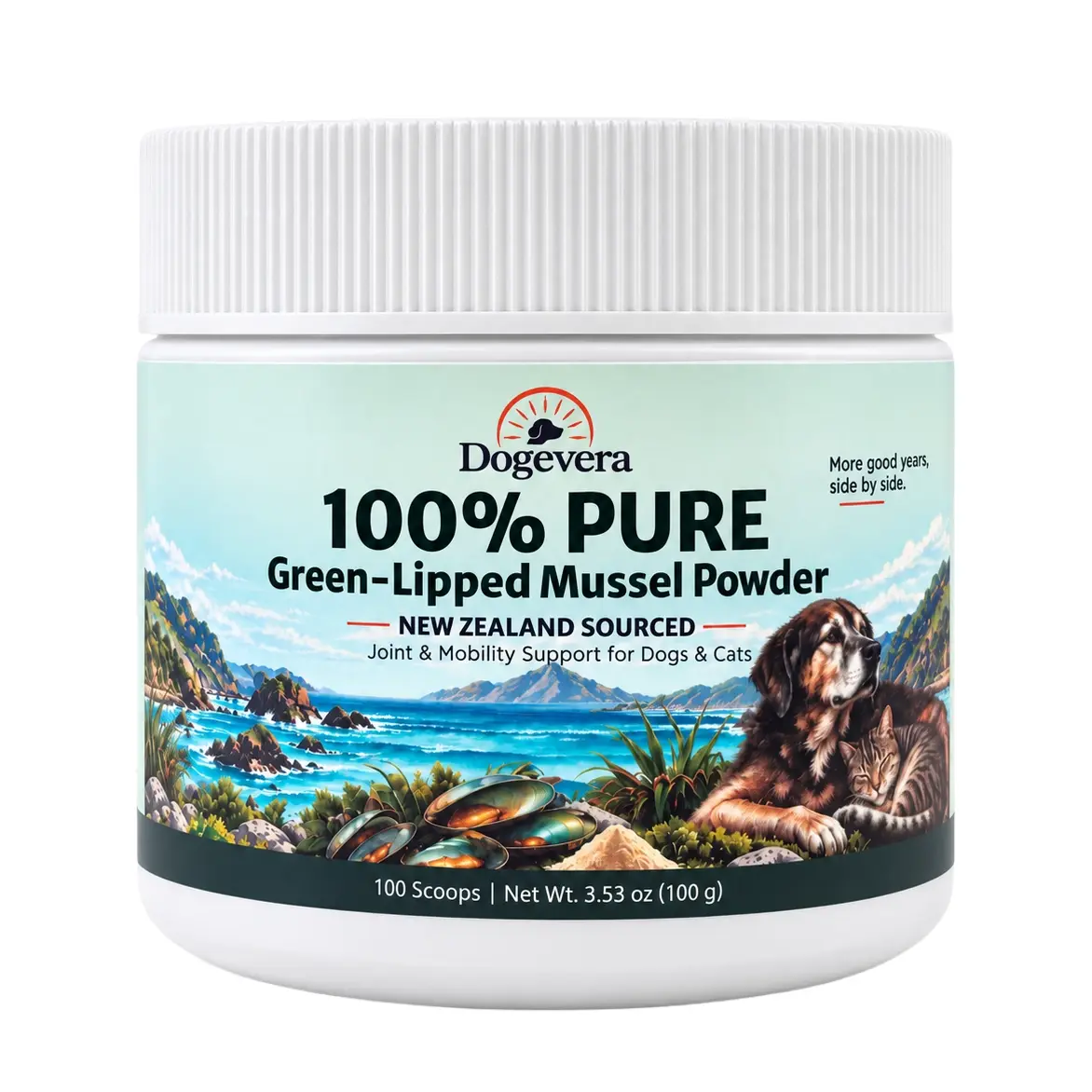
We sell this powder. It was not the product tested in the studies discussed here.
TL;DR
For hip dysplasia in older dogs, support products should make daily movement easier and more predictable while fitting the care plan already in place. Compare a ramp or harness by fit and control, improve footing, measure food portions consistently, and choose supplements only when the label clearly states ingredients, amounts and claims. These products do not diagnose hip dysplasia or correct joint anatomy.
Start with the daily problem, not the product
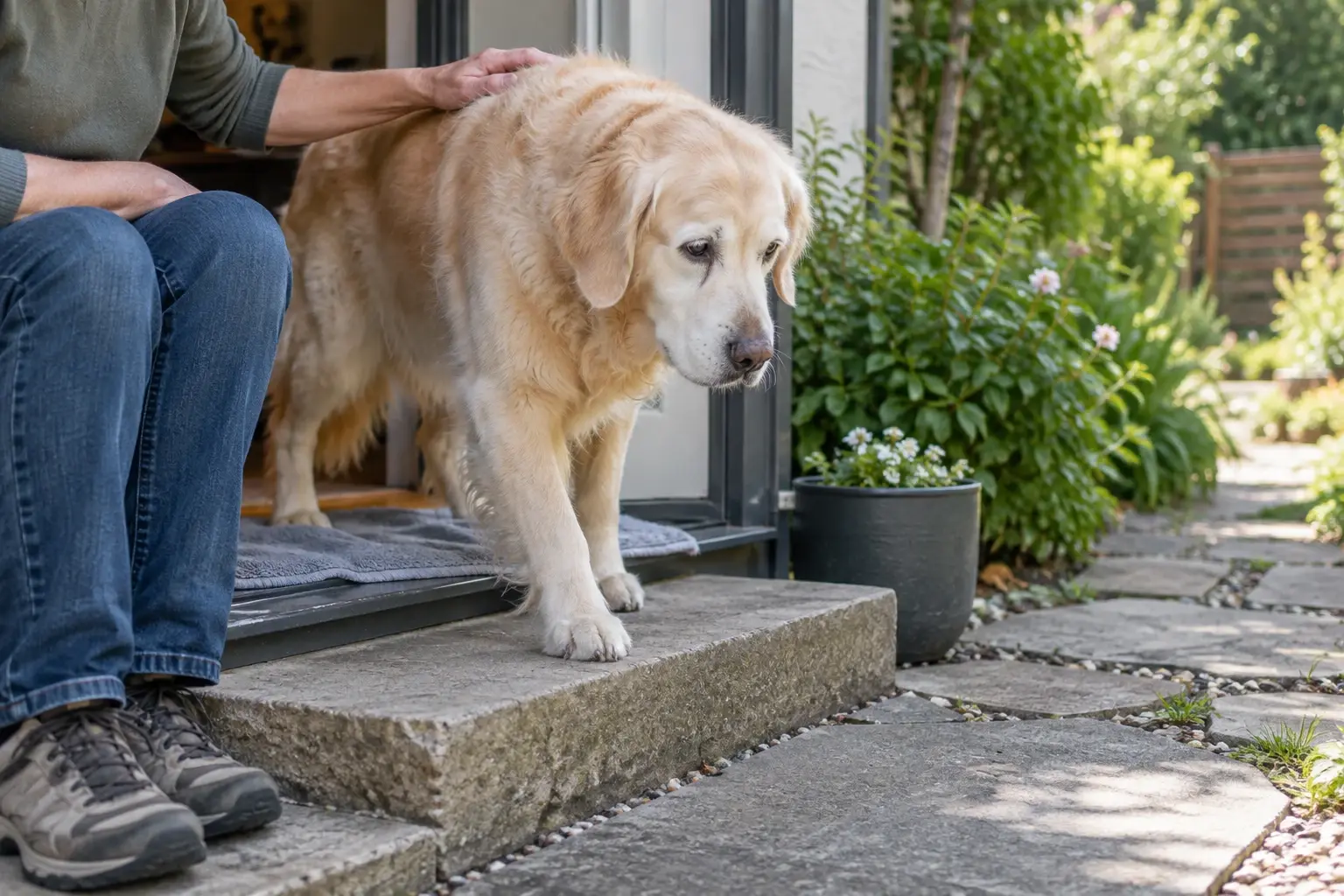
An older dog with an established hip dysplasia plan may struggle most with ordinary transitions: getting up from a bed, crossing a slippery floor, climbing into a car, turning on a tight landing or keeping balance while toileting. The useful question is, “Which moment is difficult, and what change would make it easier?”
Canine hip dysplasia is described as a common orthopedic disease in a 2022 paper published in Frontiers in Veterinary Science that examined Labrador and Golden Retrievers with and without hip dysplasia at different ages (the study summary). That background does not tell you which product your dog needs. It does explain why a long-term home setup deserves regular review as the dog ages.
Support is also an economic decision. A small change that keeps a dog from repeatedly slipping, struggling at a doorway or refusing a car ride may be less costly than replacing several unsuitable products or dealing with a preventable household accident. Maintenance helps preserve the routine you already have instead of waiting for each access problem to become a larger repair job.
For three days, write down four observations:
- The surface or transition that caused difficulty.
- Whether the dog hesitated, slipped, sat down or needed lifting.
- Which leg or body position seemed uncomfortable, without trying to diagnose the cause.
- What happened afterward, including whether the dog returned to the usual activity.
Use this short record to choose one change at a time. New or sudden symptoms need prompt veterinary care, and supplements do not replace diagnosis or treatment.
Ramp or stairs: choose the easier route to control
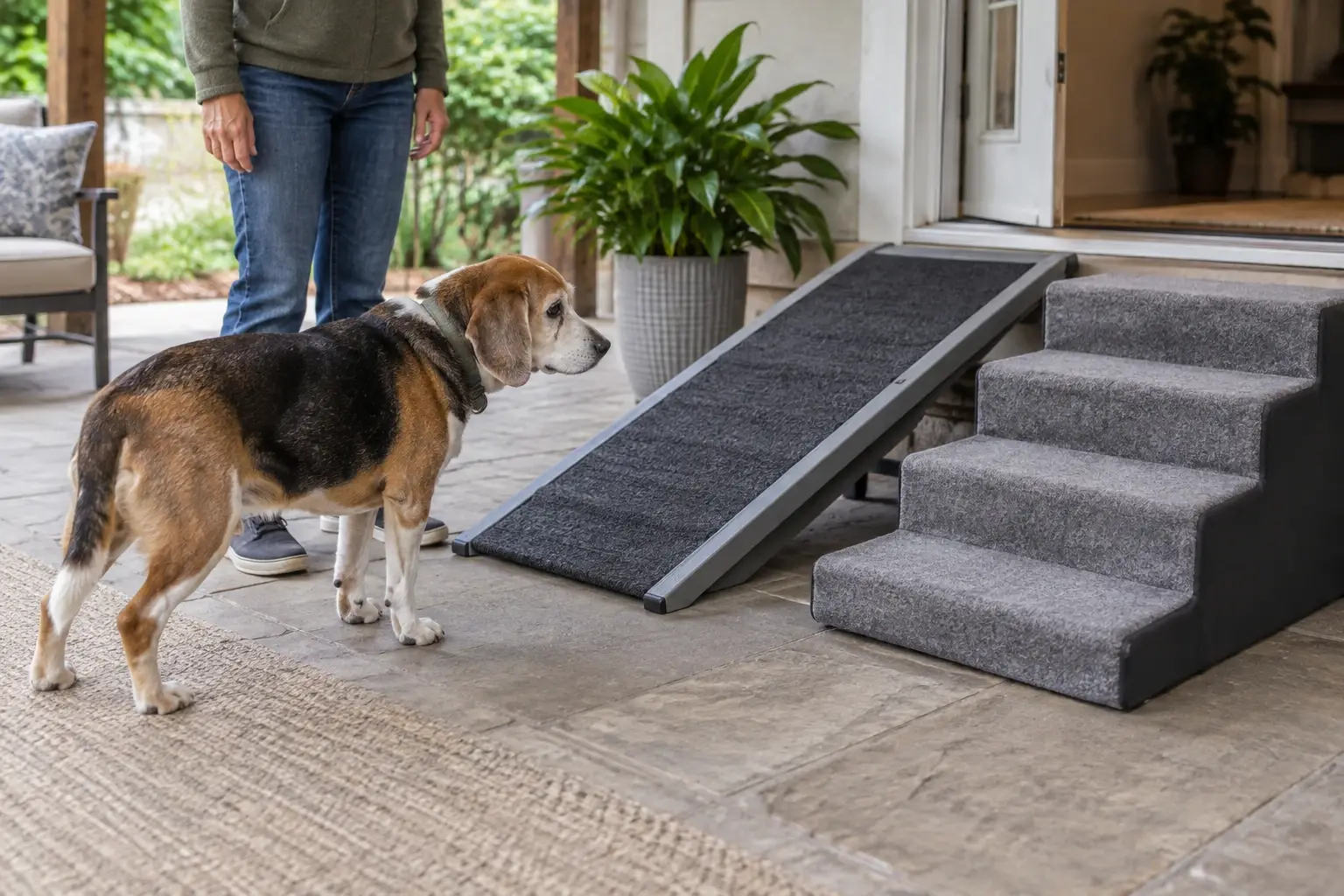
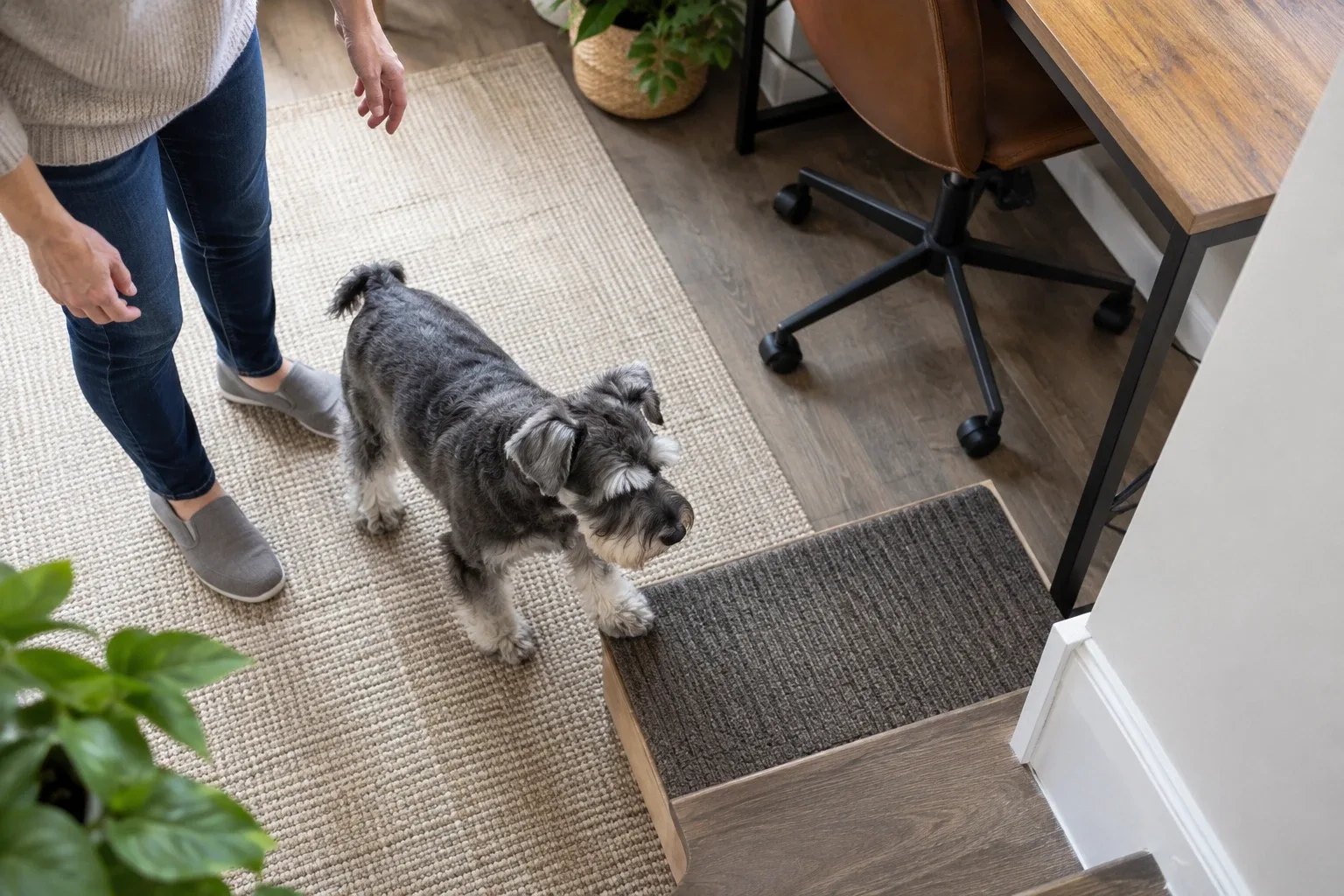
A ramp is often the better starting point when stairs require repeated lifting of the back legs, sharp turns or a high step into a vehicle. Stairs may suit a dog that can place each foot confidently and has enough room to turn around. The choice depends on the actual height, slope, width and surface in your home.
Use this comparison:
- Choose a ramp when: the dog needs a continuous path, the destination is high, or stepping up and down causes hesitation.
- Consider stairs when: the height is modest, each tread is deep enough for the dog’s feet, and the dog can use them without rushing.
- Reject either option when: it shifts underfoot, has a slick surface, forces a tight turn, or leaves too little room at the top and bottom.
Measure the destination before buying. Check the available floor length for a ramp, the height of the top step, the width of the path and where the product will be stored when it is not in use. A product that fits the dog but blocks a doorway will not become part of a dependable routine. The same practical comparison applies to ramps and pet stairs for older dogs, including tread, stability and placement (how to choose between dog ramps and stairs).
Introduce the route beside the old access point. Let the dog investigate it while it is stable, then practise short crossings without pulling or forcing. Stop if the dog freezes, scrambles or tries to jump around the equipment. The purpose is a controlled path that the dog accepts, not a demonstration of how much assistance the product can provide.
Harness fit: support movement without changing alignment
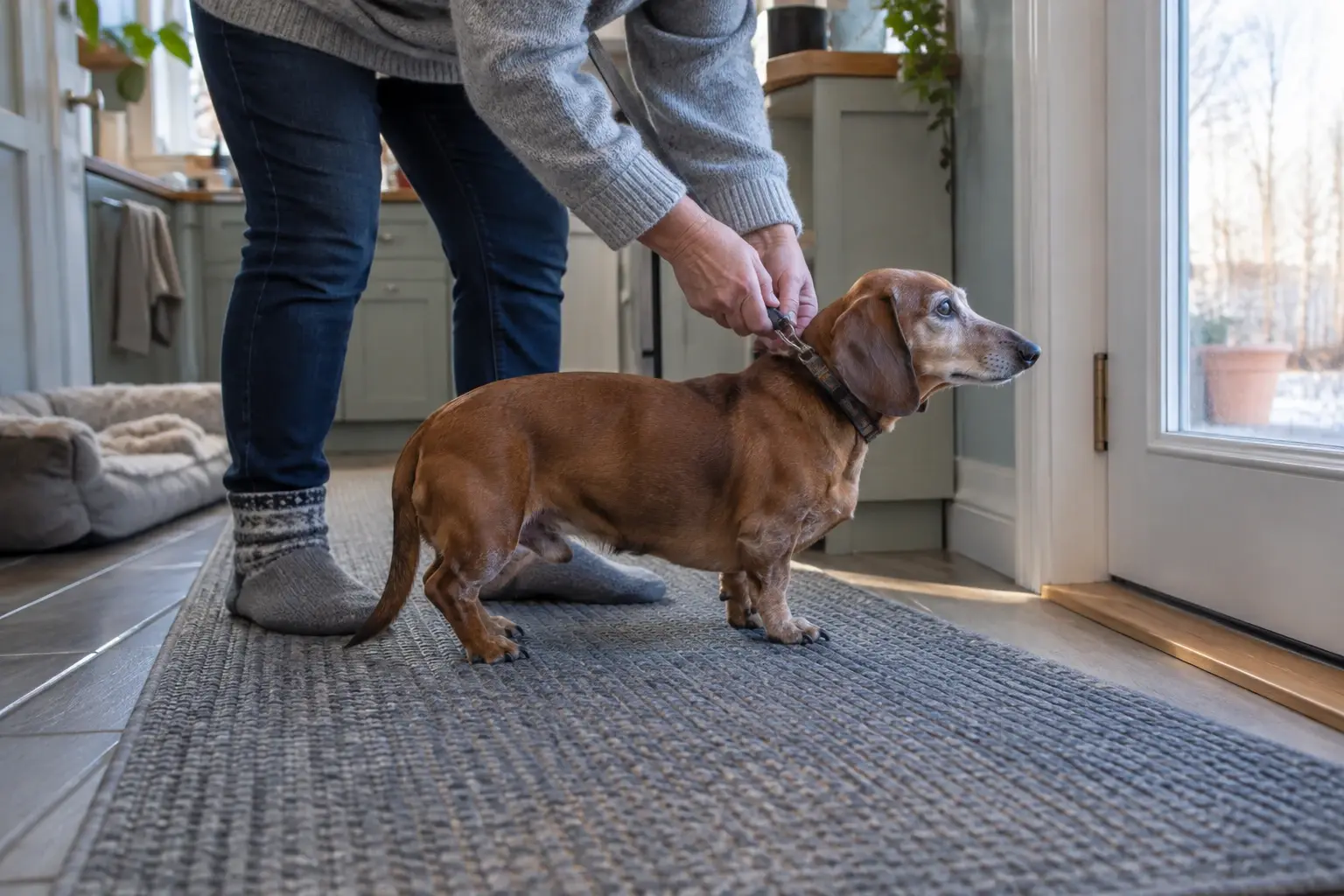
A support harness can help a caregiver guide or steady a dog during a known difficult transition. It should feel secure without rubbing behind the front legs, pressing into the throat or restricting normal breathing. The handle should sit where the caregiver can use it without twisting the dog’s body.
Before buying, compare:
- Support location: front, rear or full-body support, matched to the moment that needs help.
- Adjustment range: enough room for the dog’s current chest, waist and leg shape, with no loose straps that can catch.
- Caregiver control: a handle or lift point that allows a steady guide rather than a sudden haul.
- Bathroom access: straps should not make toileting difficult or require a full removal every time.
- Cleaning: removable or washable parts matter when the harness is used frequently.
Put the harness on while the dog is calm and check the skin afterward. A harness can support a transition, but it does not diagnose hip dysplasia, reposition a joint or correct its anatomy. Stop using it if the dog shows clear distress, rubbing or a new change in movement. A support harness for senior dogs comparison can help you examine placement, fit and caregiver grip before choosing a design.
Non-slip access and manageable food portions
Footing is part of the support plan. Start with the routes your dog uses most: bed to water bowl, doorway to yard, food area, stairs and the car-loading path. Secure runners or mats so they do not bunch at the edges. Keep nails and paw hair managed according to the existing care routine, and remove clutter that makes the dog turn sharply.
Observe whether the dog walks differently on one surface than another. If the dog moves well on a grippy mat but hesitates on tile, the first purchase may be flooring support rather than another mobility device.
Food portions deserve the same practical attention. Extra treats, toppers and supplement carriers can make daily intake harder to judge. Measure the main food in a repeatable way, keep treats visible in the daily record, and check whether a topper changes the amount of complete food being offered. A complete food and a separate joint-support product have different roles, so compare calories, ingredients and feeding directions before changing both at once. This guide to dog food for joint health expands on that comparison.
Supplement claims: what a useful label tells you
For an established care plan, a supplement is a buying decision, not a replacement for the plan. Start with the purpose you can state plainly, such as supporting joint comfort or helping maintain a routine. Then read the finished product label for:
- Every active ingredient and its amount per serving.
- The serving size and the form of each ingredient.
- Any carriers, flavorings or other ingredients that may overlap with food or another supplement.
- Storage directions and the product’s current claim language.
- A clear distinction between an ingredient description and evidence for the finished product.
Avoid proprietary blends that hide the amount of individual ingredients. A named ingredient does not prove that the finished product will produce a particular outcome, and evidence for one form or product cannot automatically be transferred to another. The dog joint supplement ingredient guide explains how to compare forms, amounts and preparation-specific evidence.
If green-lipped mussel is one of the ingredients you are comparing, New Zealand Green Lipped Mussel Powder for Dogs is one product page to inspect using the same label standard. Record the product name, serving direction and ingredient amounts before adding it to a list of possible choices. Do not stack it with another product until you have compared every overlapping ingredient and serving direction.
The buyer’s final checklist
Before buying any support product, confirm:
- The exact daily problem it is meant to address.
- The measurements needed for fit, height or available floor space.
- A stable, non-slip route at both ends of the equipment.
- Whether your dog can use it without being pulled, rushed or forced.
- The cleaning and storage routine you can maintain.
- The complete food, treats, toppers and supplements already in use.
- The full ingredient list and amount per serving, with no hidden blend.
- A simple observation you will track after the change, such as hesitation at the car or slipping at the doorway.
If the product fails one of these checks, pause before buying. The most useful support is the change your dog can use calmly every day.
FAQ
Can a ramp fix hip dysplasia in an older dog?
No. A ramp can make a transition easier to manage and may reduce the need for jumping or repeated steps, but it does not diagnose hip dysplasia or correct joint anatomy.
Is a harness better than a ramp?
They solve different access problems. A ramp provides a route between two heights, while a harness gives the caregiver a way to steady or guide the dog during a transition. Choose based on the moment your dog cannot manage comfortably.
Should I change food and start a supplement at the same time?
Changing both makes daily observations harder to interpret. Record the current food, treats and supplements first, then make one practical change at a time when the established care plan allows it.
What should I do if my dog suddenly refuses the ramp or cannot rise?
Stop the practice session and record what changed. Sudden or worsening movement problems need prompt professional assessment rather than a new product trial.
References
- Center of pressure and ground reaction forces in Labrador and Golden Retrievers with and without hip dysplasia at 4, 8, and 12 months of age. Frontiers in veterinary science (2022). PMID: 36619950. DOI: 10.3389/fvets.2022.1087693
For individual health questions, your veterinarian remains the best partner.