TL;DR
The typical pug lifespan is about 11 to 12 years. In a 2024 UK study of 584,734 dogs, pugs had a median lifespan of 11.6 years, slightly below the 12.0 years for mixed breeds, and flat-faced breeds as a group were among those most at risk of dying young. Our founder Morty has raised seven pugs since childhood, and his family's experience was harder than the average: most of his pugs died between about 7 and 10, the longest lived to 11, and every one of them developed joint problems. The biggest threats to a pug's lifespan are breathing problems from the flat face, heat, weight gain, spine and hind-leg disease, and eye injuries. A lean weight, a cool home, careful eye and skin care, and acting early on stiffness and lumps give a pug its best chance at a long life.
How long do pugs live?
| Measure | Pug | Mixed breed |
|---|---|---|
| Median lifespan (2024 UK study) | 11.6 years | 12.0 years |
| 95% confidence interval | 11.4 to 11.8 | 12.0 to 12.1 |
| Senior from about (last 25% of lifespan) | 8.7 years | 9.0 years |
The median is the age by which half of the pugs in the study had died, so half lived longer. But the same study put pugs at about a third higher risk of dying at any given age than mixed breeds. Check your own pug's life stage with our dog age calculator.
Our founder's seven pugs
Morty grew up with pugs; his family has kept them since he was a child, seven in all. Their lives were shorter than the study median:
- one died at 5, one at 7 and one at 9
- most died somewhere between 7 and 10
- the longest-lived reached 11
- every one developed joint problems as it aged
The pug he lost at five had developed hind-limb weakness and could no longer stand. It had surgery, but never recovered, and the vet put the problem down to inflammation around the hip. Morty's corgi later went through a similar decline. Those losses are why Dogevera focuses on joint and mobility care.
One family's dogs are not a study. But his experience lines up with the research: pugs carry a heavy load of breed-related disease, and mobility problems are a big part of it.
What shortens a pug's life
A 2022 study of UK veterinary records compared 4,308 pugs with 21,835 other dogs. Pugs had 1.86 times the odds of having at least one disorder diagnosed in a year, and higher odds for 23 of 40 common disorders.
| Problem | How much more likely in pugs | What it means |
|---|---|---|
| Brachycephalic obstructive airway syndrome (BOAS) | 53.9 times the odds | Narrowed airways: noisy breathing, snoring, poor heat and exercise tolerance |
| Narrowed nostrils (stenotic nares) | 51.3 times | Part of BOAS; can be widened surgically |
| Corneal ulcers | 13.0 times | Prominent eyes are easily scratched |
| Skin fold dermatitis | 16.3 times the odds of crossbreeds (separate UK study) | Infection in the nose fold and other wrinkles |
Some things were less common in pugs: heart murmurs (0.23 times the odds), fatty lumps called lipomas (0.24) and aggression (0.31). That last figure matches what Morty saw in his own dogs: friendly, gentle and not inclined to bite.
An earlier study of pugs in England found the most common problems were overweight or obesity (13.2%), corneal disorders (8.7%) and outer ear infections (7.5%).
Joints, spine and back legs
Every one of Morty's pugs had joint trouble, and research shows why pugs are vulnerable:
- Pug myelopathy. A 2023 genetics study describes pug thoracolumbar myelopathy as a late-onset spinal cord disease causing progressive wobbliness and weakness of the back legs, commonly with incontinence, and affecting more males than females.
- Arthritis in the hips, knees and spine, made worse by extra weight.
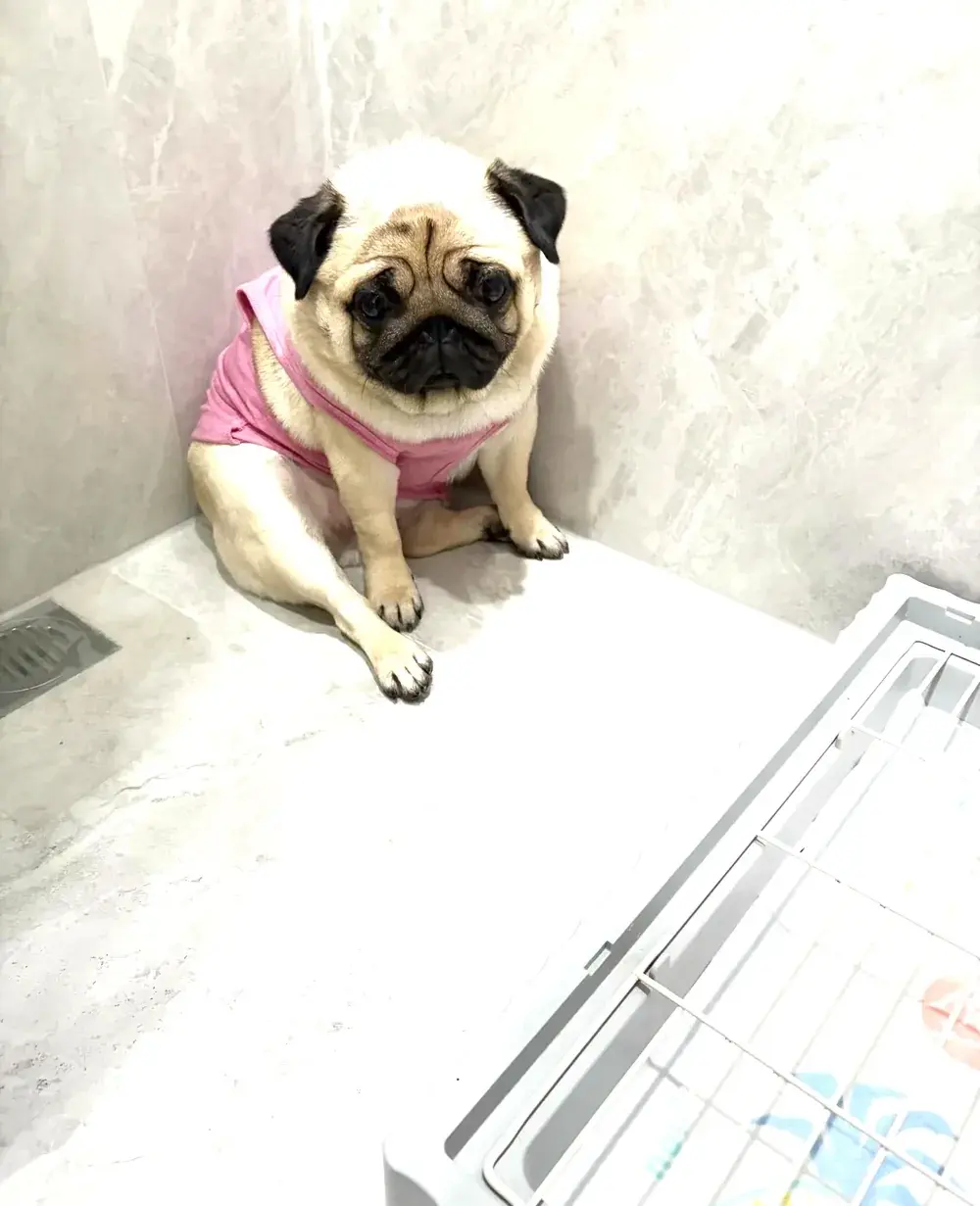
What hind-leg trouble looked like in Morty's pugs
Pugs are not naturally very active, so early pain is easy to miss. In Morty's experience, a pug with sore back legs:
- became much less willing to move, and did not even want to go out
- sat down often during walks or around the house
- had stiff back legs, especially after resting
- yelped when he stroked the back legs or hips, even gently
That last sign is worth knowing: if your pug cries out when you stroke its back end, it is in pain, even if it still eats and greets you normally. See old dog weak back legs and arthritis in dogs: treatment and home care.
For daily joint support, omega-3 fish oil and green-lipped mussel have the best evidence. In a 2006 trial, 67% of dogs with joint disease given a green-lipped mussel extract had improved by day 56, against 41% on placebo. Our green-lipped mussel powder is a single-ingredient daily topper; a small pug takes 0.5 to 1 g a day.
Breathing, heat and cold
- Heat is dangerous. A UK study of 905,543 dogs found dogs with flat faces were at greater risk of heat-related illness, and 14% of heatstroke cases were fatal. Walk your pug in the cool of the day, avoid hot cars and hot pavements, and give shade and water.
- Know the breathing warning signs: gasping, blue or gray gums, collapse, or noisy breathing that is getting worse need a vet at once.
- Cold: Morty found his pugs caught colds easily in winter and believes their short noses handle temperature poorly. A jacket on cold walks and a draft-free bed help.
- Snoring is normal for most pugs, but loud snoring and breathing effort during sleep are signs of BOAS worth discussing with your vet.
Eyes, skin and ears
- Eyes: check daily for squinting, redness, cloudiness or discharge. Corneal ulcers can worsen quickly; see a vet the same day.
- Face folds: the PDSA veterinary charity advises cleaning skin folds regularly with saline on cotton pads and drying them thoroughly. In Morty's experience, most "pug smell" comes from dirt trapped in the folds, plus drool that needs wiping. See senior dog grooming.
- Ears: outer ear infections are among the most common pug problems; look for redness, smell or head shaking.
Weight: the factor you control most
Overweight and obesity was the single most common problem in the English pug study. Extra weight makes breathing, heat tolerance and joints all worse. In a lifelong study of Labradors, dogs kept lean lived a median of 13.0 years against 11.2 for their heavier littermates. Weigh your pug monthly and keep treats under 10% of daily calories. See senior dog food for weight loss.
Lumps
One of Morty's pugs developed a small lump that the vet diagnosed as a tumor and removed surgically. Pugs had lower odds of fatty lipomas in the 2022 study, so a new lump in a pug should never be assumed to be harmless. Cornell University's veterinary college advises a vet visit for any lump the size of a pea or larger, present for a month, or growing or changing. See senior dog grooming: lumps and bumps.
How to help your pug live longer
- Keep your pug lean.
- Protect it from heat; never leave it in a car.
- Clean face folds and check eyes daily.
- Use a harness, not a collar, to keep pressure off the airway.
- Watch the back legs: stiffness, frequent sitting or crying when touched means a vet visit.
- Have lumps checked early.
- Discuss breathing with your vet, including whether surgery to widen the nostrils would help.
- Twice-yearly check-ups from about 8 to 9 years old, when a pug becomes a senior.
FAQ
How long do pugs live?
The median pug lifespan in a 2024 UK study of 584,734 dogs was 11.6 years, so half of pugs lived longer than that. Breathing, spine and other breed problems cut some lives short.
Is 10 old for a pug?
Yes. A pug is a senior from about 8.7 years, and at 10 it has lived about 86% of the median lifespan, similar to a person in their late 60s.
Do pugs have a lot of health problems?
More than most dogs. In UK vet records, pugs had 1.86 times the odds of at least one disorder in a year, with much higher odds of airway disease, narrowed nostrils, eye ulcers and skin fold infections.
Are pugs good dogs for older people?
In Morty's experience, yes: pugs are friendly, gentle, fairly quiet and do not need much exercise, and UK data show lower odds of aggression than other dogs. The trade-offs are drool, skin fold care, loud snoring and vet costs for breed-related problems. See best dogs for older people.
Why do pugs get joint problems?
Pug myelopathy, a spinal cord disease of the breed, arthritis and extra weight all play a part. Keep your pug lean and see your vet early if the back legs stiffen.
References
- McMillan KM, et al. Longevity of companion dog breeds: those at risk from early death. Scientific Reports. 2024. PMID: 38302530
- O'Neill DG, et al. Health of Pug dogs in the UK: disorder predispositions and protections. Canine Medicine and Genetics. 2022. PMID: 35581668
- O'Neill DG, et al. Demography and health of Pugs under primary veterinary care in England. Canine Genetics and Epidemiology. 2016. PMID: 27293771
- O'Neill DG, et al. Ironing out the wrinkles and folds in the epidemiology of skin fold dermatitis in dog breeds in the UK. Scientific Reports. 2022. PMID: 35794173
- Brander G, et al. Multiple genetic loci associated with pug dog thoracolumbar myelopathy. Genes. 2023. PMID: 36833311
- Hall EJ, Carter AJ, O'Neill DG. Incidence and risk factors for heat-related illness (heatstroke) in UK dogs under primary veterinary care in 2016. Scientific Reports. 2020. PMID: 32555323
- Kealy RD, et al. Effects of diet restriction on life span and age-related changes in dogs. Journal of the American Veterinary Medical Association. 2002. PMID: 11991408
- Pollard B, et al. Clinical efficacy and tolerance of an extract of green-lipped mussel in dogs presumptively diagnosed with degenerative joint disease. New Zealand Veterinary Journal. 2006. PMID: 16751841
- PDSA. Skin fold dermatitis in dogs.
- Cornell University College of Veterinary Medicine, Riney Canine Health Center. Skin Lumps and Bumps. 2023.
- World Small Animal Veterinary Association. Feeding treats to your dog. 2025.
For individual health questions, your veterinarian remains the best partner.