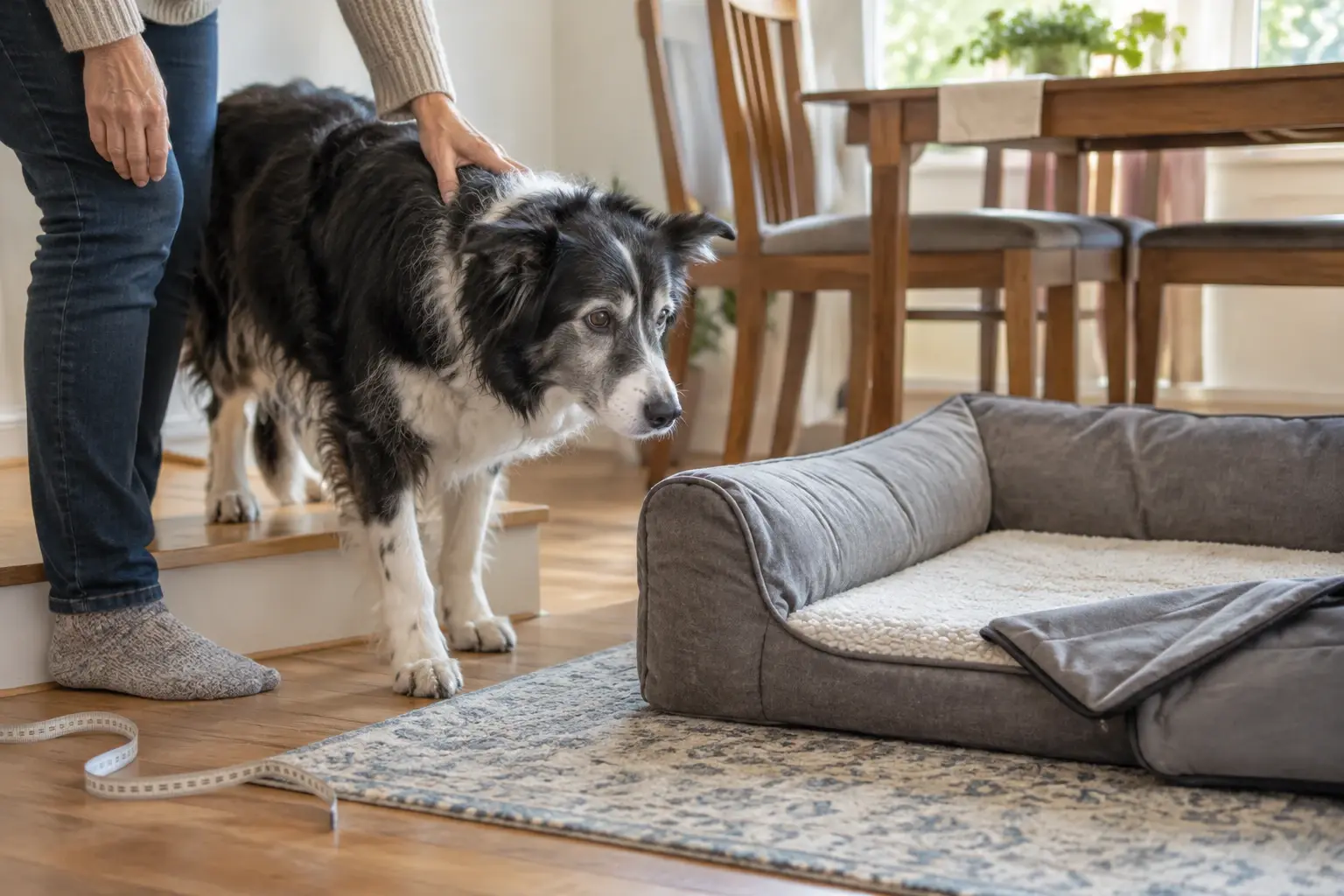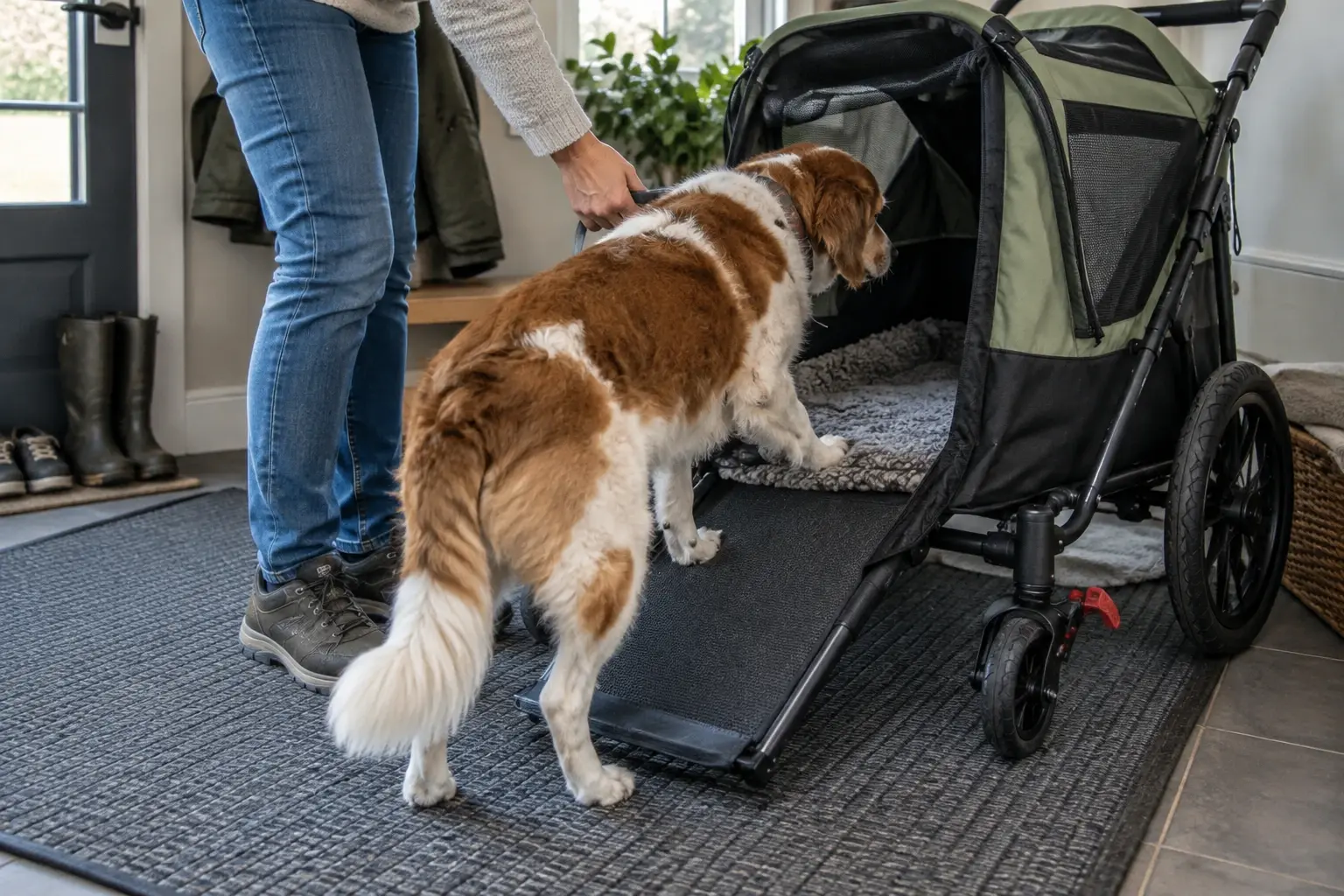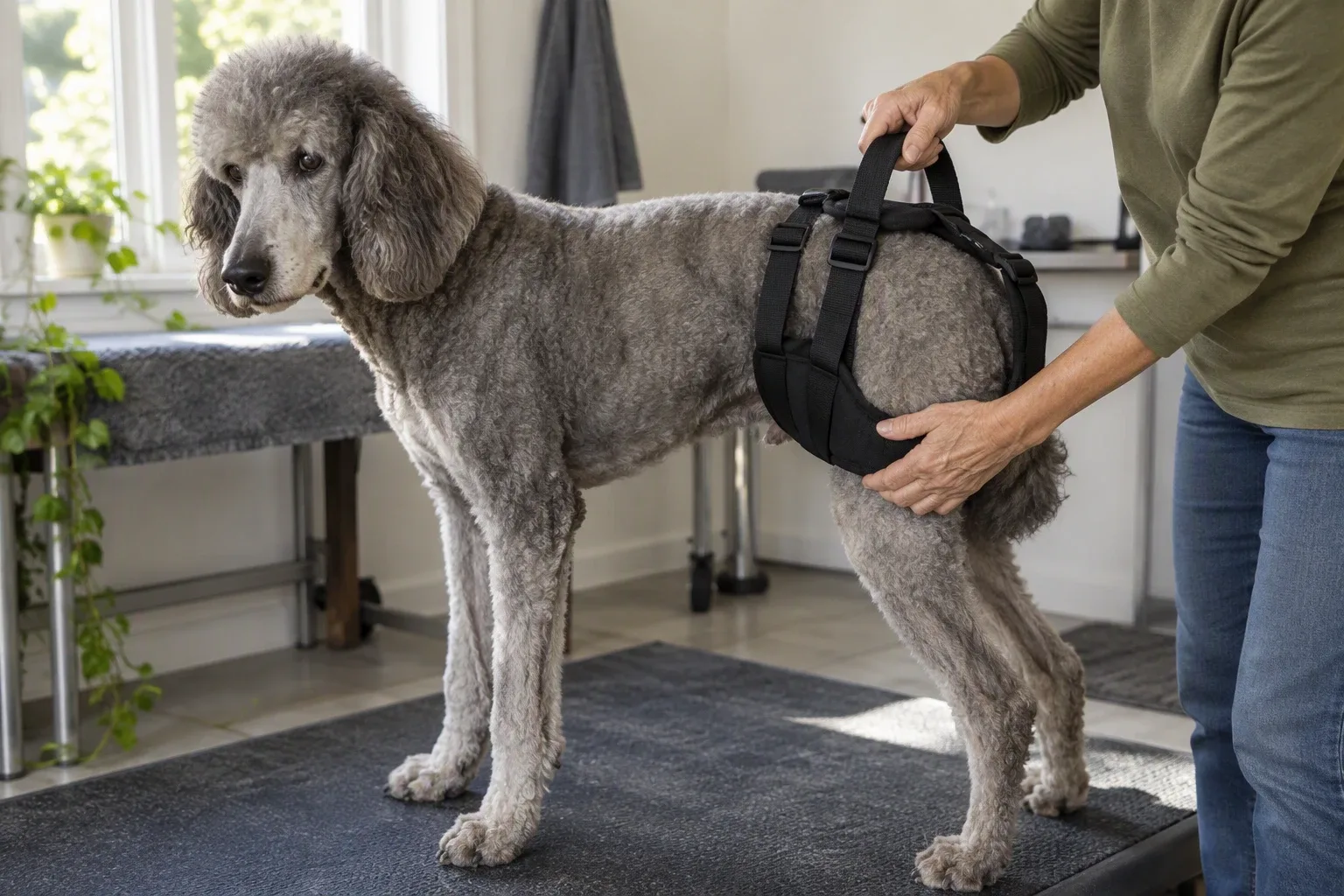
When your older dog pauses at the doorstep or needs a steadier trip from bed to yard, a support harness can make handling feel more manageable. The best choice is the one that places support where you need it, follows the manufacturer’s instructions, and stays comfortable without pressing, twisting, or slipping.
A harness is a handling tool, not a diagnosis or a replacement for professional care when a dog has a sudden or serious change in mobility.
Start With Where Support Is Needed
Look at the specific moment when you reach for help. Is it getting up from a bed, taking a few steps outdoors, climbing into a car, or keeping balance during a short transition?
Use that everyday task to compare support placement:
- Rear-support designs: Consider these when you mainly need a secure way to assist the hind end during a brief transition.
- Full-body designs: Consider these when you need to handle support at both the front and rear rather than relying on one end alone.
- Front-support designs: Consider these when your main handling point is around the chest and front body.
Do not choose based only on phrases such as “senior,” “mobility,” or “lifting.” Look at the product photos, strap layout, and instructions to see exactly where the harness contacts your dog’s body.
Use a Fit Check Before Relying on a Harness
A size label is only a starting point. Follow the manufacturer’s measurement instructions and check the harness while your dog is standing naturally, if that is comfortable for them.
Use this quick fit checklist:
- Straps lie flat rather than folded or twisted.
- Buckles and seams are not sitting against a sensitive area.
- The harness stays centered when your dog takes a few calm steps.
- The handle remains easy for you to reach without pulling the harness sideways.
- Your dog can move without the harness shifting into the armpit, belly, groin, or throat area.
Watch what happens after a short, calm practice indoors. Turning away during fitting, stopping abruptly, altered movement, strap marks, or persistent rubbing are useful details to note. Remove the harness and reconsider the fit or design rather than tightening it further without a clear reason.
Compare Support Harness Placement and Construction
Two harnesses may look similar online but work very differently in the hand. Compare the details that affect how you will use it at home.
Support area
Check whether the support panel is narrow and sling-like or broader across the body. A wider panel may cover more area, while a narrower one may be simpler to position for a quick outing. What matters is whether the panel sits where the manufacturer intends and stays away from pressure points.
Straps and closures
Look for clear adjustment points and closure placement you can manage without rushing. If your dog wears a collar or another harness, consider whether the pieces can be used together as instructed without bunching.
Material and lining
Choose materials based on your household routine:
- A removable or washable section can be useful for muddy paths or occasional accidents.
- Smooth edges may be easier to keep free of trapped hair and debris.
- A lighter construction may be easier to dry after wet weather.
- A more structured design may be easier to hold in shape during fitting.
No material is automatically the most comfortable for every dog. The useful question is whether it stays clean, lies smoothly, and works with your dog’s coat and daily routine.
Check the Caregiver Grip, Not Just the Dog Fit
A support harness also needs to work for the person using it. Before heading outside, hold the handle while the harness is on your dog and notice your own position.
Ask yourself:
- Can I reach the handle without bending or twisting awkwardly?
- Does the handle feel centered when I hold it?
- Is there enough room to keep my hand clear of my dog’s body and the straps?
- Can I release the handle calmly if my dog changes direction?
- Does the manufacturer describe this handle as suitable for the kind of assistance I plan to provide?
Avoid assuming that every handle is intended for full lifting. Use the harness only as its manufacturer directs, especially for car entry, stairs, or any situation where your dog’s full weight could be involved.
Keep Separate Decisions Separate
A support harness can help with a handling task, but it does not answer separate questions about food, activity, or supplements. If you are also considering those choices, compare them on their own terms rather than expecting one purchase to cover every concern.
For example, a joint supplements for senior dogs buyer’s guide can help you review labels and product evidence separately. If body condition or food selection is part of the bigger picture, use the same label-first approach in this guide to high-protein food for senior dogs. Be cautious with broad “energy” language as well; senior dog energy supplement claims deserve their own close reading.
Make Cleaning Part of the Buying Decision
A harness that is difficult to clean can become unpleasant to use. Before buying, check the care instructions rather than assuming it can go in the washing machine or dryer.
A practical cleaning routine includes:
- Removing loose hair, grit, and dried mud after use.
- Checking seams, straps, and buckles while the harness is off.
- Washing only as the manufacturer directs.
- Letting the harness dry fully before storing it.
- Keeping it in one easy-to-reach spot near the door, bed, or car setup where you use it most.
Inspect the harness regularly for frayed webbing, damaged stitching, cracked buckles, or a handle that no longer feels secure in your hand. Replace damaged equipment rather than trying to rely on a repair that changes how it fits or functions.
FAQ
Should a senior dog wear a support harness all day?
Follow the manufacturer’s use instructions. A support harness is often most useful for a specific handling task, such as a transition outdoors, rather than being left on without a reason.
How do I know if a harness is putting pressure in the wrong place?
Check for shifting straps, bunching, rubbing, marks, reluctance during fitting, or a change in how your dog moves while wearing it. Remove it and reassess the fit and design if you notice these signs.
Is a rear-support sling the same as a full-body harness?
No. A rear-support sling focuses on the hind end, while a full-body design has support points at both the front and rear. Compare the placement to the specific moment when you need to help your dog.
When should I seek prompt professional care?
Seek prompt professional care for a sudden inability to stand, collapse, severe distress, or a sharp change from your dog’s usual movement.
For individual health questions, your veterinarian remains the best partner.