TL;DR
A dog wheelchair for back legs (also called a rear-support cart) holds up a dog's hindquarters on two wheels so it can walk with its front legs. It helps dogs whose back legs are weak or paralyzed from degenerative myelopathy, disc disease, severe arthritis, hip problems or spinal injury. The best evidence comes from a 2024 survey of owners of 954 dogs that used carts: owners reported a better quality of life in 74% of dogs using rear-wheel carts, and 79% of all owners would recommend a cart. But 64% reported at least one complication, most often skin wounds, so fit, padding and short sessions matter. Before buying, ask your vet for a diagnosis first, because some causes of back-leg weakness can recover with surgery or rehab. And keep the back legs working wherever possible: in dogs with degenerative myelopathy, those given intensive physiotherapy survived an average of 255 days, against 55 days for dogs given none.
Does my dog need a wheelchair?
A rear-support wheelchair is worth discussing with your vet if your dog:
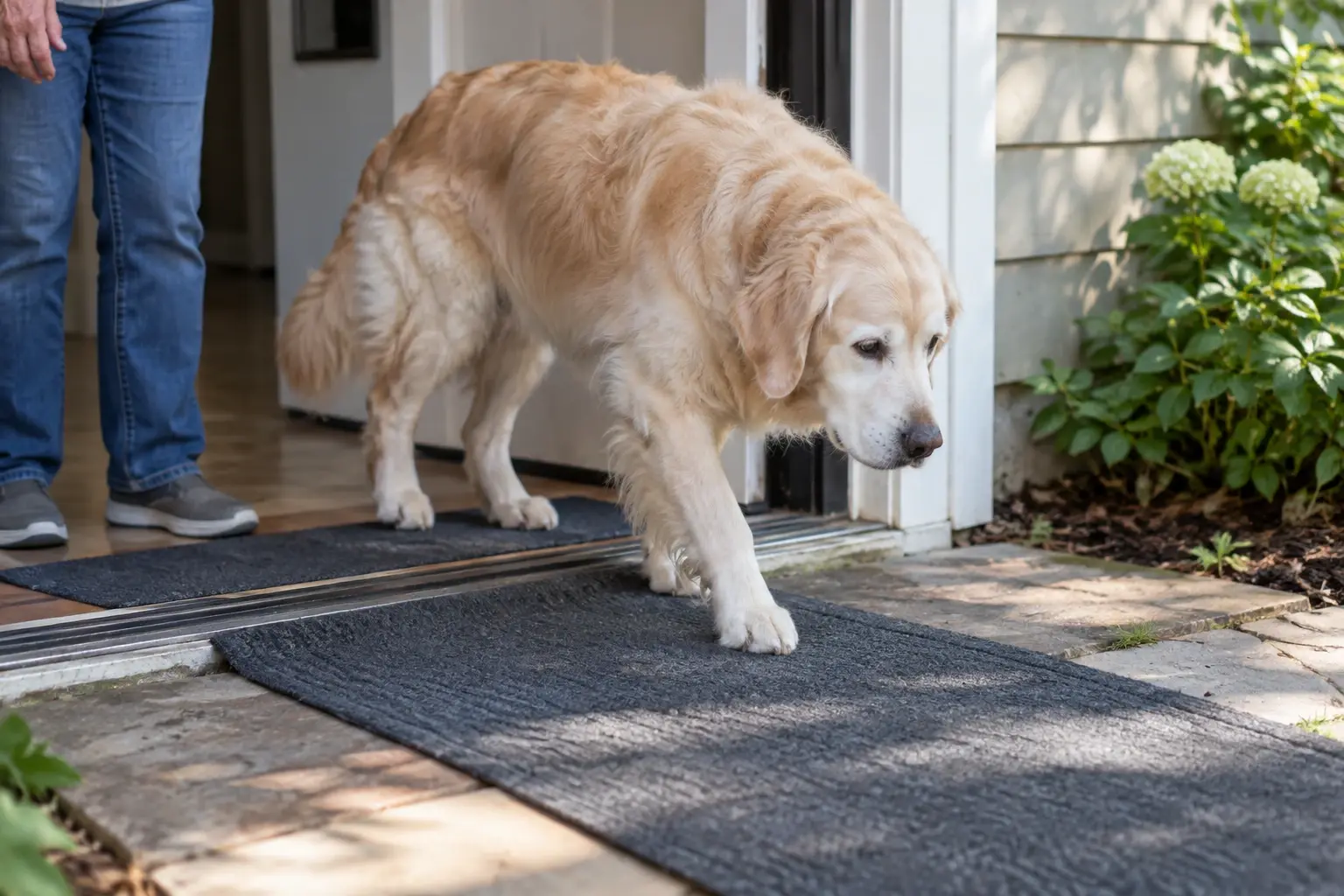
- Drags its back feet or knuckles over onto the tops of its paws
- Collapses at the back or cannot stand up without help
- Can walk only a few steps before sitting or falling
- Has lost the use of its back legs but is bright, alert and still wants to go out
- Is recovering from spinal surgery and needs support while rehab rebuilds strength
A wheelchair is not usually the first step for a dog that is just stiff or slow. Pain relief, weight control, exercise and a support harness come first. See old dog weak back legs.
Common reasons dogs need back-leg wheelchairs
| Condition | What happens | Role of a wheelchair |
|---|---|---|
| Degenerative myelopathy (DM) | Slowly progressive spinal cord disease of older dogs; back legs weaken, then front legs | Keeps the dog walking and exercising as the back legs fail |
| Intervertebral disc disease (IVDD) | A disc presses on the spinal cord, sometimes suddenly | Support during recovery, or long term if function does not return |
| Severe arthritis or hip dysplasia | Painful, weak back legs | Takes weight off the hips so walks are possible |
| Spinal injury or stroke of the spinal cord | Sudden weakness or paralysis | Support while waiting to see how much function returns |
| Amputation of a back leg, or two damaged back legs | Loss of support | Balance and mobility |
| Age-related muscle loss | Thin, weak back legs | Usually a harness first; a cart if the dog can no longer stand |
Degenerative myelopathy
Degenerative myelopathy is an adult-onset, fatal spinal cord disease that has been compared with ALS in people. It begins with weakness and wobbliness in the back legs and progresses over months until the front legs are affected too. A mutation in the SOD1 gene is a known risk factor, and a DNA test is available.
In a study of 50 dogs with degenerative myelopathy, German Shepherds, Kuvasz, Hovawarts and Bernese Mountain Dogs were overrepresented, and the average age at diagnosis was 9.1 years. Exercise made a striking difference: dogs given intensive daily physiotherapy survived an average of 255 days, compared with 130 days with moderate physiotherapy and 55 days with none, and dogs given physiotherapy stayed on their feet longer. A wheelchair is one of the ways to keep these dogs moving.
Disc disease: see the vet before you buy
Many dogs with sudden back-leg weakness from a slipped disc recover, especially with prompt treatment. In a review of case series, dogs that could not walk but could still feel their legs recovered in 93% of cases after surgery, against 62% to 79% with rest and medication, depending on severity. Even dogs that had lost deep pain sensation recovered in 61% of cases after surgery. Sudden back-leg weakness is an emergency, so see a vet the same day before thinking about a cart.
Do dog wheelchairs work?
The largest study is a 2024 survey of caretakers of animals that used mobility carts, including 954 dogs. In dogs:
- 62% of owners reported a better quality of life for their dog, and 61% a better quality of life for themselves.
- Rear-wheel carts did best: owners reported a better quality of life in 74% of dogs using them, compared with 54% for four-wheel carts and 47% for front-wheel carts.
- 79% of all caretakers said they would recommend a cart.
- Larger dogs were harder to get into their carts.
- 64% reported at least one complication, and 53% of those were wounds, such as rubbing or pressure sores.
The lesson is that wheelchairs help most dogs, but they need good fitting and daily skin checks.
Types of dog wheelchair
- Rear-support (two-wheel) wheelchair: for dogs with weak or paralyzed back legs and strong front legs. The most common type, and the one with the best owner-reported results.
- Full-support (four-wheel or "quad") wheelchair: for dogs that are weak in all four legs, such as dogs with late-stage degenerative myelopathy.
- Front-support wheelchair: for dogs with weak front legs.
Most wheelchairs let the back legs either touch the ground, so the dog can still step and exercise them, or rest in stirrups if they are paralyzed. If your dog can still move its back legs at all, keeping the feet on the ground helps preserve muscle.
How to choose and fit a wheelchair
- Get a diagnosis first, and ask your vet or a rehabilitation vet which type suits your dog.
- Measure carefully following the maker's guide, usually your dog's weight, height at the back and length of the body. A poor fit causes most problems.
- Choose adjustable if your dog's condition is likely to change, as with degenerative myelopathy.
- Check the saddle and straps for padding and for pressure on the groin, belly and inner thighs.
- Look at the wheels and frame: larger wheels roll better on grass and gravel; a lighter frame is easier for small or weak dogs.
Getting your dog used to a wheelchair
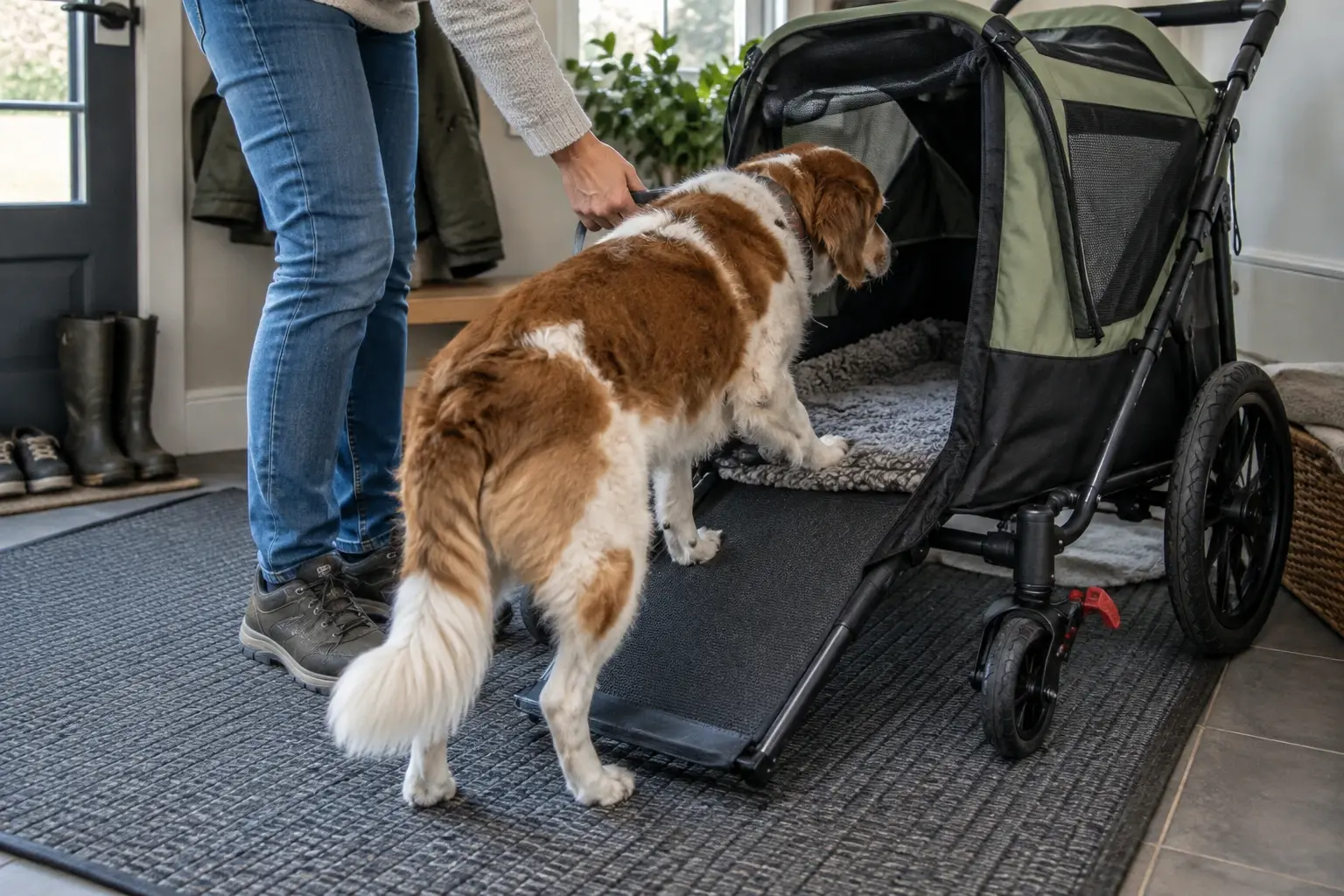
- Start indoors in a quiet space, with treats and praise.
- Short sessions first: a few minutes, then build up as your dog gets confident.
- Walk in front and call your dog to you.
- Never leave your dog unattended in a wheelchair. Most dogs cannot lie down in one.
- Take breaks for rest, water and toileting.
Preventing sores and other problems
With wounds the most common complication in the 2024 survey, daily checks matter:
- Check the skin every day where the saddle and straps touch: groin, belly, inner thighs, chest and armpits.
- Add padding or soft covers to straps that rub.
- Keep sessions reasonable and let your dog rest out of the cart.
- Protect the feet of dogs that drag them, with boots or a bootie, because the tops of the toes wear quickly.
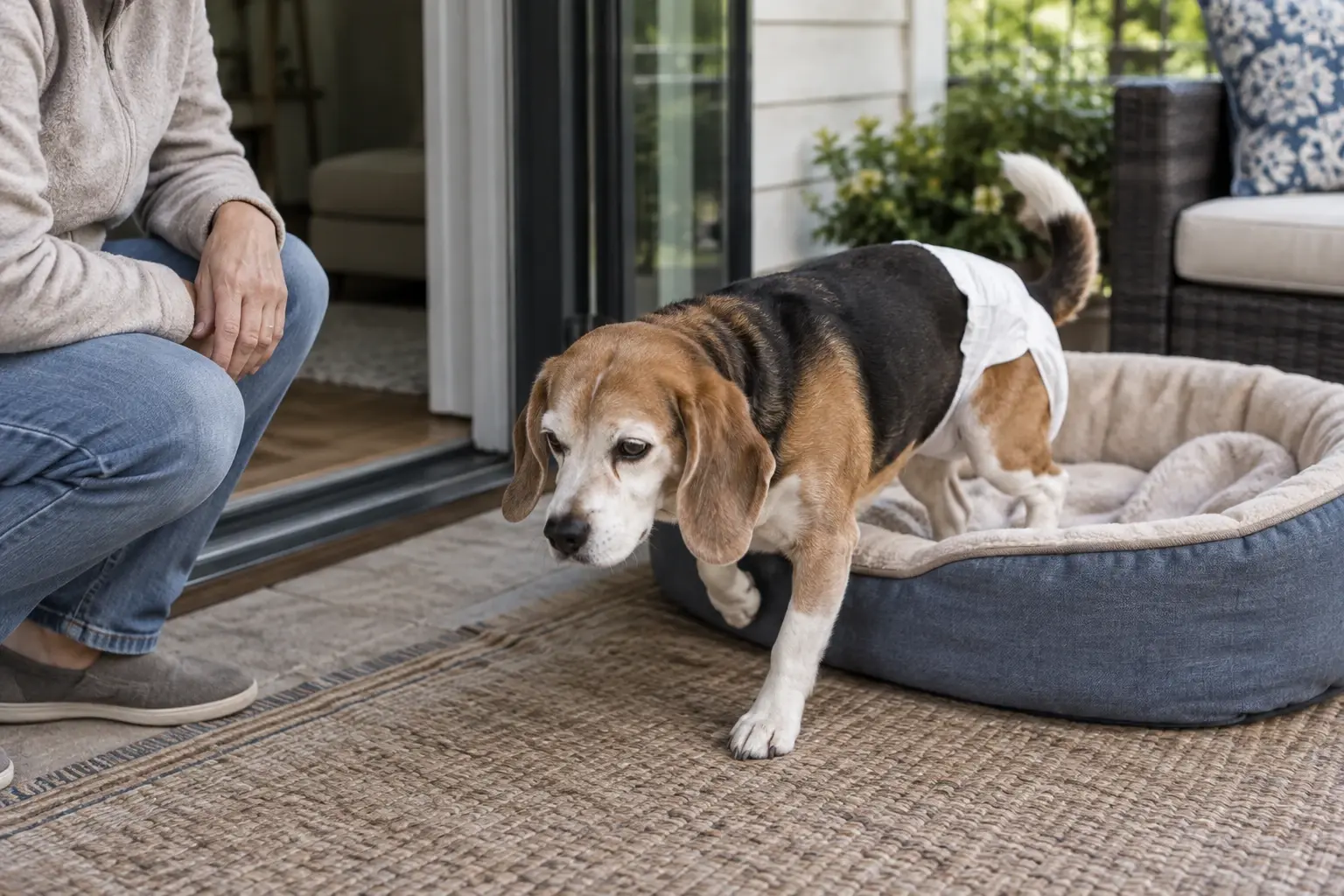
- Keep the skin clean and dry, especially in dogs with incontinence.
- Recheck the fit as your dog gains or loses weight or muscle.
Before a wheelchair: harnesses and slings
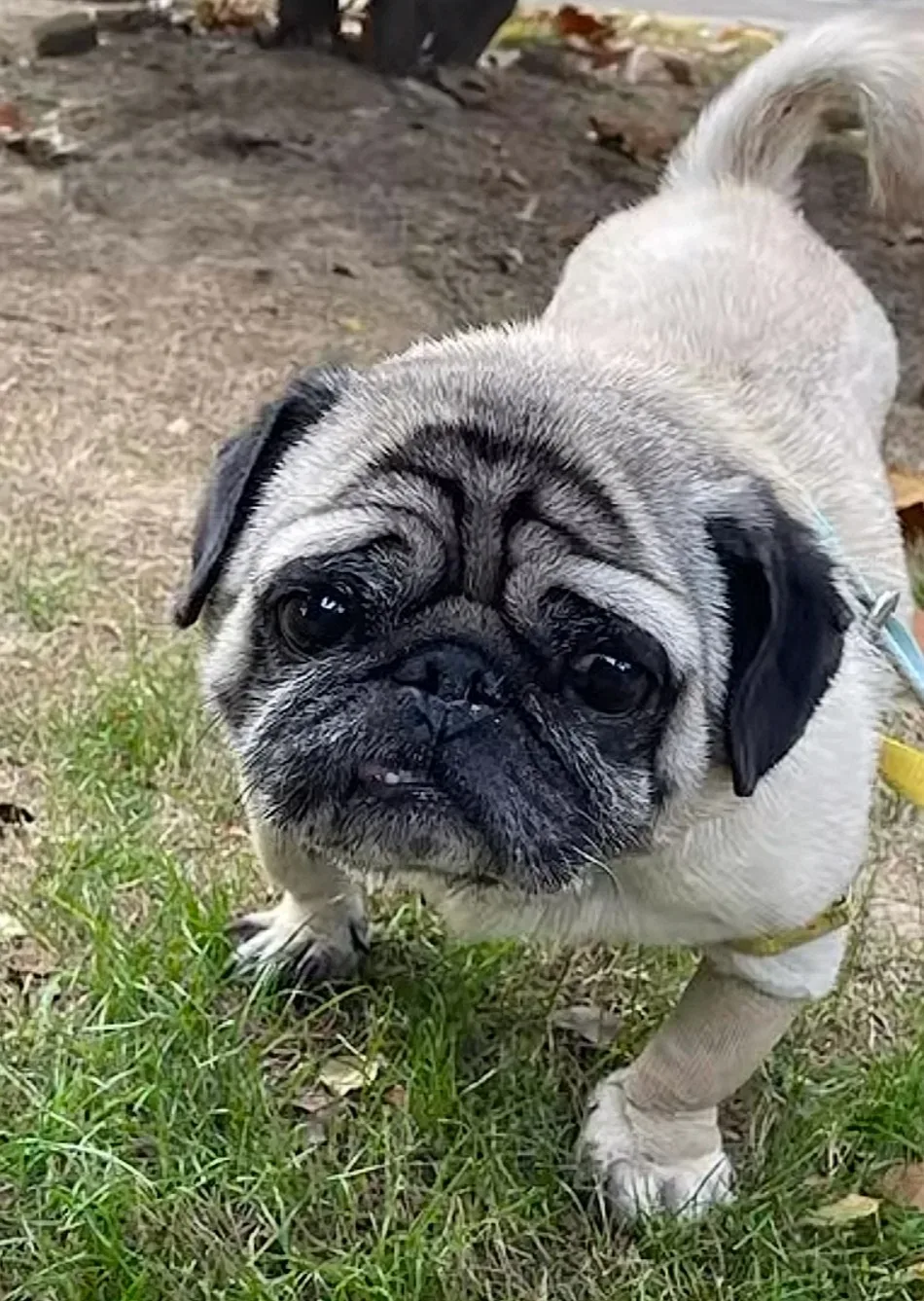
For many older dogs with weak back legs, a support harness or a sling under the belly is enough, at least at first. They let you take some weight while your dog still uses its own legs. Our founder Morty, who has raised seven pugs, supported the pugs' back ends with a towel or a harness under the belly when their hind legs grew weak. See support harnesses for senior dogs.
Morty also raised the food bowl slightly for the pugs with weak back legs, by just a few centimeters, which Morty found helped them stand and use their back legs at mealtimes.

Keep the back legs as strong as possible
A wheelchair helps a dog get around, but the muscles still need work:
- Physiotherapy and hydrotherapy. In dogs with degenerative myelopathy, intensive daily physiotherapy was linked to an average survival of 255 days, against 55 days without. Ask your vet about a rehabilitation clinic.
- Exercises at home: supported standing, weight shifting, slow walks with a sling and gentle range-of-motion work.
- Pain control for arthritis or hip pain. See arthritis shots for dogs and hip dysplasia treatment.
- A lean body weight, which makes every step easier.
- Daily nutrition for joints and muscle. In a 2006 trial, 67% of dogs with joint disease improved on a green-lipped mussel extract by day 56, against 41% on placebo. Our green-lipped mussel powder is a single-ingredient topper, and our Muscle Strength & Recovery Soft Chews provide 150 mg calcium HMB and 160 mg L-leucine per serving. See muscle atrophy in dogs.
FAQ
Do vets recommend dog wheelchairs?
Yes, for the right dogs. Vets and rehabilitation specialists commonly use wheelchairs for dogs with degenerative myelopathy, disc disease, severe arthritis or spinal injuries. Ask your vet for a diagnosis and fitting advice first.
Are dogs happy in wheelchairs?
Most adapt well. In a 2024 survey of owners of 954 dogs using carts, 62% reported a better quality of life for their dog, rising to 74% with rear-wheel carts, and 79% of owners would recommend one.
Do dog wheelchairs really work?
For dogs that cannot walk well on their back legs, yes. They let dogs walk, sniff and toilet outdoors again. The main problem is rubbing and sores, which were reported by many owners in the 2024 survey, so fit and daily skin checks matter.
How long can a dog stay in a wheelchair?
Start with a few minutes and build up. Dogs should not be left unattended or kept in a wheelchair all day, because most cannot lie down in one and the straps can rub. Ask your vet or the maker for a schedule that suits your dog.
How can I help my older dog whose back legs are collapsing?
See a vet to find the cause, since some causes, such as disc disease, need urgent treatment. Then combine pain relief, weight control, physiotherapy, non-slip floors and a support harness. A wheelchair helps when your dog can no longer stand or walk safely.
How can I get a free dog wheelchair?
Ask rehabilitation clinics, rescue groups and breed clubs whether they lend or pass on used carts. Adjustable wheelchairs are often resold or donated when a dog no longer needs one. Make sure any used cart can be adjusted to fit your dog properly.
References
- Narum M, Miscioscia E, Repac J. Caretaker-reported quality of life, functionality, and complications associated with assistive mobility cart use in companion animals. Frontiers in Veterinary Science. 2024. PMID: 39529851
- Kathmann I, et al. Daily controlled physiotherapy increases survival time in dogs with suspected degenerative myelopathy20[927:dcpist]2.0.co;2). Journal of Veterinary Internal Medicine. 2006. PMID: 16955818
- Coates JR, Wininger FA. Canine degenerative myelopathy. Veterinary Clinics of North America: Small Animal Practice. 2010. PMID: 20732599
- Langerhuus L, Miles J. Proportion recovery and times to ambulation for non-ambulatory dogs with thoracolumbar disc extrusions treated with hemilaminectomy or conservative treatment: a systematic review and meta-analysis of case-series studies. The Veterinary Journal. 2017. PMID: 28190499
- Pollard B, et al. Clinical efficacy and tolerance of an extract of green-lipped mussel in dogs presumptively diagnosed with degenerative joint disease. New Zealand Veterinary Journal. 2006. PMID: 16751841
For individual health questions, your veterinarian remains the best partner.