TL;DR
To brush a dog's teeth, use a soft dog toothbrush or finger brush and a dog toothpaste (never human toothpaste), lift the lip, and brush the outer surfaces of the teeth in small circles, focusing on the big canines and back teeth along the gum line. Aim for every day: in a controlled study in Beagles, brushing daily or every other day slowed plaque and tartar and reduced gum inflammation significantly better than brushing weekly. Build up gradually over a week or two so your dog learns to accept it. In a study of 21 Beagles, all four tools tested (manual and ultrasonic toothbrushes, a nylon glove and a microfiber finger cloth) improved gum health, and dogs got used to the routine over time. It matters: in a 2026 study, 98.6% of dogs over 1 year had some gum disease.
Why brushing matters
Plaque forms on teeth every day. If it is not removed, it hardens into tartar and inflames the gums, and eventually destroys the ligament and bone that hold teeth in place.
- In a 2026 US study, vets examined the teeth of 369 dogs under anesthesia: 98.6% of dogs over 1 year had periodontal disease, and 59.6% were at a stage where tooth support was already being lost.
- Small dogs are hit hardest. In a UK study of 22,333 dogs, the odds of gum disease fell steadily as body weight rose.
Brushing is the most effective home care because it physically removes plaque before it hardens. See how many teeth does a dog have for which teeth are most at risk.
How often should you brush?
| Brushing frequency | Result in a controlled Beagle study |
|---|---|
| Every day | Best result; recommended by the researchers |
| Every other day | Significantly better than weekly |
| Once a week | Less effective |
| Every other week | Less effective |
| Never | Most plaque, tartar and gum inflammation |
The 28-day study found no injuries to the gums from brushing at any frequency.
Real life is harder: in a 2023 survey of owners whose dogs had already been treated for gum disease, only about 42% brushed every day. If you cannot manage daily, every other day still makes a clear difference.
What you need
- A dog toothpaste. Dog toothpastes are made to be swallowed and come in flavors dogs like. Never use human toothpaste: it is not meant to be swallowed, and the US FDA warns that xylitol, a sweetener in some human dental products, is dangerous to dogs. See best dog toothpaste.
- A brush your dog will accept. Options include a soft toothbrush with an angled head, a finger brush, a nylon dental glove or a microfiber finger cloth. In a study of 21 Beagles brushed once a day for five weeks, all four of these tools reduced plaque and gum inflammation.
- Treats to reward each step.
Step by step: training your dog to accept brushing
Take it slowly. A short, pleasant session every day works better than one long struggle.
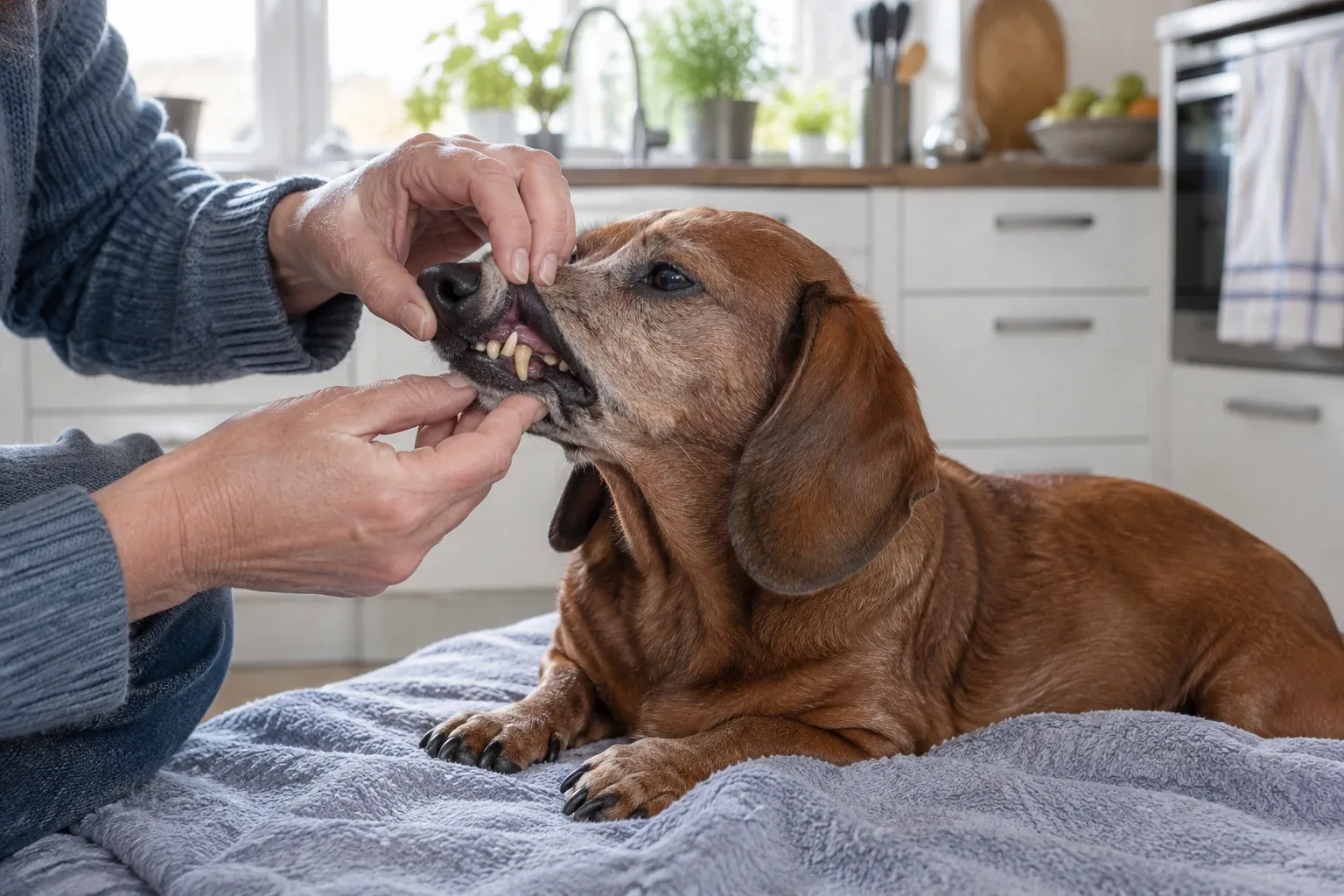
- Days 1 to 3: touch the mouth. Sit beside your dog, gently lift the lip for a second or two, then reward. Stop while your dog is still relaxed.
- Days 3 to 5: taste the toothpaste. Let your dog lick a little dog toothpaste off your finger. Then rub your finger along the outer surface of a few teeth.
- Days 5 to 7: introduce the brush or finger cloth. Let your dog sniff and lick it with toothpaste on it. Touch it to the canine teeth for a few seconds, then reward.
- Week 2: brush a few teeth. Lift the lip and brush the canines and the big back teeth on one side in small circles, angled toward the gum line. Reward.
- Build up to the whole mouth: both sides, outer surfaces, front to back.
Tips
- Focus on the outside surfaces facing the cheeks. Most dogs do not need the inner surfaces brushed, and they are much harder to reach.
- Use the same time every day, such as after an evening walk, so it becomes routine.
- Stop before your dog struggles and end on a good note.
- Expect a little pink gum bleeding at first if the gums are inflamed. If gums bleed a lot, look very red, or your dog seems sore, see your vet: painful teeth need treating before brushing.
Brushing an older dog
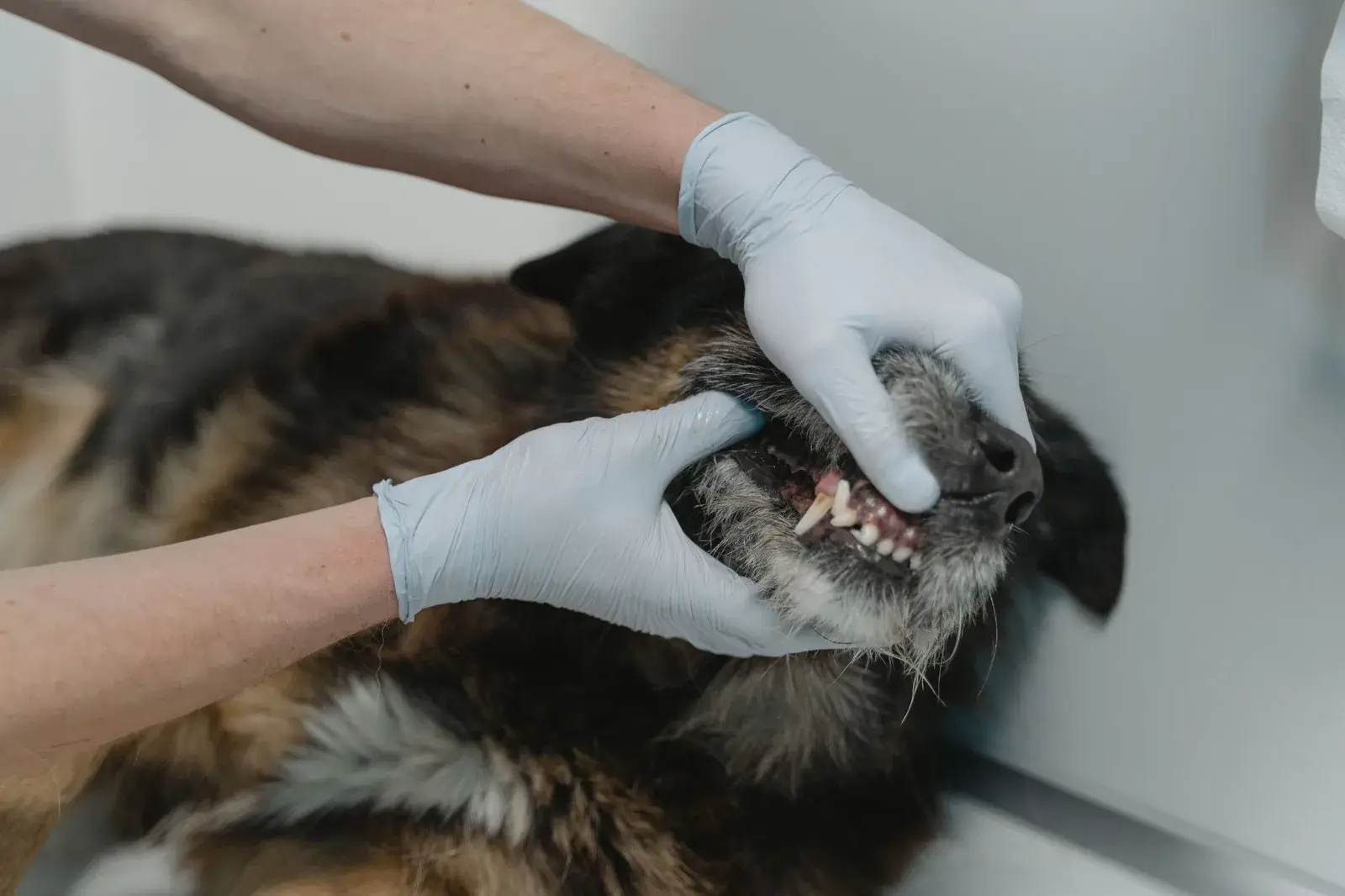
Senior dogs often already have tartar and sore spots. Brushing does not remove hardened tartar; only a professional cleaning does that. If your older dog has heavy tartar, red gums or bad breath, have the mouth checked first, then start brushing on a clean mouth. See senior dog dental care and dog teeth cleaning cost.
Older dogs with sore necks or backs may be more comfortable lying on their side for brushing. Keep sessions short.
If your dog will not let you brush
Some dogs never accept a brush, and some owners cannot manage it every day. Other options help, especially between brushing sessions:
- Dental chews and diets accepted by the Veterinary Oral Health Council (VOHC). See dental treats for dogs.
- Seaweed in food. In a randomized, placebo-controlled trial of 60 small dogs, daily treats containing the brown seaweed Ascophyllum nodosum led to significantly less plaque and tartar and fresher breath over 90 days. Our Daily Dental Cleaning Powder contains 700 mg of Ascophyllum nodosum plus sodium hexametaphosphate per 4 g serving, stirred into food, and is now available to pre-order.
- Combinations. In a 2025 study of dogs that had not had a professional cleaning, regular mechanical action (brushing every other day or a daily dental chew) reduced plaque and tartar over 8 weeks, and gum health improved when a daily water additive was combined with weekly brushing or a daily chew.
See how to clean dog teeth without brushing for every option.
FAQ
How often should I brush my dog's teeth?
Every day if you can. In a controlled study, brushing daily or every other day worked significantly better than brushing once a week or less.
Can I use human toothpaste on my dog?
No. Human toothpaste is not meant to be swallowed, and some human dental products contain xylitol, which the US FDA warns is dangerous to dogs. Use a toothpaste made for dogs.
Is it too late to start brushing an older dog's teeth?
No, but have the mouth checked first. Brushing prevents new plaque but cannot remove hardened tartar, and painful teeth should be treated before you start.
What if my dog hates having its teeth brushed?
Go back a step and train more slowly, with short sessions and treats. A finger brush or microfiber cloth may be easier to accept. If brushing is impossible, combine VOHC-accepted chews with a daily dental additive in food or water.
How long should I brush my dog's teeth?
A short, calm session that covers the outer surfaces of the teeth on both sides is enough, with most attention on the canines and the big back teeth along the gum line. Consistency every day matters more than a long session.
Does a finger brush work as well as a toothbrush?
In a study of 21 Beagles, a manual toothbrush, an ultrasonic toothbrush, a nylon glove and a microfiber finger cloth all reduced plaque and gum inflammation over five weeks. The best tool is the one your dog accepts every day.
References
- Harvey C, Serfilippi L, Barnvos D. Effect of frequency of brushing teeth on plaque and calculus accumulation, and gingivitis in dogs. Journal of Veterinary Dentistry. 2015. PMID: 26197686
- Ols茅n L, et al. Improved oral health and adaptation to treatment in dogs using manual or ultrasonic toothbrush or textile of nylon or microfiber for active dental home care. Animals. 2021. PMID: 34573447
- Sv盲rd J, Enlund KB. Adherence to dental home care in dogs with periodontitis: a post-treatment survey. Acta Veterinaria Scandinavica. 2023. PMID: 38115050
- Gawor J, et al. Effectiveness of dental homecare protocols in unscaled dogs. Journal of Veterinary Dentistry. 2025. PMID: 39587858
- Stepaniuk KS, Gingerich W, Ziche AM. Oral examination in a random anesthetized canine population for the prevalence of periodontal disease and fractured teeth. Journal of Veterinary Dentistry. 2026. PMID: 42095652
- O'Neill DG, et al. Epidemiology of periodontal disease in dogs in the UK primary-care veterinary setting. Journal of Small Animal Practice. 2021. PMID: 34374104
- Gawor J, et al. Effects of edible treats containing Ascophyllum nodosum on the oral health of dogs: a double-blind, randomized, placebo-controlled single-center study. Frontiers in Veterinary Science. 2018. PMID: 30109236
- US Food and Drug Administration. Paws Off Xylitol; It's Dangerous for Dogs.
For individual health questions, your veterinarian remains the best partner.