TL;DR
Adult dogs have 42 teeth: 20 in the upper jaw and 22 in the lower jaw, made up of 12 incisors, 4 canines, 16 premolars and 10 molars. That is 10 more than an adult human. Puppies have 28 baby teeth, which start coming in at about 3 to 5 weeks of age. The adult teeth begin to replace them at around 4 to 5 months, and the full set of 42 is usually in place by about 7 months. Adult teeth are meant to last for life, so an older dog losing teeth is not normal aging: it is almost always a sign of dental disease or injury. In a 2026 study that examined 369 dogs under anesthesia, 98.6% of dogs over 1 year old had some degree of periodontal disease, and 50.9% had at least one broken tooth.
How many teeth does a dog have?
| Tooth type | Adult dog (upper + lower) | Puppy | What they do |
|---|---|---|---|
| Incisors | 12 (6 + 6) | 12 | Small front teeth for nibbling and grooming |
| Canines | 4 (2 + 2) | 4 | The long "fangs" for gripping and holding |
| Premolars | 16 (8 + 8) | 12 | Sharp side teeth for cutting and shearing |
| Molars | 10 (4 + 6) | 0 | Flat back teeth for crushing and grinding |
| Total | 42 (20 + 22) | 28 |
A few details surprise most owners:
- The lower jaw has more teeth than the upper jaw (22 versus 20) because it has three molars on each side, while the upper jaw has two.
- Puppies have no molars at all. The molars and the first premolars have no baby teeth before them; they come in only as adult teeth.
- The biggest chewing teeth are the upper fourth premolar and the lower first molar, called the carnassial teeth. They work like a pair of scissors.
Dog teeth chart: how vets number the teeth
Vets record each tooth with a three-digit number, called the modified Triadan system. The first digit is the quarter of the mouth, and the last two digits are the tooth's position counting back from the middle.
| First digit | Quarter of the mouth | Teeth in an adult dog |
|---|---|---|
| 1 | Upper right | 10 (101 to 110) |
| 2 | Upper left | 10 (201 to 210) |
| 3 | Lower left | 11 (301 to 311) |
| 4 | Lower right | 11 (401 to 411) |
In every quarter, 01 to 03 are the incisors, 04 is the canine, 05 to 08 are the premolars and 09 onward are the molars. So "tooth 108" on a dental chart is the upper right fourth premolar, the big carnassial tooth. Baby teeth use 5 to 8 as the first digit instead (for example, 504 is the upper right puppy canine). Knowing this makes a dental report from your vet much easier to read.
Puppy teeth: when they come in and fall out
When puppy teeth come in
The Merck Veterinary Manual says puppy teeth start to erupt at 3 to 5 weeks of age. A US Department of Agriculture (USDA) guide used to estimate puppies' ages says all 28 are usually in by about 8 weeks:
| Puppy's age | Puppy teeth in the mouth |
|---|---|
| 2 to 3 weeks | 8 |
| 3 to 4 weeks | 12 |
| 4 to 6 weeks | 20 |
| 5 to 6 weeks | 24 |
| 6 to 8 weeks | 28 (all) |
When adult teeth replace them
Adult teeth begin to come in at about 4 to 5 months, according to Merck, and all are present by about 7 months. The USDA guide gives this typical order:
| Age | Adult teeth coming in | Adult teeth in total | Puppy teeth left |
|---|---|---|---|
| 2 to 4 months | First incisors | 8 | 20 |
| 4 to 5 months | Last incisors, 1st and 4th premolars | 20 | 12 |
| 5 months | Canines | 24 | 8 |
| 5 to 6 months | First lower molars | 26 | 8 |
| 6 months | Middle premolars | 34 | 0 |
| 6 to 8 months | Last molars | 42 (all) | 0 |
Most owners never find the baby teeth. Puppies usually swallow them, or they fall out during play and chewing.
Retained puppy teeth
Sometimes a baby tooth stays put while the adult tooth grows in beside it. The USDA guide says this is most common with the canine teeth, and that retained puppy teeth crowd the adult teeth, trap food and lead to rapid tartar buildup and gum inflammation. It is especially common in small breeds: in UK vet records, retained baby teeth were among the most common problems in Chihuahuas (5.7% in a year) and Yorkshire Terriers (3.57%). If you can see two teeth in the space where one should be at around 6 to 7 months, ask your vet whether the baby tooth should be removed.
Can you tell a dog's age by its teeth?
In puppies, roughly. The USDA guide notes that a puppy with fewer than 28 baby teeth and no adult teeth is likely to be under 8 weeks old, and a dog that still has puppy premolars and only its first lower molars is likely to be under 6 months.
In adults it is much less precise. Merck says vets can estimate age from tooth wear in most large adult dogs with normal teeth and jaws, but it is harder in small and toy breeds. For a better sense of where your dog is in life, use our dog age calculator, which converts age by breed.
Do dogs lose teeth when they get old?
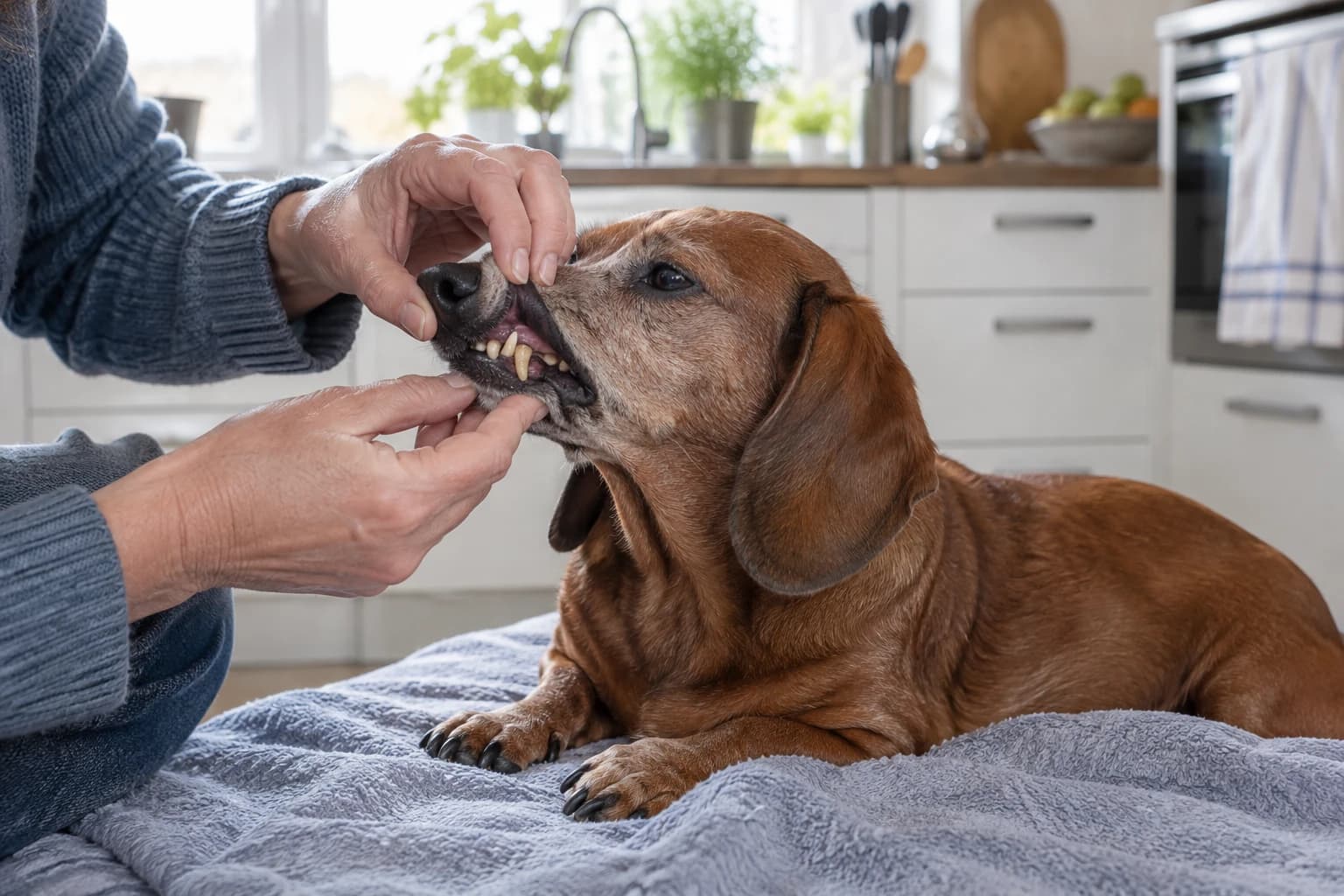
Healthy adult teeth do not fall out with age. When an older dog loses a tooth, the usual cause is periodontal disease: plaque and tartar inflame the gums, then destroy the ligament and bone that hold the tooth in place until it loosens. Broken teeth are the other common cause.
How common is this? Much more than most owners think:
- Almost every dog has some. In a 2026 US study, vets examined and probed the teeth of 369 dogs under anesthesia. 98.6% of dogs over 1 year old had periodontal disease: 39% at the earliest stage and 59.6% at stages 2 to 4, where the tooth's support is already being lost.
- Broken teeth are common too. In the same study, 50.9% of dogs had at least one fractured tooth, and the number of broken teeth rose with age and body weight.
- Small dogs lose more teeth. The same study found more missing teeth as body weight went down. In a UK study of 22,333 dogs, heavier dogs had progressively lower odds of periodontal disease.
- Most of it is missed. UK vets recorded periodontal disease in only 12.52% of dogs in a year, far below the 98.6% found when every tooth was probed under anesthesia. Much of it goes unnoticed, because gum disease mostly hides below the gum line.
Breeds with the highest risk
In the UK study of 22,333 dogs, the breeds with the highest odds of periodontal disease compared with crossbreeds were:
| Breed | Odds of periodontal disease |
|---|---|
| Toy Poodle | 3.97 times |
| King Charles Spaniel | 2.63 times |
| Greyhound | 2.58 times |
| Cavalier King Charles Spaniel | 2.39 times |
Flat-faced (brachycephalic) breeds such as pugs, French Bulldogs and Shih Tzus had 1.25 times the odds of breeds with a medium-length skull, and spaniel types had 1.63 times the odds. Gum disease was also the most common problem recorded in UK Yorkshire Terriers, affecting 21.1% in a single year.
What to do if your senior dog loses a tooth
- Check the gap. Bleeding that stops quickly is common. Ongoing bleeding, swelling of the face or jaw, or pus needs a vet.
- Look at the other teeth. If one tooth was loose enough to fall out, others may be close behind. Look for red gums, brown tartar, loose teeth and bad breath.
- Watch how your dog eats. Chewing on one side, dropping food or pawing at the mouth are signs of pain. See broken dog tooth: what to do.
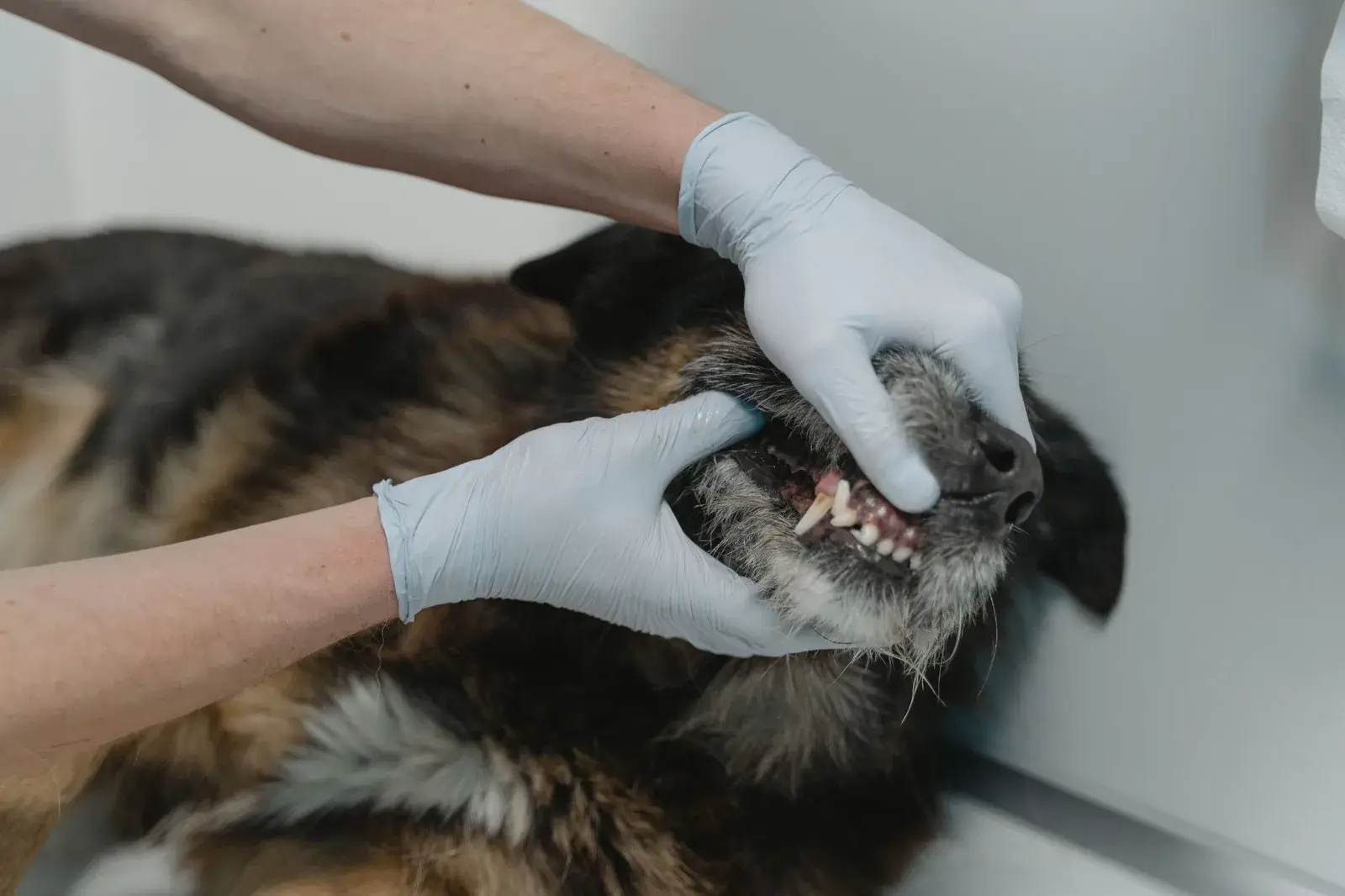
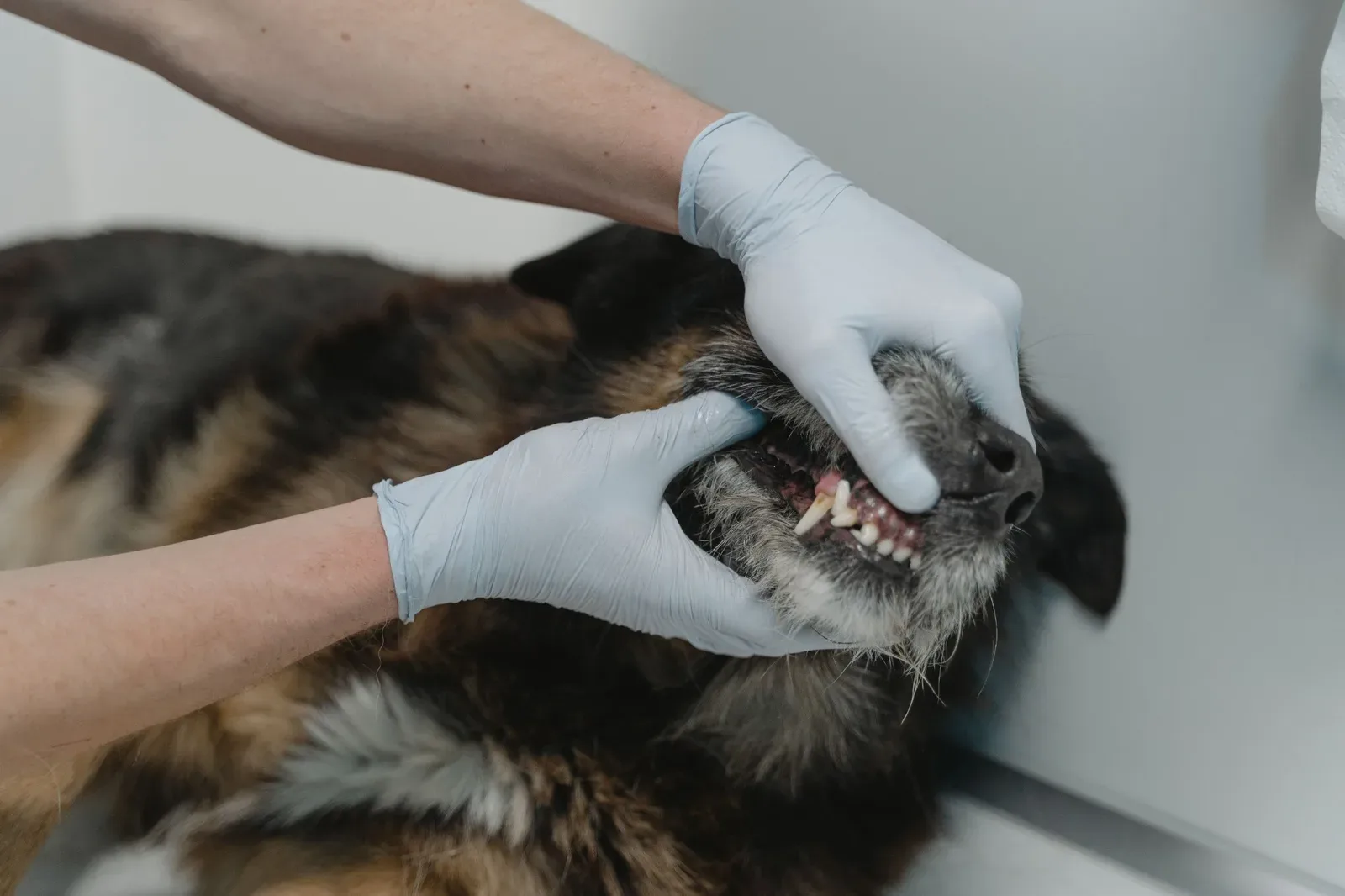
- Book a dental exam. Most of the disease sits below the gum line, so a full assessment needs anesthesia and dental X-rays. See senior dog dental care for anesthesia safety in older dogs and dog teeth cleaning cost for prices.
Dogs manage surprisingly well with fewer teeth once the painful ones are gone. If your dog needs extractions, see tooth extraction recovery and soft food for senior dogs with bad teeth.
How to keep all 42 teeth
- Brush daily with a dog toothpaste. It is the gold standard for removing plaque before it hardens into tartar. See how to brush your dog's teeth and best dog toothpaste.
- Start young. In a study of Yorkshire Terriers, 98% already had early periodontitis on at least one tooth by about 9 months of age (37 weeks), and the odds rose 2.74 times by 18 months. Dental care is not just for old dogs.
- Add daily help if you cannot brush. In a randomized, placebo-controlled trial of 60 small dogs, daily treats containing the brown seaweed Ascophyllum nodosum led to significantly less plaque and tartar and fresher breath over 90 days after a professional cleaning. Our Daily Dental Cleaning Powder contains 700 mg of Ascophyllum nodosum plus sodium hexametaphosphate per 4 g serving, stirred into food, and is now available to pre-order. See how to clean dog teeth without brushing for every option.
- Choose dental chews and diets carefully. See dental treats for dogs and dental health dog food.
- Avoid very hard chews. Antlers, bones and hard nylon toys can break teeth, including the big carnassial tooth.
- Get a professional cleaning when your vet recommends it, especially for small, toy and flat-faced breeds.
FAQ
How many teeth does a dog have?
An adult dog has 42 permanent teeth: 12 incisors, 4 canines, 16 premolars and 10 molars, with 20 in the upper jaw and 22 in the lower jaw. A puppy has 28 baby teeth.
Do dogs have more teeth than humans?
Yes. Adult dogs have 42 teeth and adult humans have 32, so dogs have 10 more. Puppies have 28 baby teeth, compared with 20 in human children.
When do puppies lose their baby teeth?
The adult teeth start to push out the baby teeth at about 4 to 5 months, beginning with the incisors, and the full adult set is usually in by about 7 months.
Do small dogs have fewer teeth?
Small dogs have the same 42 teeth in a much smaller mouth, which crowds them. Small dogs are more likely to have missing teeth, retained baby teeth and periodontal disease.
Is it normal for an old dog to lose teeth?
No. Adult teeth are permanent. Tooth loss in an older dog is almost always caused by periodontal disease or a broken tooth, and it means the rest of the mouth needs a vet check.
Can dogs live without teeth?
Yes. Many dogs eat and live comfortably after several or even all of their teeth are removed, often more comfortably than before, because the painful teeth are gone. Soft or soaked food helps.
How many teeth do dogs have on top and bottom?
20 on top and 22 on the bottom. The lower jaw has one extra molar on each side.
References
- Merck Veterinary Manual, Pet Owner Version. Muylle S. Dental Development of Dogs. Last updated 2025.
- Merck Veterinary Manual. Wright A. Dentition and Dental Nomenclature of Animals. 2026.
- USDA Animal and Plant Health Inspection Service. Aging Puppies by Teeth. APHIS-23-030. 2023.
- Stepaniuk KS, Gingerich W, Ziche AM. Oral examination in a random anesthetized canine population for the prevalence of periodontal disease and fractured teeth. Journal of Veterinary Dentistry. 2026. PMID: 42095652
- O'Neill DG, et al. Epidemiology of periodontal disease in dogs in the UK primary-care veterinary setting. Journal of Small Animal Practice. 2021. PMID: 34374104
- O'Neill DG, et al. Demography and commonly recorded clinical conditions of Chihuahuas under primary veterinary care in the UK in 2016. BMC Veterinary Research. 2020. PMID: 32046714
- O'Neill DG, et al. Yorkshire Terriers under primary veterinary care in the UK: demography and disorders. Companion Animal Health and Genetics. 2025. PMID: 42135803
- Wallis C, et al. A longitudinal assessment of periodontal disease in Yorkshire terriers. BMC Veterinary Research. 2019. PMID: 31226991
- Gawor J, et al. Effects of edible treats containing Ascophyllum nodosum on the oral health of dogs: a double-blind, randomized, placebo-controlled single-center study. Frontiers in Veterinary Science. 2018. PMID: 30109236
For individual health questions, your veterinarian remains the best partner.