TL;DR
Mouth cancer in dogs usually shows up as a lump on the gums, lips, tongue or roof of the mouth, often with bad breath, bleeding from the mouth, drooling, a loose tooth or trouble eating. Not every mouth lump is cancer: in a study of 773 confirmed oral tumors in dogs, 63% were benign, most of them a slow-growing gum growth called a peripheral odontogenic fibroma (an "epulis"). Of the malignant tumors, melanoma (38%), squamous cell carcinoma (21%) and fibrosarcoma (8%) were the most common, and dogs were a median of 9.4 years old. The outlook depends heavily on the type and on catching it early. After removing part of the jaw, 91% of dogs with squamous cell carcinoma and 97% with a benign ameloblastoma were alive a year later, against 21% with melanoma. Any lump in the mouth that is new, growing, bleeding or loosening teeth should be biopsied, not watched.
Signs of mouth cancer in dogs
| Sign | What you might notice |
|---|---|
| Lump or mass | On the gums, lips, tongue, roof of the mouth or behind the teeth |
| Bad breath | Sudden, strong or rotten-smelling breath |
| Bleeding | Blood on toys, in the water bowl or on bedding |
| Drooling | Sometimes blood-tinged |
| Loose or displaced teeth | A tooth that moves or shifts in an adult dog without heavy tartar |
| Eating changes | Dropping food, chewing on one side, reluctance to eat hard food |
| Facial swelling | A firm swelling of the jaw or face |
| Weight loss | From pain and eating less |
| Swollen lymph nodes | Lumps under the jaw |
Many of these overlap with dental disease, which is far more common. See dog tooth abscess and dog chewing on one side of the mouth. The difference that matters is a mass that keeps growing, or a loose tooth with little or no gum disease.
Types of oral tumors in dogs
In the Swiss study of 773 oral tumors confirmed under the microscope:
| Type | Share | Behavior |
|---|---|---|
| Benign tumors | 63% of all tumors | Do not spread; may grow locally |
| Peripheral odontogenic fibroma | 77.8% of benign tumors | Firm gum growth, often near a tooth; usually cured by removal |
| Malignant tumors | 37% of all tumors | Can invade bone and spread |
| Malignant melanoma | 38.1% of malignant tumors | Often dark but can be pink; more common on the lips in this study; spreads readily |
| Squamous cell carcinoma | 21% of malignant tumors | Invades bone locally; spreads less often |
| Fibrosarcoma | 8% of malignant tumors | Locally aggressive, tends to come back |
The study found no breed predisposition, and oral tumors were mostly in older dogs (median age 9.4 years).
Oral melanoma
An international expert guideline on melanoma describes mouth and nail-bed melanomas as the most common malignant types in dogs. Not all are black: pigment varies, so a pink mass can still be melanoma. Treatment centers on surgery with wide margins and radiotherapy, with immunotherapy or chemotherapy offered to dogs at high risk of spread.
How vets diagnose a mouth tumor
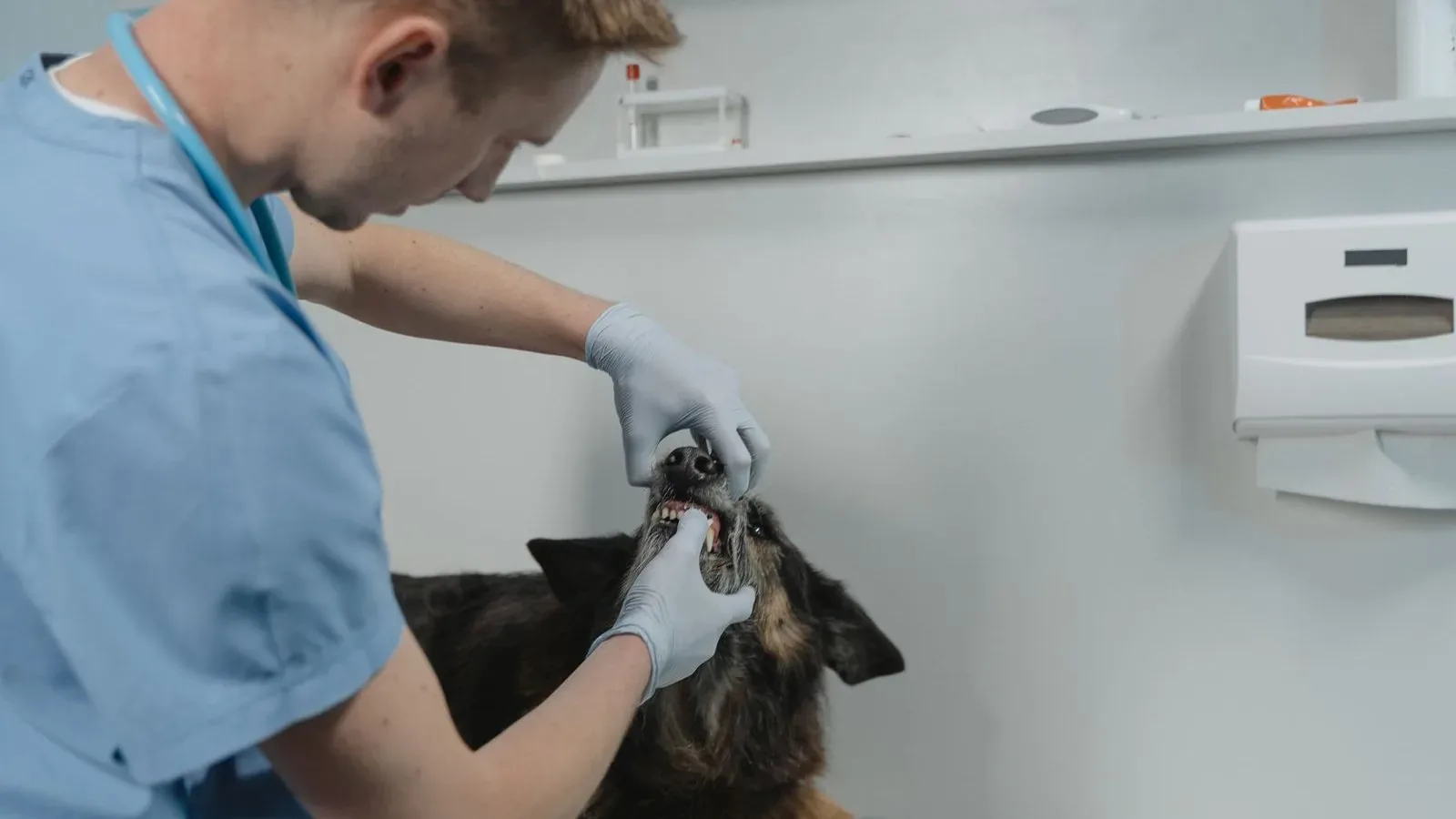
- Full mouth exam, often under sedation, because the back of the mouth is hard to see in an awake dog.
- Biopsy of the mass. A small sample sent to a pathologist is the only way to tell a benign epulis from melanoma or carcinoma.
- Fine-needle sample of the lymph nodes under the jaw.
- Chest X-rays or CT to check for spread.
- Dental X-rays or CT of the skull to see how far into the bone the tumor reaches, which decides the surgery.
Treatment and outlook
Surgery to remove the tumor with a margin of normal tissue, which often means removing part of the upper or lower jaw (maxillectomy or mandibulectomy), is the main treatment. Most dogs adapt well and eat and play normally once healed.
In a study of 142 dogs treated by partial removal of the lower jaw:
| Tumor | One-year survival |
|---|---|
| Ameloblastoma (benign) | 97% |
| Squamous cell carcinoma | 91% |
| Fibrosarcoma | 50% |
| Osteosarcoma | 35% |
| Melanoma | 21% |
A later study of 87 dogs after jaw surgery for squamous cell carcinoma or fibrosarcoma found:
- Median survival for dogs with squamous cell carcinoma was not reached, because most were still alive at the end of the study.
- Dogs with fibrosarcoma had a median survival of 557 days.
- For squamous cell carcinoma removed without clean margins, adding radiotherapy raised median survival from 181 days to 2,051 days.
The lesson for owners: small tumors found early can be removed with a margin, and some types are curable. Large tumors at the back of the mouth are much harder to treat.
Can you prevent mouth cancer in dogs?
There is no proven way to prevent it, but you can find it early:
- Look in your dog's mouth once a week, lifting the lips on both sides and checking the gums, tongue and roof of the mouth. Daily brushing makes this easy. See how to brush your dog's teeth.
- Take note of a new smell, blood or drooling.
- Ask for a full mouth check at every senior visit, and during dental cleanings under anesthesia.
- Do not let a "gum growth" be watched for months without a biopsy.
Keeping the mouth clean also makes changes easier to spot. Our Daily Dental Cleaning Powder is a once-a-day plaque-control powder stirred into food, now available to pre-order; it is for plaque and tartar, not a cancer treatment.
For the other warning signs of cancer elsewhere in the body, see signs of cancer in dogs. When one of our founder Morty's pugs grew a 5 cm lump on its leg at age 9, the vet removed it surgically and the dog was walking again, slowly, the next day.
FAQ
What does mouth cancer look like in dogs?
Usually a lump on the gums, lips, tongue or roof of the mouth. It may be dark or pink, smooth or ulcerated, and may bleed. Bad breath, drooling and loose teeth are common.
Is a lump on my dog's gum cancer?
Not always. In a study of 773 oral tumors, 63% were benign, most often a gum growth called a peripheral odontogenic fibroma. Only a biopsy can tell for sure.
How long can a dog live with mouth cancer?
It depends on the type. After jaw surgery, 91% of dogs with squamous cell carcinoma were alive a year later, while melanoma had a much shorter outlook, with 21% alive at one year in that study.
Which dogs get mouth cancer?
Mostly older dogs, with a median age of 9.4 years in a large study. That study found no particular breed was predisposed.
Can dogs eat normally after jaw surgery?
Most can. Dogs adapt well to having part of the jaw removed and usually eat and play normally once healed.
References
- Gasymova EE, et al. A retrospective analysis of oral tumors in dogs in Switzerland identifies peripheral odontogenic fibroma and melanoma as the predominant tumor types. Journal of the American Veterinary Medical Association. 2024. PMID: 39442534
- Kosovsky JK, et al. Results of partial mandibulectomy for the treatment of oral tumors in 142 dogs. Veterinary Surgery. 1991. PMID: 1369522
- Riggs J, et al. Outcomes following surgical excision or surgical excision combined with adjunctive, hypofractionated radiotherapy in dogs with oral squamous cell carcinoma or fibrosarcoma. Journal of the American Veterinary Medical Association. 2018. PMID: 29911943
- Polton G, et al. Melanoma of the dog and cat: consensus and guidelines. Frontiers in Veterinary Science. 2024. PMID: 38645640
For individual health questions, your veterinarian remains the best partner.